


Key Takeaways
- 1Demand spikes can quickly strain internal support teams.
- 2Overflow solutions add flexible capacity when volume rises.
- 3AI, routing, reporting, and trained agents help maintain service quality.
- 4The right model protects customer experience without permanent headcount growth.
Call center overflow solutions help businesses maintain service levels during unexpected spikes in customer demand by routing excess interactions to trained support teams. They reduce wait times, prevent abandoned calls, and provide flexible capacity without the cost of permanently expanding headcount.
Customer demand is no longer predictable. Seasonal peaks, product launches, service disruptions, and marketing campaigns can overwhelm even well-staffed contact centers.
Without a scalable support strategy, longer wait times quickly become lost revenue, frustrated customers, and burned-out agents.
What Is a Call Center Overflow Solution?
A call center overflow solution is a flexible customer support model that activates additional capacity whenever internal teams reach predefined thresholds. Overflow interactions are routed to trained agents who work as an extension of your business while maintaining consistent service quality.
Unlike permanent hiring, overflow support allows organizations to scale resources only when needed, improving efficiency while controlling costs.
Why Businesses Invest in Overflow Support
Modern organizations use overflow solutions for more than seasonal demand. They help solve ongoing operational challenges, including:
- Managing demand volatility by responding to seasonal peaks, product launches, promotions, and other periods of increased customer activity.
- Maintaining service continuity during unexpected call surges caused by outages, disruptions, or other unforeseen events.
- Addressing workforce constraints such as hiring challenges, absenteeism, or fluctuating staffing requirements without compromising service quality.
- Scaling efficiently by extending support capacity when needed instead of maintaining excess headcount during normal operations.
The Four Pillars of Overflow Readiness
The strongest overflow strategies are built around four essential capabilities.
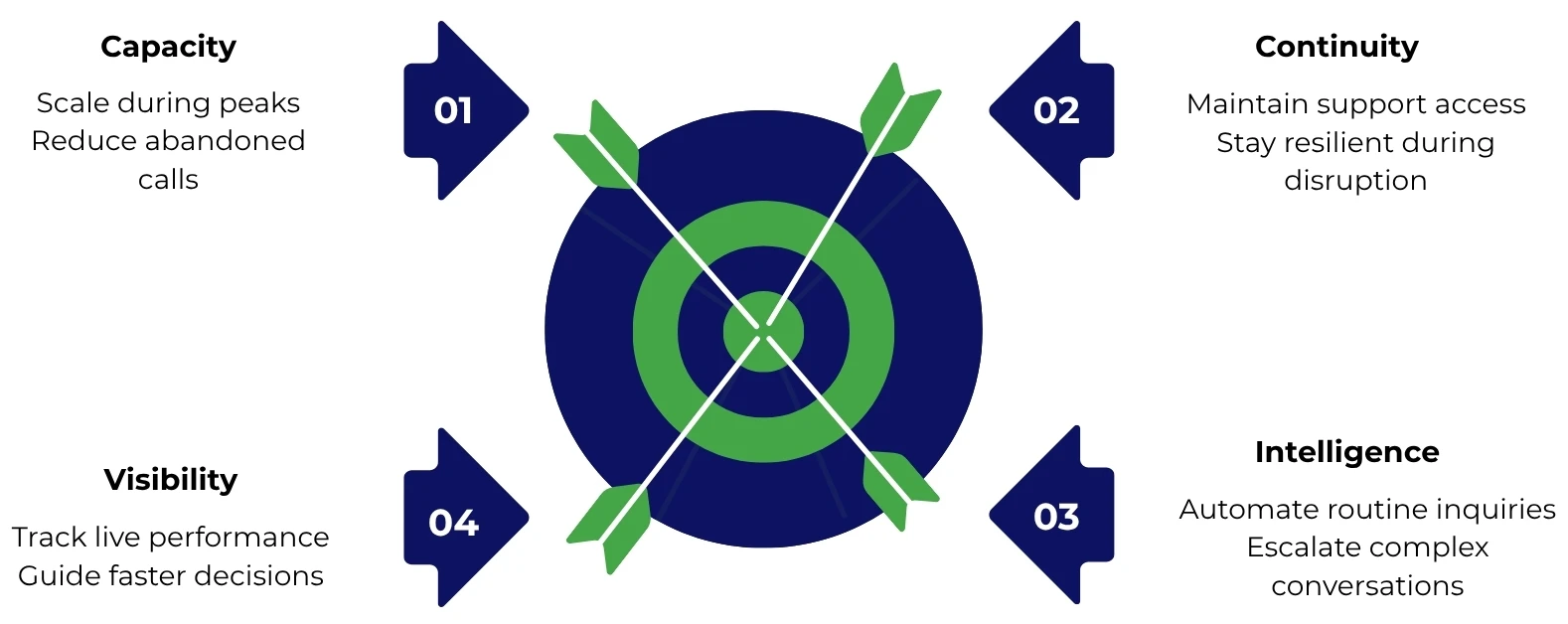
Four Pillars of Overflow Readiness
1. Capacity
Additional trained agents absorb excess demand before queues become unmanageable.
2. Continuity
Business continuity plans ensure customer support remains available during disruptions, staffing shortages, or unexpected events.
3. Intelligence
Human-in-the-loop AI automates routine requests, while experienced agents handle complex conversations that require judgment and empathy.
4. Visibility
Real-time reporting provides insights into service levels, queue performance, response times, and customer trends, enabling leaders to make informed operational decisions.
What Should Businesses Look for in a Call Center Overflow Solution?
The best call center overflow solutions do more than add capacity. They combine technology, skilled support, and operational visibility to help businesses maintain consistent customer experiences while scaling efficiently.
Before selecting an overflow solution, evaluate these core capabilities:
- Omnichannel Engagement: Support customers across voice, email, chat, SMS, and social channels without losing context.
- Human-in-the-Loop AI: Use automation for routine inquiries while keeping skilled agents available for complex or high-value interactions.
- Real-Time Reporting: Track service levels, response times, queue performance, and customer trends as volume changes.
- Security and Compliance: Protect customer data, meet regulatory requirements, and maintain continuity during disruption.
Why Overflow Support Has Become a Strategic Capability
Customer expectations continue to rise while demand becomes less predictable. Businesses that rely only on fixed staffing models often struggle to maintain consistent service during peak periods.
That is why overflow support is evolving from a vendor-based backup plan into a co-sourced operating model. In a co-sourcing approach, external support teams work as an integrated extension of internal operations, sharing workflows, quality standards, reporting, and customer experience goals.
Organizations that adopt this model gain measurable advantages:
- Higher customer satisfaction
- Reduced abandoned calls
- Better agent productivity
- Improved operational resilience
- Greater flexibility to support growth
- More consistent service quality across internal and external teams
Build a More Resilient Customer Operations Strategy
The organizations that deliver exceptional customer experiences are those prepared for demand before it arrives. Scalable overflow support protects revenue, strengthens customer trust, and gives your teams the flexibility to grow with confidence.
Premier NX helps businesses strengthen overflow support through scalable CX operations, omnichannel coverage, human-in-the-loop AI, real-time reporting, and performance visibility.
Connect with our team to explore how Premier NX can help you design a scalable overflow strategy that aligns with your business goals and delivers better customer outcomes.