


Key Takeaways
- 1Back-office efficiency comes from strengthening connected processes, not fixing isolated tasks.
- 2Finance, data, procurement, automation, IT, and order operations form the foundation of scalable growth.
- 3Automation reduces manual work, while better data and controls improve speed, accuracy, and visibility.
- 4Strategic outsourcing helps businesses expand capacity and modernize operations without increasing overhead at the same pace.
Back-office efficiency comes from improving the systems behind your business, not simply reducing costs. The most efficient organizations strengthen core functions: finance, data management, procurement, automation, IT support, and order operations. When these processes work together, businesses reduce manual effort, improve visibility, scale more efficiently, and make faster, better decisions.
Growth often exposes hidden operational bottlenecks. Finance teams struggle with increasing transaction volumes, fragmented data, slower procurement, and repetitive administrative work that consumes valuable resources. Optimizing the back office creates the operational foundation needed to grow without increasing overhead at the same pace.
6 Back-Office Processes That Drive Efficiency
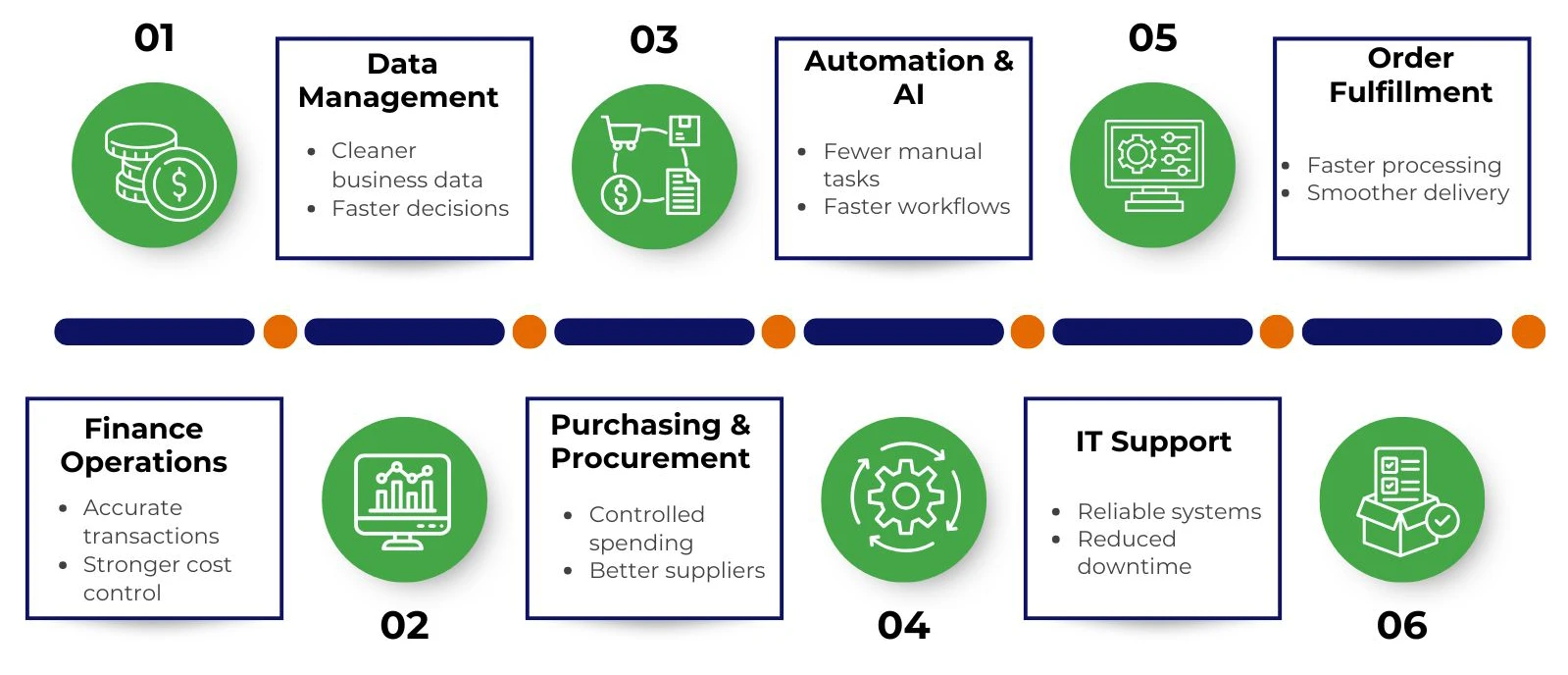
The back-office capabilities that support long-term business growth
1. Finance Operations: Improve Control and Reduce Cost Leakage
Well-managed finance operations give leadership a clearer view of cash, cost, and performance while keeping high-volume financial activity accurate and controlled.
Core focus: Invoicing, reconciliations, approvals, transaction processing, and financial reporting.
Business outcomes: Faster close cycles, stronger financial controls, improved cash-flow visibility, and lower processing costs.
2. Data Management & Processing: Create a Trusted Operational Data Layer
Data management ensures business information is accurate, consistent, and ready for reporting, analytics, and automation.
Core focus: Data entry, cleansing, document processing, ETL, warehousing, and data-quality management.
Business outcomes: Fewer data exceptions, faster information flow, more reliable reporting, and stronger operational decision-making.
3. Purchasing & Procurement: Optimize Spend and Supplier Performance
An efficient procurement function balances cost, supplier reliability, and operational continuity. Standardized purchasing workflows help organizations control spending, improve vendor management, and ensure resources are available when and where they’re needed.
Core focus: Purchase orders, vendor management, procurement workflows, supplier coordination, and expenditure management.
Business outcomes: Better spending control, improved supplier performance, shorter procurement cycles, and reduced operational waste.
4. Back-Office Automation & AI: Eliminate Manual Work at Scale
Automation and AI improve back-office efficiency by reducing repetitive work, accelerating routine processes, and enabling teams to focus on higher-value activities.
Core focus: Workflow automation, AI-assisted processes, intelligent document processing, robotic process automation (RPA), and process orchestration.
Business outcomes: Faster process execution, fewer manual errors, increased productivity, and greater operational scalability.
5. IT Support & Service Operations: Keep Business-Critical Systems Running
Reliable IT operations ensure employees have secure, uninterrupted access to the systems they depend on every day.
Core focus: Service desk, infrastructure support, system administration, networking, cybersecurity, and device management.
Business outcomes: Reduced downtime, higher workforce productivity, stronger operational resilience, and improved system reliability.
6. Order Processing & Fulfillment Support: Improve Operational Execution
Efficient order processing and fulfillment create smoother coordination between internal teams, suppliers, and customers while reducing delays across the operational lifecycle. Standardized execution helps organizations scale operations without increasing administrative complexity.
Core focus: Order processing, fulfillment coordination, order tracking, logistics administration, supplier communication, and quality control.
Business outcomes: Faster order fulfillment, improved process consistency, lower administrative costs, and better operational efficiency.
Back-Office Outsourcing as an Optimization Strategy
As organizations grow, operational complexity often increases faster than internal resources.
According to PwC’s 2025 Global Business Services Study, back-office functions are evolving from administrative support into value-generating business capabilities that drive automation, operational agility, and enterprise transformation.1
Strategic outsourcing helps businesses:
- Scale capacity without expanding fixed overhead
- Introduce standardized processes and governance
- Accelerate automation initiatives
- Gain specialized expertise
- Improve operational consistency
Rather than replacing internal teams, the right outsourcing partner becomes an extension of your operations, continuously improving processes while supporting long-term growth.
Turn Back-Office Efficiency Into a Business Advantage
Operational efficiency comes from strengthening the systems that support every customer interaction and business decision. Organizations that modernize these six back-office functions build a stronger foundation for sustainable growth.
Premier NX supports these priorities through tailored back-office services across Finance Operations, Data Management & Processing, Procurement, Automation, IT Support, and Fulfillment.