


Key Takeaways
- 1Modern MSP and MDM metrics now measure operational readiness, scalability, and workforce continuity.
- 2High-performing IT environments reduce escalation dependency, improve endpoint governance, and restore operational stability faster.
- 3The strongest managed services models create proactive visibility and operational confidence across distributed IT ecosystems.
Most Managed Service Provider (MSP) dashboards still measure activity: ticket volume, response time, uptime, and SLA compliance. In 2026, high-performing IT organizations are measuring something larger: operational readiness.
The strongest MSP and Mobile Device Management (MDM) metrics reveal whether the support environment is reducing operational friction, protecting workforce continuity, and creating scalable IT capacity.
Which MSP Service Desk & MDM Metrics Actually Matter in 2026?
The most valuable MSP and MDM metrics in 2026 are not dashboard vanity metrics. They are operational indicators that reveal scalability, continuity readiness, endpoint governance maturity, and the overall ability of support environments to sustain business momentum under growing complexity.
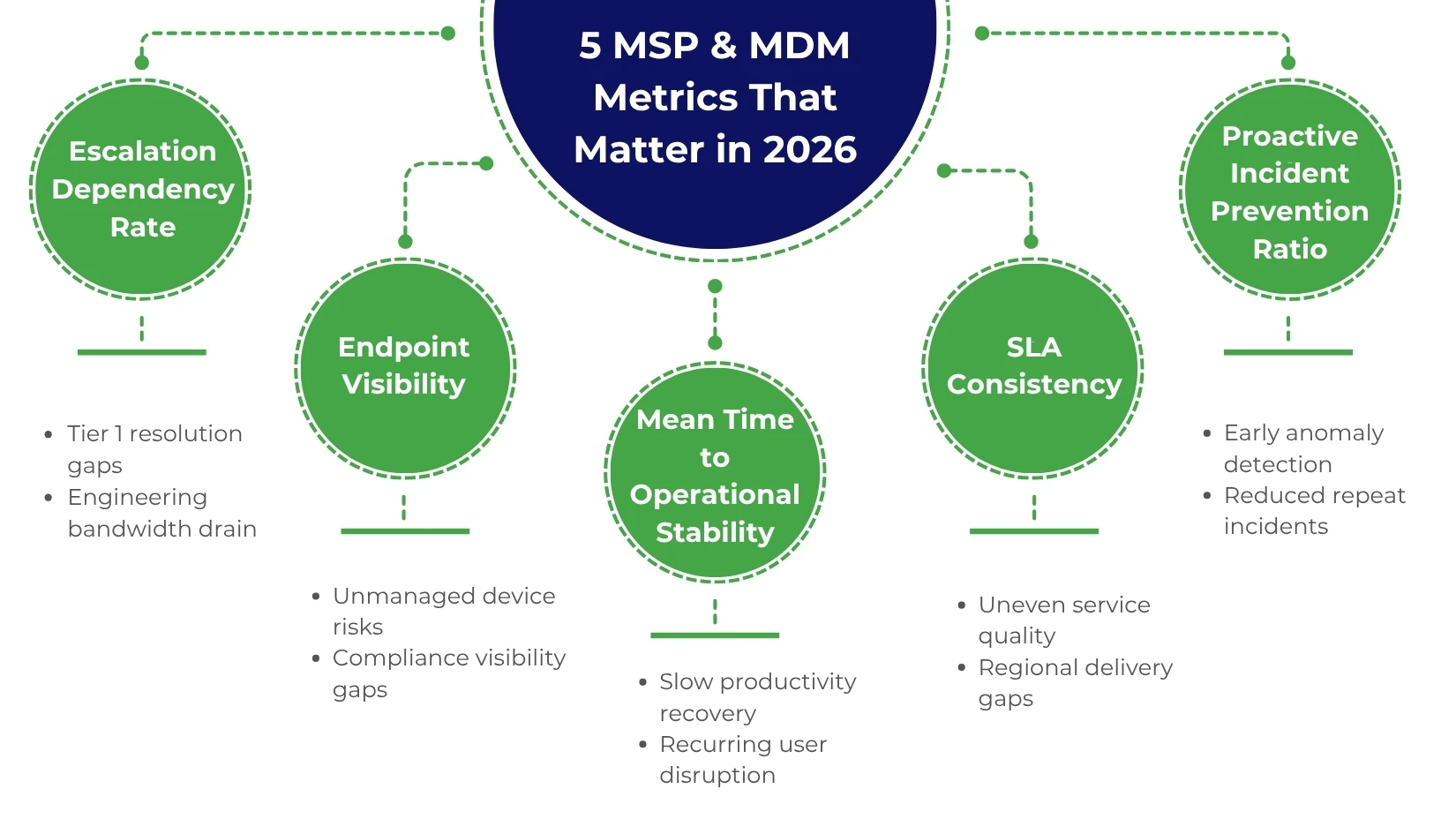
1. Escalation Dependency Rate: Reduce Tier 2 Support Drag
Escalation Dependency Rate measures how often frontline support must rely on higher-tier engineering teams to restore stability.
- High escalation rates usually signal weak workflows, poor documentation, or fragmented endpoint visibility.
- Excessive Tier 2 dependency pulls senior IT resources away from automation and strategic projects.
- Strong MSP environments reduce repeat escalations through proactive remediation and stronger frontline resolution.
Key KPI: Lower repeat escalations and faster frontline resolution rates.
2. Endpoint Visibility & Compliance Coverage: Govern the Entire Environment
Endpoint Visibility & Compliance Coverage measures the extent to which the device ecosystem remains visible, compliant, and centrally governed.
- Hybrid work has increased unmanaged devices, patching gaps, and operational blind spots.
- Mature MDM (Mobile Device Management) environments improve governance across remote and distributed teams.
- Limited endpoint visibility increases continuity, compliance, and security risk.
Key KPI: Percentage of compliant and centrally managed endpoints.
3. Mean Time to Operational Stability: Restore Productivity Faster
Mean Time to Operational Stability measures how quickly users, systems, and workflows fully return to normal after disruption.
- Ticket closure does not always mean operational recovery.
- Many environments resolve incidents technically while productivity disruption continues.
- Mature MSP models prioritize workflow restoration, not just incident resolution speed.
Key KPI: Reduced post-resolution disruption and recurring user impact.
4. SLA Consistency: Scale Support Predictably
SLA Consistency measures whether support quality remains stable across regions, workloads, and operational complexity.
- Hitting SLA targets occasionally is not the same as delivering predictable support quality.
- Inconsistent service creates execution delays, workforce friction, and operational unpredictability.
- High-performing MSPs maintain stable governance and escalation handling as operations scale.
Key KPI: Consistent response and resolution performance across all support environments.
5. Proactive Incident Prevention Ratio: Prevent Disruption Before Users Feel It
The Proactive Incident Prevention Ratio measures how effectively IT operations prevent incidents before they affect users or workflows.
- Modern MSP environments are shifting from reactive support toward operational foresight.
- AI-assisted monitoring and automation increasingly identify risks before disruption spreads.
- Prevention preserves engineering capacity and reduces operational drag at scale.
Key KPI: Reduction in repeat incidents and unplanned user-impacting events.
What High-Performance MSP Environments Prioritize
The strongest MSP environments in 2026 prioritize operational stability over reactive support activity.
They increasingly focus on:
- Proactive visibility over reactive monitoring
- Endpoint governance over device administration
- Stability restoration over ticket closure speed
- Operational intelligence over isolated reporting
What IT Leaders Should Retain In-House
Not every IT function should be outsourced.
Organizations should typically retain:
- IT strategy and transformation priorities
- Security governance and risk ownership
- Executive technology planning and budgeting
The goal is not to outsource accountability. The goal is to reduce operational friction.
Build MSP Metrics Around Operational Readiness
In 2026, MSP service desk and MDM metrics will reflect more than support performance. They will show how prepared an organization is to sustain continuity, scale operations, govern endpoints, and protect workforce productivity.
For executives, the question is no longer whether support is active.
It is whether the managed services model is creating operational confidence.
That is where the Premier NX approach fits: building scalable support ecosystems around visibility, proactive optimization, strategic alignment, and continuity-focused operations.