


Key Takeaways
- 1Repeat complaints reveal where customer friction is recurring.
- 2Better product information helps prevent unnecessary support contacts.
- 3Consistent refund and replacement workflows reduce follow-ups.
- 4Reporting and scalable consumer care help brands manage growth.
Food and beverage brands reduce repeat complaint volume by fixing the operational friction that creates avoidable customer contacts. Repeat complaints often start with product quality, damaged packaging, fulfillment delays, promotion confusion, unclear product information, or replacement gaps, not with the support team itself.
As brands expand across retail, e-commerce, marketplaces, subscriptions, and direct-to-consumer channels, consumer care teams feel the strain first. Adding agents may reduce backlog, but it does not reduce the conditions that keep customers coming back. The stronger approach is to identify complaint drivers, fix repeat issues, and build a scalable consumer care model.
What Causes Food and Beverage Complaint Volume to Rise?
Food and beverage complaint volume rises when brand growth creates more customer friction than existing support workflows can absorb.
A damaged packaging complaint, a spoiled product complaint, a missing order, an allergen question, a coupon issue, or a delayed delivery may all reach the same contact center. Still, each point refers to a different operational source. Without a clear categorization of complaints by issue type, product, channel, retailer, location, and season, leaders cannot see which problems recur.
The goal is not simply to close more tickets. The goal is to understand why customers are contacting support and which avoidable contacts can be prevented.
Premier NX helps food and beverage brands review complaint patterns, consumer care workflows, and support gaps to identify the sources of repeat contacts.
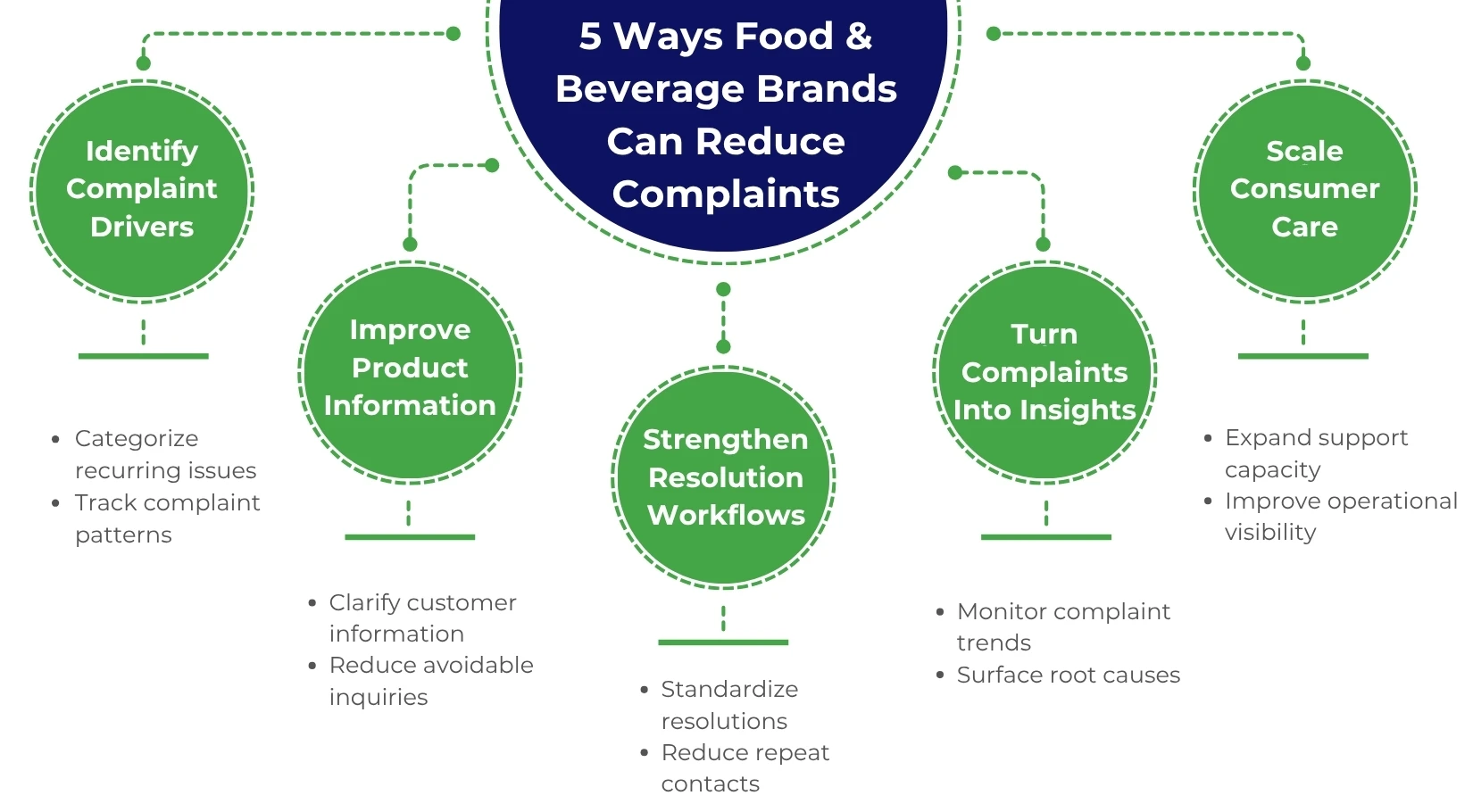
Five practical strategies food and beverage brands can use to reduce repeat complaints
1. How Can Food Brands Identify Complaint Drivers?
Food brands identify complaint drivers by turning customer complaints into structured business intelligence.
Every complaint should be tagged by cause, product, channel, retailer, location, season, and resolution type. This helps consumer care and operations teams distinguish between support issues and business issues. For example, damaged packaging may indicate issues with fulfillment or handling. Repeated ingredient questions may show unclear product information. Promotion complaints may reveal a campaign or coupon issue.
Once complaint data is organized, leaders can prioritize the issues creating the most repeat contact volume.
2. How Can Better Product Information Reduce Complaints?
Clear product information reduces complaints by helping customers make decisions without contacting support.
Food and beverage brands should keep customer-facing details consistent across packaging, retail listings, e-commerce pages, DTC sites, marketplace content, and support responses. This includes ingredients, allergens, nutrition information, storage instructions, serving sizes, expiration guidance, shipping expectations, subscription terms, refund rules, and promotion details.
When product information is incomplete or inconsistent, customer care bears the brunt of the confusion.
3. Why Do Replacement and Refund Workflows Matter?
Replacement and refund workflows matter because inconsistent resolution creates repeat contacts.
Food and beverage brands need clear rules for when to refund, replace, escalate, or investigate. This is especially important for perishable items, damaged goods, incorrect orders, melted shipments, leaking packaging, spoiled products, and food-quality concerns.
A consistent workflow helps agents resolve issues faster, protect brand trust, and avoid unnecessary back-and-forth. It also gives leaders a clearer view of which complaints are service issues and which require operational action.
4. How Does Complaint Reporting Prevent Repeat Issues?
Complaint reporting prevents recurring issues by showing leaders where customer friction occurs.
One complaint may look isolated. A trend may reveal that a single SKU, fulfillment location, retailer, shipment method, promotion, or product page is generating a large share of avoidable contacts. Reporting helps brands move from reactive support to proactive improvement.
The most useful metrics include complaint rate, first-contact resolution, response time, repeat-contact rate, escalation rate, replacement turnaround time, CSAT, and complaint trends by product, channel, retailer, location, and season.
5. When Should Food Brands Use a Customer Support Partner?
Food brands should consider a customer support partner when complaint volume, seasonal spikes, product inquiries, replacement requests, promotion support, or omnichannel service needs exceed internal capacity.
Common signs include slower response times, inconsistent answers, rising repeat contacts, limited reporting, overwhelmed consumer care teams, and leaders spending too much time on daily support issues.
Premier NX helps food and beverage brands scale consumer care by managing complaints, handling product inquiries, streamlining replacement workflows, supporting promotions, ensuring QA, enabling reporting, and managing omnichannel contact center operations. The goal is not just to answer complaints faster. It is to build support workflows that help prevent avoidable complaints from coming back.
Looking to Reduce Complaint Volume Without Expanding Your Support Team?
If you want a clearer view of where complaint volume is coming from, book a free Food & Beverage Complaint Reduction Consultation with Premier NX.
In 30 minutes, we will review your consumer care workflow, identify the biggest sources of repeat complaints, and outline practical next steps to improve response times, reduce repeat contacts, and scale support more efficiently.
Frequently Asked Questions (FAQs)
About the Author

Lisa Murray is a Consumer Goods Industry Advocate at Premier NX, helping North American CPG brands strengthen support for consumers, retailers, internal teams, and day-to-day operations. Focus centers on building scalable onshore, offshore, and right-shore service models that improve trust, efficiency, insight, and growth across the business.