



Product data entry is often treated as a simple operational task, but in e-commerce, it directly shapes how products are discovered, evaluated, and purchased.
It goes far beyond basic input. E-commerce product data entry involves creating, formatting, enriching, and maintaining product information across e-commerce platforms, marketplaces, catalogs, and PIM systems.
This includes managing product titles, descriptions, SKUs, pricing data, inventory data, product images, attributes, specifications, variants, metadata, and marketplace-specific requirements.
As catalogs grow, product catalog management becomes a continuous discipline. Inconsistent or incomplete data can weaken search visibility, reduce conversions, damage customer trust, and create operational inefficiencies across merchandising, support, and fulfillment teams.
This is where product data entry outsourcing supports scalable, accurate, and consistent ecommerce catalog management, helping businesses maintain high-quality product information across every channel where customers search, compare, and buy.
What does It Mean to Outsource Product Data Entry?
Outsourcing product data entry means partnering with a specialized provider to create, update, organize, enrich, and maintain product information across ecommerce platforms, marketplaces, catalogs, PIM systems, and internal databases.
In practice, product data entry outsourcing may include:
- Product listing creation: Building accurate product pages with titles, descriptions, pricing, and inventory details.
- Bulk product uploads: Adding large volumes of products across e-commerce platforms or marketplaces.
- SKU management: Creating, updating, and maintaining SKU structures, variants, and product relationships.
- Product categorization: Assigning products to the right categories, subcategories, and taxonomy paths.
- Attribute formatting: Standardizing product specifications, sizes, colors, materials, and technical details.
- Product enrichment: Improving product content with clearer descriptions, stronger attributes, and complete supporting details.
- Image uploads: Matching product images, alt text, and media files to the correct listings.
- Data cleansing: Removing duplicates, correcting errors, and validating missing or inconsistent fields.
- Marketplace feed preparation: Formatting product data for Amazon, Walmart, eBay, Google Merchant Center, and other channels.
- Product data migration: Moving catalog data between spreadsheets, e-commerce platforms, PIM systems, or internal databases.
Why does Product Data Entry Matter for E-commerce Growth?
Product data entry directly impacts e-commerce growth by determining the accuracy, consistency, and completeness of the information customers, marketplaces, and search engines rely on.
How does Product Data Entry Influence Search Visibility?
Product data entry influences search visibility by ensuring product information is accurate, complete, and structured so search engines, marketplaces, and AI systems can understand it.
Effective product data entry helps maintain:
- Product titles that align with customer search intent
- Product descriptions that provide relevant product details
- Metadata that supports indexing and discoverability
- Product categories that improve navigation and classification
- Product attributes such as size, color, dimensions, and specifications
- Structured product data that enables systems to interpret product information consistently
This directly impacts visibility across:
- Google Shopping
- Marketplace search
- E-commerce site search
- AI shopping assistants
- Product recommendation engines
Poorly maintained product listings can limit product discovery, while accurate product data entry strengthens product SEO and search performance.
How does Product Data Entry Affect Customer Trust and Conversions?
Product data entry enhances customer trust by ensuring buyers have accurate, complete information when evaluating products.
Common product data entry issues include:
- Missing specifications
- Incorrect dimensions
- Wrong product images
- Outdated pricing
- Inconsistent sizing information
- Missing compatibility details
Even small inaccuracies can create hesitation during the buying journey. In contrast, well-maintained product listings improve the product experience, strengthen customer trust, increase conversion rates, and help reduce avoidable returns.
How does Product Data Entry Improve Operational Efficiency?
Product data entry improves operational efficiency by establishing a reliable foundation of product information for teams across the business.
High-quality product data supports:
- Customer support through fewer product-related inquiries
- Merchandising through faster catalog updates and management
- Inventory management through more reliable product records
- Fulfillment through reduced order and shipping errors
- Marketing through better-performing feeds, campaigns, and promotions
As product catalogs grow, maintaining product information becomes increasingly complex. Effective product data entry helps businesses scale catalog operations while preserving product information quality across every channel.
What Product Data Entry Tasks Can Be Outsourced?
Product data entry tasks that can be outsourced include creating, enriching, maintaining, cleansing, migrating, and publishing product information across ecommerce platforms, marketplaces, catalogs, PIM systems, and internal databases.
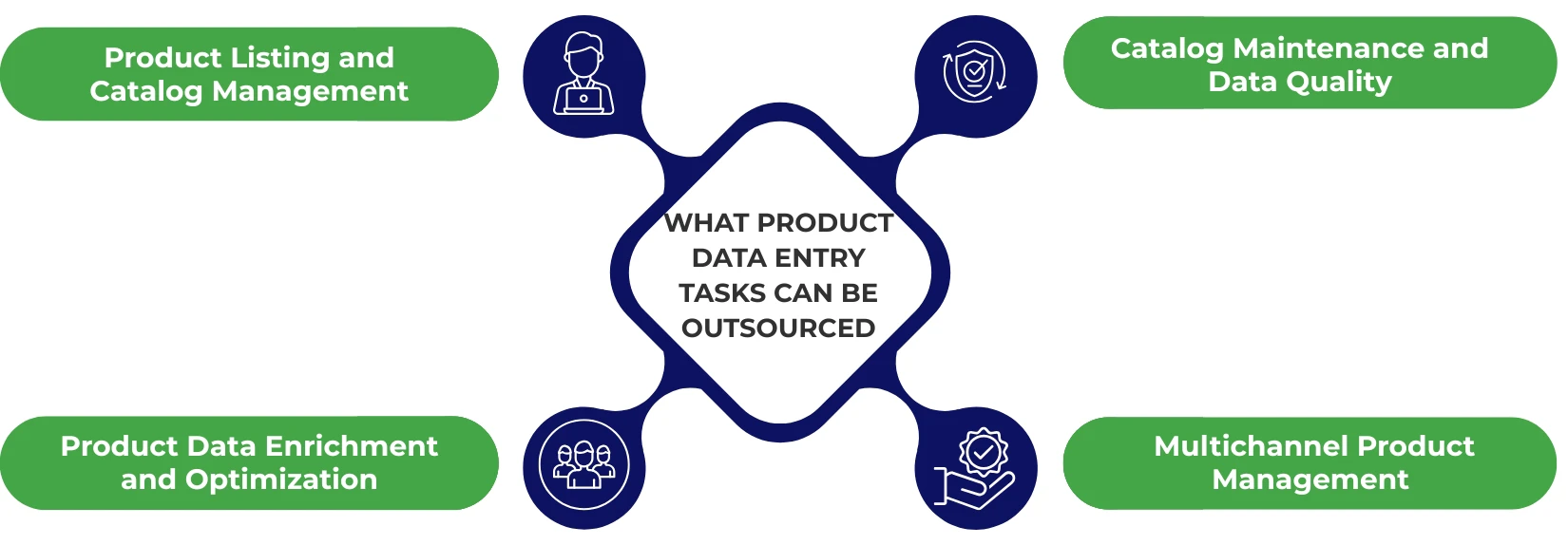
Product Listing and Catalog Management
The foundation of any e-commerce catalog is accurate and consistent product information. Outsourced teams can support:
- Product title creation and updates
- Product description management
- Pricing and inventory data entry
- Product categorization and tagging
- Product image uploads and organization
- Catalog creation and bulk product uploads
This helps ensure product listings remain consistent across platforms and sales channels.
Product Data Enrichment and Optimization
Beyond basic data entry, product enrichment improves the quality and usefulness of product information.
Common tasks include:
- Product specifications and technical attributes
- Dimensions, materials, and sizing information
- Compatibility and usage details
- Product FAQs
- SEO fields and metadata
- Image alt text optimization
Enriched product content improves product discovery, supports better customer experiences, and helps buyers make more informed decisions.
Catalog Maintenance and Data Quality
As catalogs grow, maintaining data quality becomes an ongoing responsibility rather than a one-time project.
Outsourced teams can help with:
- SKU management and organization
- Variant management
- Product feed management
- Data cleansing and validation
- Duplicate record removal
- Product taxonomy management
- Product data migration between systems
These activities help maintain product information quality while reducing catalog errors and inconsistencies.
Marketplace and Multichannel Product Management
Each marketplace has unique listing requirements, attributes, and compliance standards. Managing them manually can quickly become resource-intensive.
Product data entry outsourcing often includes:
- Amazon Seller Central listing management
- Walmart Marketplace product uploads
- eBay and Etsy listing support
- Google Merchant Center feed management
- Marketplace attribute mapping
- Product feed preparation
- Listing compliance and validation
This ensures product information remains accurate, compliant, and optimized wherever customers search and buy.
What are the Benefits of Outsourcing Product Data Entry?
Outsourcing product data entry helps ecommerce and catalog-driven businesses improve data accuracy, accelerate product launches, maintain consistency across channels, and scale catalog operations without expanding internal teams.
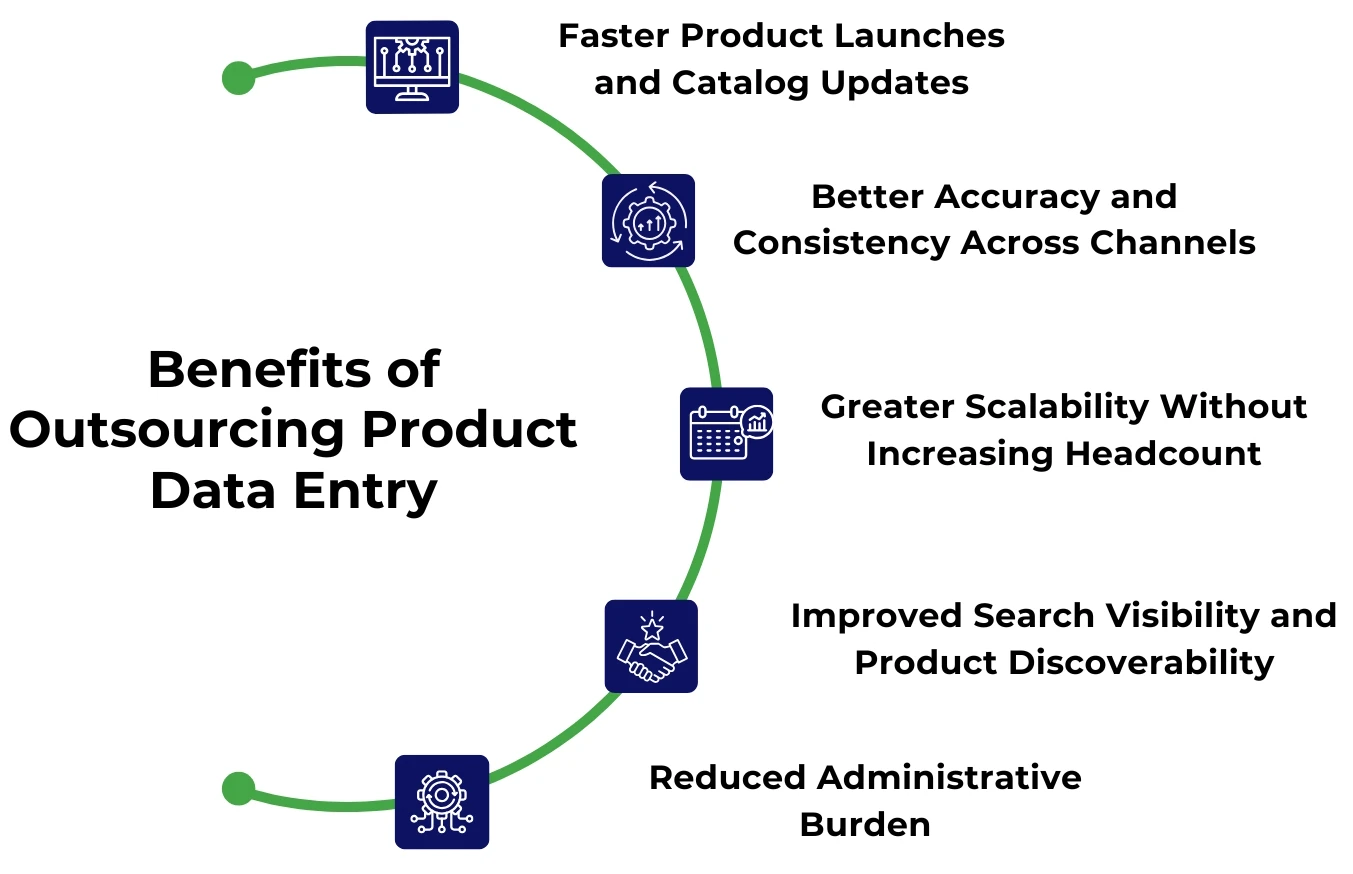
Faster Product Launches and Catalog Updates
New products do not generate revenue while they sit in spreadsheets, supplier files, or internal queues. Outsourced product data entry helps move products from intake to live listings faster, supporting seasonal launches, large catalog rollouts, and marketplace expansion with fewer delays.
Better Accuracy and Consistency Across Channels
It is about ensuring that every product title, SKU, price, attribute, image, and description remain consistent wherever the product appears.
This requires:
- Validation processes
- QA reviews
- Standardized formatting
- Consistent categorization
- Clean product records
Greater Scalability Without Increasing Headcount
Catalog growth creates operational pressure. Outsourcing gives businesses flexible capacity without adding permanent internal roles.
This is especially valuable for large SKU counts, growing ecommerce brands, multi-brand retailers, B2B distributors, and manufacturers with complex catalogs.
Improved Search Visibility and Product Discoverability
Product discoverability depends on how well product information is structured and maintained. Optimized titles, complete attributes, consistent metadata, and high-quality product feeds help improve product SEO, marketplace visibility, and omnichannel commerce performance.
Better product data entry makes products easier to find, compare, and recommend.
Reduced Administrative Burden
Product data entry often pulls high-value teams into repetitive catalog work.
For example, merchandising teams get pulled into product updates. E-commerce teams spend time fixing listings. Marketing teams deal with feed issues. Product managers chase missing specifications.
Outsourcing reduces that burden, allowing internal teams to focus on assortment strategy, channel growth, customer experience, and revenue-driving initiatives.
In-House vs. Outsourced Product Data Entry
In-house data entry offers more control; outsourced data entry offers greater scalability, flexibility, and bulk-processing capacity.
| Area | In-House Product Data Entry | Outsourced Product Data Entry |
|---|---|---|
| Hiring | Requires recruiting, onboarding, and managing an internal team. | Provider supplies trained data entry specialists or a dedicated data entry team. |
| Training | Training cost and process knowledge stay fully internal. | Training is shared between the brand and external team using clear documentation. |
| Speed | Productivity is limited by internal capacity and competing priorities. | Easier to scale for bulk product upload, seasonal work, or urgent catalog updates. |
| Cost structure | Payroll-heavy, with fixed hiring cost, benefits, tools, and management overhead. | Flexible pricing through hourly, per-SKU, per-listing, project-based outsourcing, or retainers. |
| Product knowledge | Usually stronger at the start because the team is closer to the business. | Requires clear product rules, taxonomy, examples, and approval workflows. |
| Quality control | QA process is fully internal and easier to supervise directly. | Requires defined review rules, error tracking, and quality assurance checkpoints. |
| Scalability | Slower for large catalogs, high SKU volume, or multichannel updates. | Better for repetitive, structured, high-volume catalog work. |
| Best for | High-control catalogs, sensitive products, or complex product knowledge. | Repetitive product uploads, data cleansing, marketplace listings, and structured catalog maintenance. |
When Should You Outsource Product Data Entry?
Businesses should consider outsourcing product data entry when catalog growth, marketplace expansion, data quality issues, or operational complexity begin to slow product launches and consume internal resources.
Common Signs It’s Time to Outsource
If any of the following sound familiar, product data entry outsourcing may be worth evaluating:
- Your catalog contains thousands of SKUs
- Product information requires frequent updates
- You are expanding into new marketplaces or sales channels
- An e-commerce platform migration is underway
- A PIM implementation is creating additional data management requirements
- Product data errors are becoming more common
- Bulk product updates consume significant internal resources
- Seasonal catalog changes create recurring workload spikes
Individually, these challenges may seem manageable. Combined, they can create bottlenecks that affect product onboarding, catalog expansion, and overall ecommerce performance.
Best Product Data Tasks to Outsource First
For businesses new to outsourcing, it often makes sense to begin with high-volume, process-driven tasks before expanding into broader catalog management responsibilities.
A practical starting point includes:
- Product uploads
- Product image uploads
- SKU updates
- Data cleansing
- Category mapping
- Feed formatting
These activities typically deliver immediate operational relief while creating a foundation for larger initiatives such as product migration projects, marketplace expansion, and long-term catalog management.
How do You Choose the Right Product Data Entry Outsourcing Partner?
The right product data entry partner should do more than process tasks. They should help maintain product information quality, support catalog growth, and operate as a reliable extension of your ecommerce team.
E-commerce and Catalog Expertise
Not all data entry providers understand the complexities of e-commerce operations.
Look for partners with experience managing:
- E-commerce platforms and product databases
- Marketplace listing requirements
- Large product catalogs
- Complex SKU and variant structures
- Product taxonomy and categorization frameworks
Quality Assurance and Data Governance
Product data errors can affect customer experience, marketplace visibility, and operational efficiency.
A strong outsourcing partner should have clear processes for:
- Validation rules and data standards
- Quality assurance reviews
- Error tracking and correction
- Data governance and documentation
The goal is not simply to complete tasks but to maintain consistent, high-quality product information over time.
Scalability and Operational Flexibility
Catalog requirements rarely remain static.
Whether you’re preparing for seasonal demand, launching new product lines, expanding into marketplaces, or managing catalog migrations, your outsourcing partner should be able to scale alongside your business.
Security and Operational Control
Product information is a business asset. Any external partner should have safeguards in place to protect itself.
Key considerations include:
- Role-based system access
- Secure file-sharing processes
- NDA and confidentiality requirements
- Activity logging and audit trails
Strong security practices help ensure product data remains protected while maintaining visibility and control over outsourced workflows.
Frequently Asked Questions (FAQs)
Is Outsourcing Product Data Entry the Right Move for Your Business?
Product data entry is no longer just an administrative function. It plays a direct role in product discovery, customer experience, marketplace performance, and operational efficiency.
The right product data entry strategy helps ensure products are launched faster, catalog information remains accurate across channels, and internal teams can focus on higher-value initiatives that drive growth.
For businesses managing large catalogs, expanding into new marketplaces, implementing PIM systems, or struggling with ongoing product data maintenance, outsourcing can provide the expertise and scalability needed to support long-term growth.
Rather than asking whether product data entry should be outsourced, a better question may be:
Does your current approach allow your team to scale efficiently while maintaining the quality and consistency your customers expect?
If the answer is no, it may be time to explore a more strategic approach to product data management and catalog operations.