

Each year, mid-market firms invest significant resources into technology rollouts to drive growth and stay competitive.
Yet, McKinsey research shows that more than 70% of these initiatives fail to deliver their expected value.1
One of the most significant barriers is complexity. Multiple interdependencies, shifting priorities, and the demands of cross-functional coordination can quickly undermine timelines, budgets, and intended outcomes.
In this article, we examine the most common challenges that make large-scale rollouts difficult to execute successfully and outline the key steps required to deliver them seamlessly.
This is the third installment in our technology rollouts series, following How to Ensure a Successful Technology Rollout in Your Organization and The Strategic Value of Technology Rollouts. It moves the discussion from planning and strategic alignment to the practical challenge of managing complexity in execution.
The Nature of Complexity in Technology Rollouts
In large-scale technology rollouts, complexity is inherent. Systems, processes, and people are tightly interconnected, creating dependencies that must be managed in parallel. Execution often spans multiple business units, functions, and regions, each with its own priorities, workflows, and operational realities. Even with strong planning, maintaining alignment across these moving parts requires continuous coordination and governance.
McKinsey reports that between 25% and 40% of large technology programs exceed their budgets or schedules by more than 50%—a direct consequence of underestimating interdependencies and execution complexity.2
The challenge intensifies with compliance, data security, and integration demands. Organizations must ensure adherence to regulatory requirements, protect sensitive information, and enable interoperability between new and existing systems without disrupting ongoing operations. As the scope increases, the number of integration points, stakeholders, and regulatory touchpoints grows exponentially.
Without a structured, phased approach that anticipates these variables, complexity can quickly erode timelines, inflate costs, and undermine strategic objectives.
Common Challenges That Derail Technology Rollouts
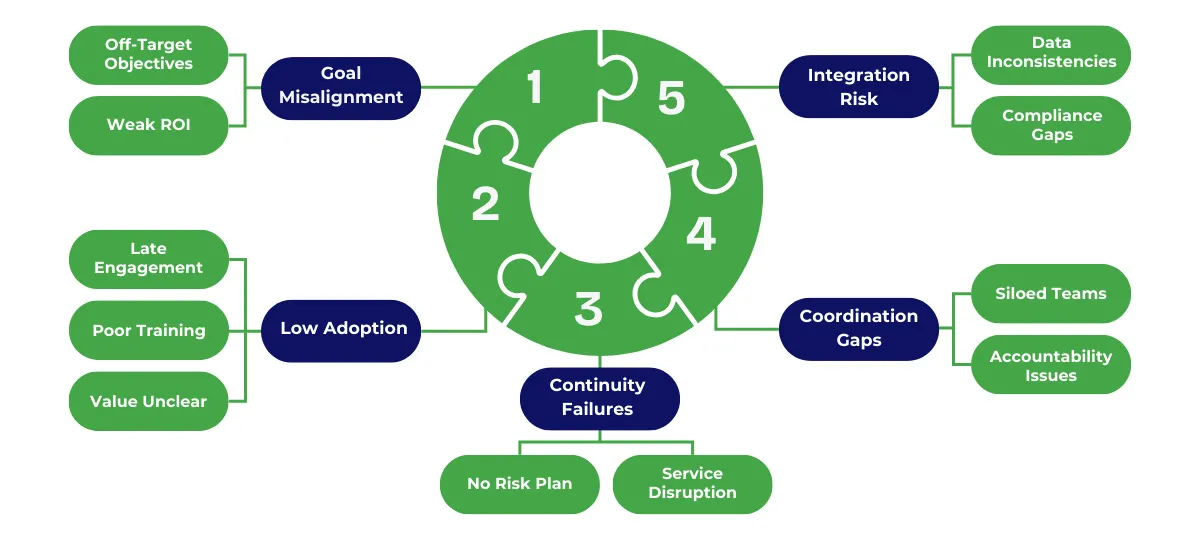
Goal Misalignment
When technical specifications rather than business priorities drive the rollout, measurable outcomes are often missed. This gap between execution and strategy leads to poor adoption, limited ROI, and an inability to scale the solution.
Low Adoption
User adoption falters when change management is treated as an afterthought. Without early communication, tailored training, and clear value demonstration, resistance builds, slowing momentum.
Integration Risk
Connecting new platforms with legacy systems is rarely straightforward. Poorly planned integrations can result in downtime, data inconsistencies, and even compliance breaches. This risk grows when organizations lack robust data governance and interoperability planning.
Coordination Gaps
Rollouts involving multiple vendors, contractors, or internal departments often suffer from unclear accountability. Without unified governance, teams work in silos, creating duplicated efforts, delays, and scope creep.
Continuity Failures
Inadequate risk management and weak contingency planning can disrupt operations during critical phases. Business continuity must be built into the rollout from the outset to protect service delivery and customer experience.
Key Steps to Mastering Complexity
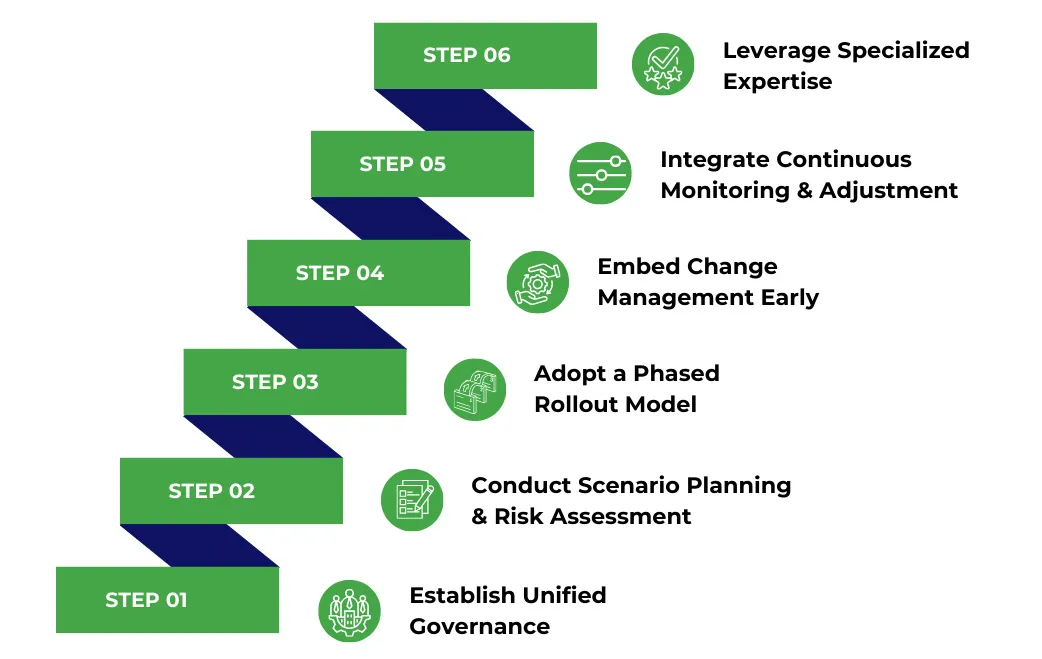
Establish Unified Governance
- Form a cross-functional steering group with clear decision-making authority.
- Maintain alignment between business priorities and technical execution.
- Resolve coordination gaps before they escalate into delays.
Conduct Scenario Planning & Risk Assessment
- Use simulations and analytics to identify high-risk dependencies.
- Address integration, compliance, and continuity risks before rollout begins.
- Build contingency plans for critical operational functions.
Adopt a Phased Rollout Model
- Start with controlled pilots to validate processes and integrations.
- Apply lessons learned before scaling across the organization.
- Reduce risk of large-scale operational disruption.
Embed Change Management Early
- Engage stakeholders from the outset with clear, consistent communication.
- Provide targeted training based on role-specific needs.
- Use feedback loops to refine adoption strategies.
Integrate Continuous Monitoring & Adjustment
- Track progress through dashboards and defined KPIs.
- Make agile adjustments to address issues as they arise.
- Maintain focus on adoption, performance, and ROI.
Leverage Specialized Expertise
- Right-shore critical functions to access specialized talent.
- Deploy expert partners for complex integration or compliance needs.
- Prevent resource strain on internal teams.
From Managing Complexity to Gaining a Strategic Edge
Effective complexity management transforms rollouts from operational challenges into opportunities for growth. When execution is precise, organizations realize faster time-to-value, maintain operational stability, and create a resilient foundation for scaling innovation.
Businesses that master it can adapt to market changes quickly, seize opportunities ahead of competitors, and ensure that every rollout advances long-term objectives. Achieving this consistently requires a structured, repeatable model that connects execution discipline to strategic intent at every stage.
The PRIME Framework: A Structured Approach to Rollout Success
At Premier NX, we help organizations approach technology rollouts as strategic initiatives rather than isolated deployments. Premier PRIME Framework provides a structured, repeatable model for managing complexity, aligning execution with business goals, and ensuring long-term adaptability.
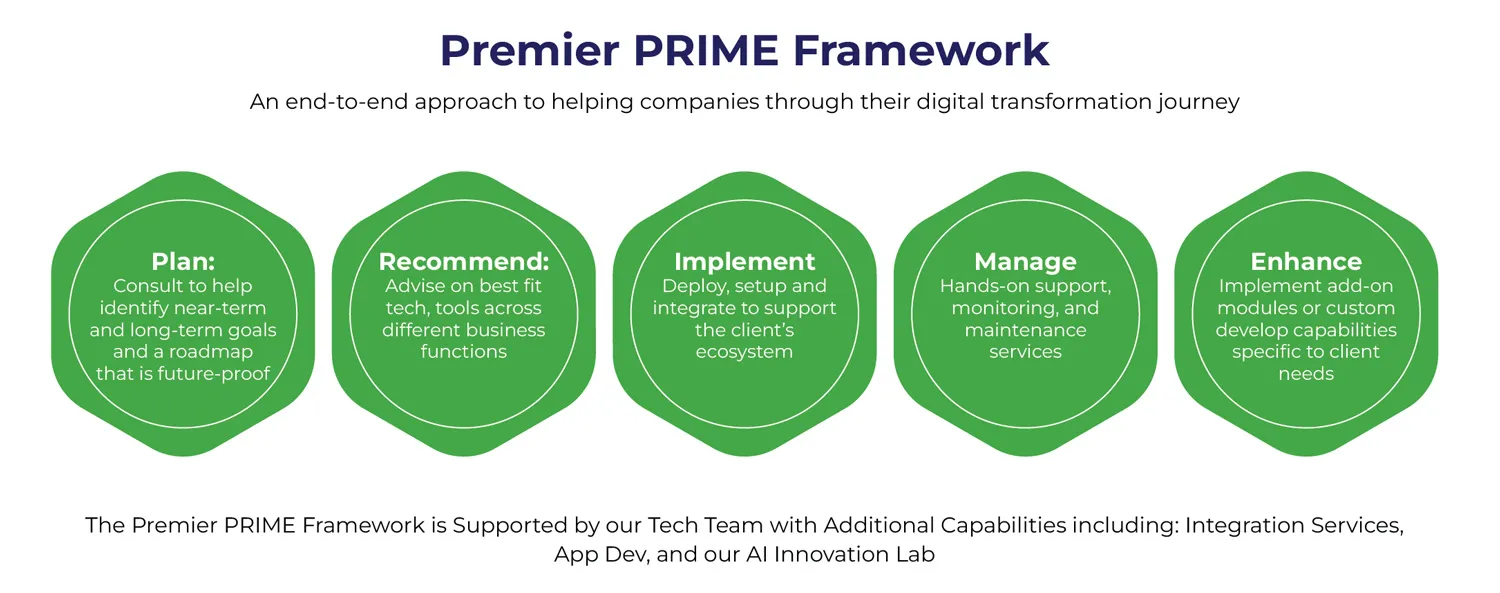
- 1Plan – Define outcome-driven roadmaps grounded in enterprise strategy, with clear priorities and governance structures.
- 2Recommend – Identify and tailor technology choices that deliver maximum cross-functional value and integrate seamlessly with existing systems.
- 3Implement – Execute with precision across systems, data, and user experience, using proven methods to minimize disruption.
- 4Manage – Sustain performance through ongoing support, monitoring, and governance to protect operational stability.
- 5Enhance – Evolve capabilities over time to meet changing needs, enabling scalability and continuous improvement.
Unlock the Strategic Advantage of Your Next Rollout
Complexity doesn’t have to slow progress. Partner with Premier NX to turn your rollout into a strategic advantage, backed by the discipline, governance, and agility of the PRIME Framework.
About the Author

As CEO, Ali Din oversees the overall strategy and direction for Premier NX. With senior leadership roles at global HR and recruiting platforms, Indeed and ADP. Ali has over 25 years of experience in the IT and advanced technology sector. Ali’s time is focused on transformation in the business, both for professional development and for clients, to enhance business outcomes.