


In boardrooms across industries, one question persists: How do we scale without compromising precision? Business Process Automation (BPA) is emerging as the answer, not as a tactical upgrade, but as a strategic rethinking of how workflows across an enterprise. As organizations struggle with operational inefficiencies, fragmented systems, and resource constraints, BPA offers a framework for achieving efficiency, consistency, and resilience.
Automating workflows can reduce errors by up to 70%, while improving overall productivity and customer satisfaction by nearly 7%.1
Far beyond automating tasks, BPA redefines business mechanics. It integrates systems, aligns departments, and delivers the kind of real-time responsiveness to today’s market demands. When implemented with foresight, it becomes a lever for transformation and reduces complexity while unlocking the agility to innovate, grow, and outperform.
What Is Business Process Automation? (and What It’s Not)
Business Process Automation is a strategic redesign of how organizations operate by reengineering workflows to be faster, more consistent, and inherently scalable. It enables businesses to automate complex end-to-end processes that span multiple teams and systems, from invoice management and employee onboarding to client communications and compliance reporting.
Unlike Robotic Process Automation (RPA), which typically mimics individual user actions within a specific application, or Robotic Desktop Automation (RDA), which enhances productivity at a single workstation, BPA operates holistically. It integrates systems, orchestrates data flow, and aligns operations with business strategy.
Consider a customer lifecycle automation scenario: BPA can trigger account creation, verify documents, assign support tiers, and synchronize financial data in real-time. These business process automation examples illustrate the systemic value BPA delivers.
Strategic Benefits of Business Process Automation
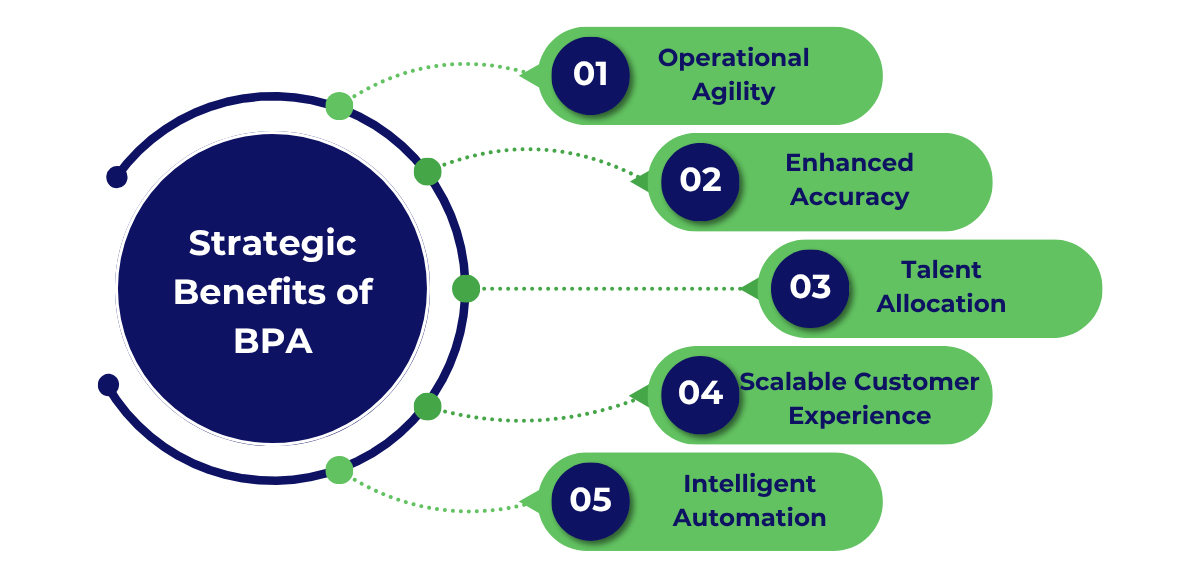
Operational Agility
BPA accelerates decision cycles and improves response times, which is critical in fast-paced markets. In fact, Gartner reports that automation initiatives reduce cycle times by 30–50%.2
Enhanced Accuracy & Risk Mitigation
By embedding controls directly into automated workflows, BPA reduces human error and 32% of businesses report notable productivity gains and fewer post-automation mistakes.3
Efficient Talent Allocation
Automation allows employees to focus on strategic, value-added work. By freeing analysts, product teams and customer-facing staff from routine tasks, BPA supports innovation and higher-value output.
Scalable Customer Experiences
Automated, consistent service delivery fosters trust and customer satisfaction, particularly when it spans multiple channels and touchpoints. Organizations deploying BPA tools can scale personalized, timely interactions without proportionally increasing costs.
Enabler of Intelligent Automation
Modern BPA platforms are stepping stones to intelligent automation. Many enterprises see BPA as essential to their broader digital transformation agenda. And in alignment with this vision, 56% of organizations are now embedding AI within process workflows.4
Common Pitfalls That Undermine Business Process Automation Initiatives
Many business process automation efforts fail not due to poor technology but due to misaligned execution. A common misstep is jumping into software deployment without first defining measurable outcomes or securing cross-functional alignment. Without strategic clarity, automation can reinforce inefficiencies rather than eliminate them.
Another frequent oversight is treating BPA as a one-time project rather than a living capability. Without ongoing management, optimization, and user feedback loops, even well-designed processes degrade over time. Many organizations also underestimate the importance of user experience; workflows that fail to consider frontline realities often struggle to gain traction.
How to Approach Business Process Automation
Start with Strategy, Not Tools
Before evaluating platforms or drafting workflows, organizations must define the business outcomes they aim to achieve. Whether it’s reducing cycle time, improving compliance, or scaling service delivery, technology decisions should follow strategy, not lead it.
Choosing the Right Solutions
With hundreds of business process automation software, tools, and solutions on the market, the right choice hinges on how well a platform integrates with your existing systems, supports cross-functional processes, and scales with your operations.
Leverage Service-Based Models for Speed
Business process automation services provide a means to accelerate implementation while minimizing internal disruptions. These models provide ready-built capabilities, from design to deployment, enabling faster time-to-value and reducing the burden on in-house teams.
Engage Strategic Partners
Working with experienced business process automation companies brings more than just technical support; it also adds a strategic perspective. The right partner ensures alignment with enterprise goals, brings proven frameworks, and provides ongoing governance for long-term success.
Premier’s Structured Approach to Business Process Automation
Before implementing any automation initiative, it’s essential to apply a structured approach that aligns with business priorities and scales over time. At Premier NX, digital transformation efforts are supported through a practical delivery model that emphasizes clarity, coordination, and long-term adaptability.
That approach is reflected in the PRIME Tech Framework, a five-step model designed to guide organizations through automation in a way that minimizes disruption and maximizes operational value:
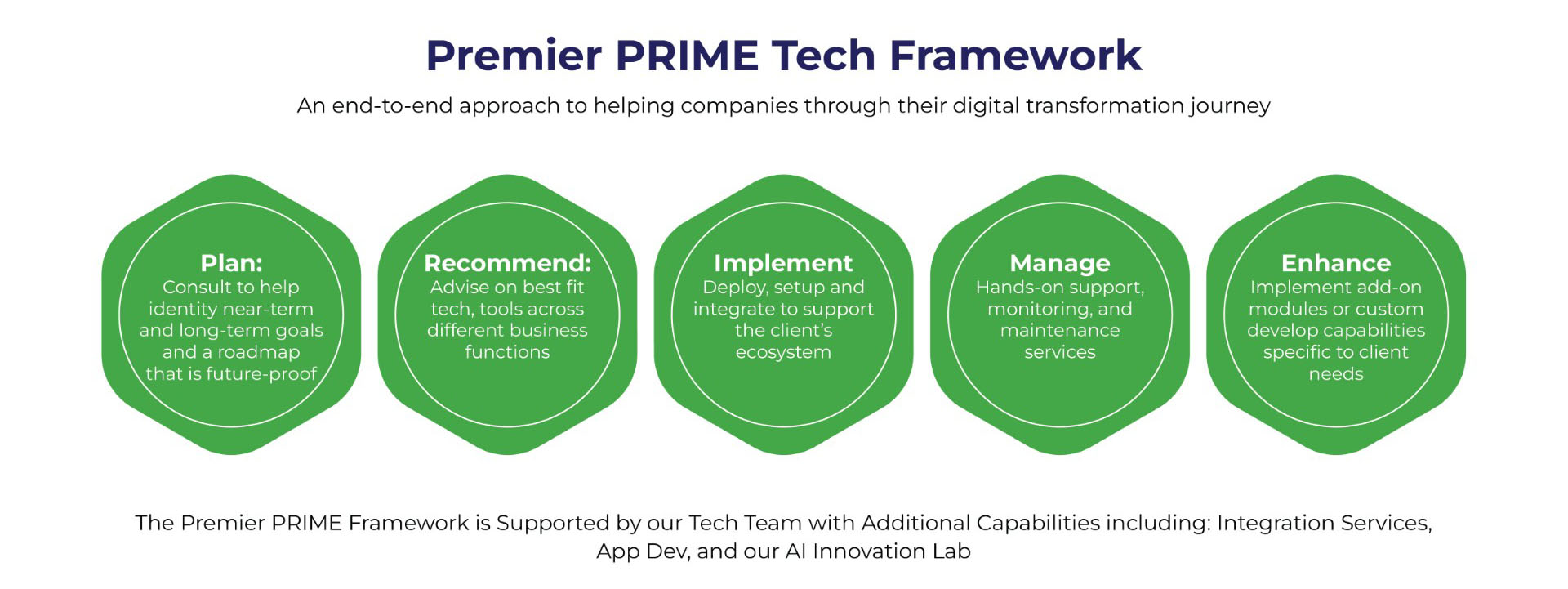
- Plan – Define outcome-driven roadmaps grounded in business strategy.
- Recommend – Tailor technology choices to maximize cross-functional value.
- Implement – Execute with precision across systems, data, and user experience.
- Manage – Sustain performance with ongoing support and governance.
- Enhance – Expand capabilities through continuous evolution and scale.
Each phase builds on the last to support automation that is not only efficient at launch but resilient and responsive to evolving business needs.
Making Business Process Automation Work for Your Business
Business process automation delivers the greatest value when it’s part of a structured, long-term strategy. Whether you’re refining internal workflows or scaling enterprise-wide transformation, success depends on clear objectives, the right tools, and a reliable execution model.
Premier NX supports organizations in aligning automation initiatives with business outcomes through a practical, scalable approach.
To explore how our team can help streamline your operations and strengthen your transformation strategy, connect with us.