


In the business landscape, there is an ongoing debate over outsourcing certain functions or even delegating everything to a partner with relevant expertise.
Some believe the benefits of outsourcing are limited to enterprises; others believe outsourcing is not particularly beneficial and that involving an external partner could pose serious risks, including security concerns, loss of control, or compromised quality.
But on-ground facts are altogether different. In 2025, the global outsourcing market is valued at USD 1.09 trillion and is expected to reach USD 1.48 trillion by 2030.
This surge clearly indicates that outsourcing is no longer just a cost-saving tactic; it has become a complete business model. Startups, mid-sized businesses, and enterprises are equally reaping the benefits of outsourcing.
Especially, the advantages are crucial to mid-sized organizations, which can access enterprise-level resources without spending that much internally or increasing their bandwidth.
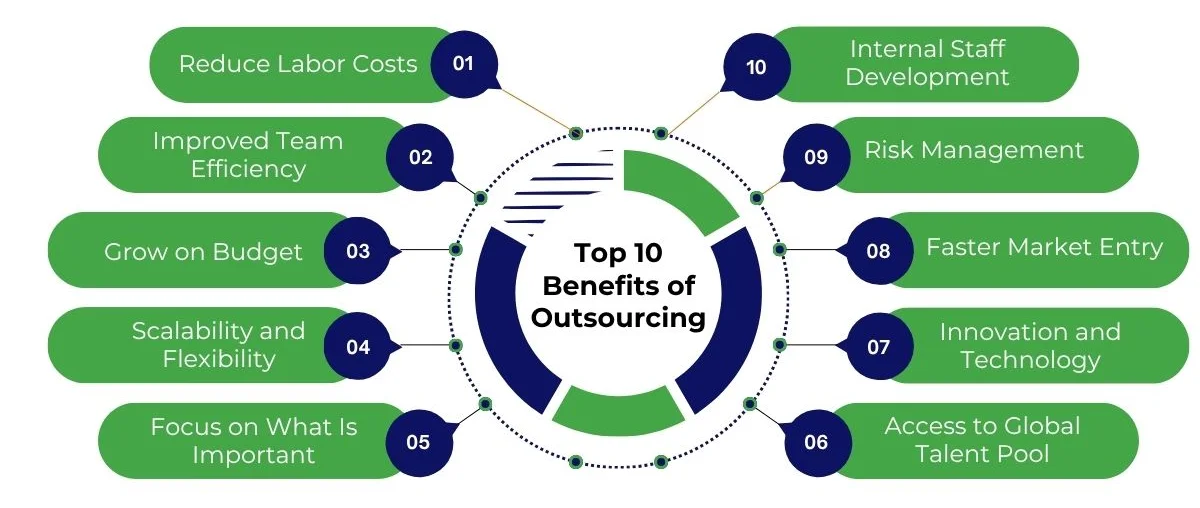
In this blog, we will discuss the top 10 strategic benefits of outsourcing, along with industry-specific use cases.
Top 10 Business Benefits of Outsourcing
Reduce Labor Cost
One of the most compelling reasons for businesses to outsource their tasks is the reduced labor cost without compromising the quality.
Outsourcing partners, most of the time, delegate your business tasks to geographies with a lower cost of living, which means you have to pay far less compared to managing an internal team.
Not only this, but by delegating crucial tasks, you save yourself a lot of time and effort through reduced overhead, no additional office space required, less HR work, shorter onboarding cycles, and less training.
Improved Team Efficiency
Beyond cost, partnering with experienced external teams enhances efficiency across the board. Specialized partners usually have access to the latest technologies, which they implement to improve the overall work efficiency.
What you have to do as a client is to finalize the working standards, SLAs, and performance benchmarks, after which the responsibility of producing the output solely relies on the outsourcing partner.
This way, the leadership and your teams focus on other strategic initiatives while they manage delegated tasks, and outsourcing becomes a force multiplier, amplifying what your internal teams can achieve on their own.
Grow on Budget
Outsourcing enables companies to shift from capital-intensive models to variable cost structures. Companies can simply outsource part of their tasks, evaluate the performance, and scale based on numbers.
This flexibility allows leadership to invest in core growth initiatives such as R&D, product innovation, and go-to-market strategies, while outsourcing partners manage the support infrastructure efficiently and with accountability.
Scalability and Flexibility
Developing and managing all necessary business capabilities often takes years for a start-up or even a mid-sized organization. On the other hand, a well-structured outsourcing model allows companies to access top-tier services, such as automation and multilingual capabilities, for their existing workflows within weeks.
And all this with full flexibility, where you can expand or limit services based on the ongoing performance. Once you have an ideal setting, you are left to oversee while the partner continues to handle all your work.
Focus on What is Important
Strategically, outsourcing provides leadership teams with crucial space. They are free from the hassle of developing and managing an internal department, allowing them to focus solely on their core initiatives.
Administrative burdens like payroll processing, IT support, HR, and data entry strain a lot of an organization’s energy; therefore, delegating these tasks gives you ample time to focus on what matters most.
Access to Global Talent Pool
Outsourcing provides immediate access to a global workforce with diverse skills, new cultural perspectives, and industry expertise.
Having this global reach not only enables you to get your work done efficiently but also helps you build a global footprint.
The specialized partners offer multiple options, and you can make your decision based on your priorities and the nature of the job.
Innovation and Technology
Beyond expertise and dedicated teams, one of the positives of outsourcing is the opportunity to connect with teams that bring innovation and the latest technology to your existing infrastructure.
Nowadays, integrating automation, analytics, and cloud platforms into existing systems is quite expensive. Managing all this in-house could not only be expensive but also require extensive experience.
While an outsourcing partner helps you get all this with a single agreement, your existing infrastructure is updated without any operational overhead.
Faster Market Entry
Whether launching a new product, entering a new market, or introducing a new service line, outsourcing enhances agility by reducing the time required to assemble, train, and deploy skilled teams.
This speed doesn’t come at the cost of control; it amplifies your strategic reach. It allows your internal teams to stay focused on market strategy while execution happens in parallel.
Risk Management
One of the greatest challenges businesses face nowadays is compliance, data security, and privacy. Managing all this internally is always quite resource-intensive and requires a dedicated team.
What is different in strategic outsourcing is that the specialized partner has to manage all this, and you just have to convey your requirements. Instead of building an in-house department, all these crucial factors are managed by the partner.
Internal Staff Development
By offloading the workload, companies can enable their teams to focus on strategic initiatives that drive overall business growth.
This shift often leads to greater employee empowerment, as in-house teams move into more strategic roles.
They gain exposure to cross-functional collaboration, digital tools, and process improvement initiatives that deepen skill sets and increase job satisfaction.
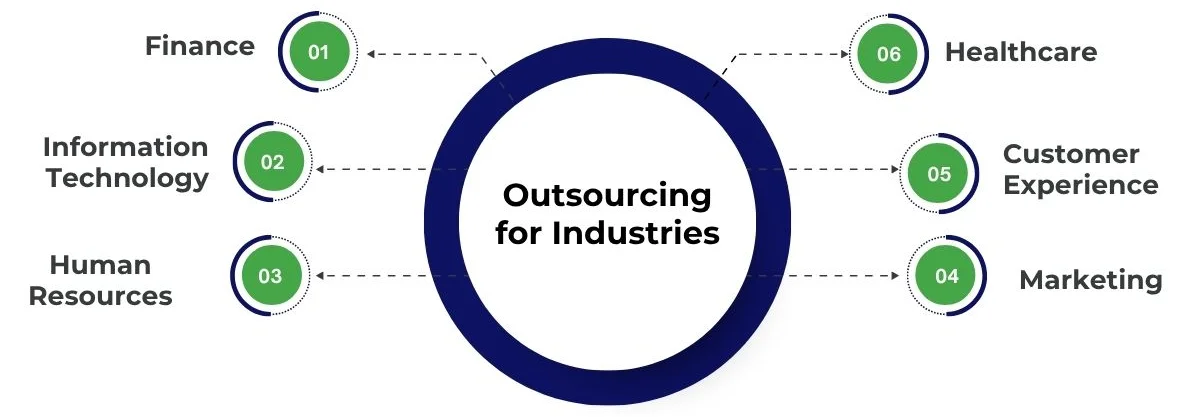
Industry-Specific Benefits of Offshore Outsourcing
Finance: Accounting & Bookkeeping
Finance and accounting is a department that is globally facing a significant talent shortage. Outsourcing the finance function helps businesses access specialized expertise without spending on talent acquisition and human resources.
Moreover, with the rise of automation in finance, your business can access resources generally considered specific to enterprise-level organizations.
IT: Technology and Infrastructure
Outsourcing IT functions like infrastructure management, helpdesk support, or cloud migration has become crucial for digital transformation. This way, companies gain rapid scalability, enhanced cybersecurity oversight, and freedom from legacy system bottlenecks.
The benefits include accelerated implementation, access to certified engineers, and 24/7 support across time zones.
HR: Talent & Payroll
Managing HR in-house can quickly become resource-intensive, especially for organizations scaling across regions. The benefits of outsourcing HR include streamlined recruitment pipelines, better employee data management, and scalable HRIS integration.
Companies can ensure timely, error-free compensation processing while mitigating compliance risks, particularly in highly regulated industries.
Marketing: Digital Strategy & Execution
The dynamics of marketing have changed, requiring constant innovation, cross-platform engagement, and data-driven optimization. Outsourcing marketing and digital strategy to specialized agencies or teams provides the agility modern brands need to thrive.
Among the key benefits of outsourcing marketing are efficient campaign execution, reduced overhead, and access to skilled strategists with expertise in SEO, paid media, and content creation.
Customer Experience: Support & Loyalty
Customer support is one of the most crucial deciding factors for any business. Whether it’s handling inquiries, managing support channels, or maintaining NPS goals, trusted outsourcing partners bring structure, empathy, and multilingual capabilities to the table.
Outsourcing customer experience-related services allows businesses to maintain 24/7 coverage, reduce churn, and offer personalized experiences that drive loyalty.
Healthcare: Medical Billing & Insurance Support
The benefits of medical billing outsourcing include faster reimbursements, fewer claim rejections, and improved coding accuracy. With HIPAA-compliant workflows and experienced billing professionals, outsourcing allows practices to streamline revenue cycle management while maintaining compliance and patient trust.
That’s why many organizations are turning to offshore partners to handle these back-office complexities.
Frequently Asked Questions (FAQs)
Conclusion
Outsourcing is not just a cost-saving tactic; it’s a primary lever of strategic growth. From managing costs to exploring global expertise, the benefits of outsourcing span across industries and impact every layer of an organization.
Whether you’re exploring outsourcing for the first time or refining an enterprise-wide strategy, the key lies in choosing partners who operate as an extension of your business.
At Premier NX, we don’t just execute; we co-create. We immerse ourselves in your business, adapt to your culture, and deliver measurable outcomes that align with your goals. The future of business isn’t built in-house; it’s built together.
About the Author

As CEO, Ali Din oversees the overall strategy and direction for Premier NX. With senior leadership roles at global HR and recruiting platforms, Indeed and ADP. Ali has over 25 years of experience in the IT and advanced technology sector. Ali’s time is focused on transformation in the business, both for professional development and for clients, to enhance business outcomes.