

Key Takeaways
- 1Business change can outgrow CX before service levels visibly decline.
- 2Pressure spreading across service, resolution, quality, reporting, and governance is a stronger structural signal than rising contact volume alone.
- 3Adding channels, markets, products, or technology can expose operating-model gaps that additional frontline capacity will not solve.
- 4CX scales more effectively when connected customer processes, technology, quality, analytics, and governance evolve with the business.
Business change can outgrow the customer operation before CX visibly fails. The first symptoms may look manageable: a rising backlog, more transfers, uneven SLA performance, or a temporary spike in escalations. But when pressure begins crossing frontline service, back-office resolution, quality, reporting, workflow, and governance, the issue is no longer simply capacity.
The executive question is whether the operating model still fits the business the organization is becoming.
When the business changes, customer operations must change with it
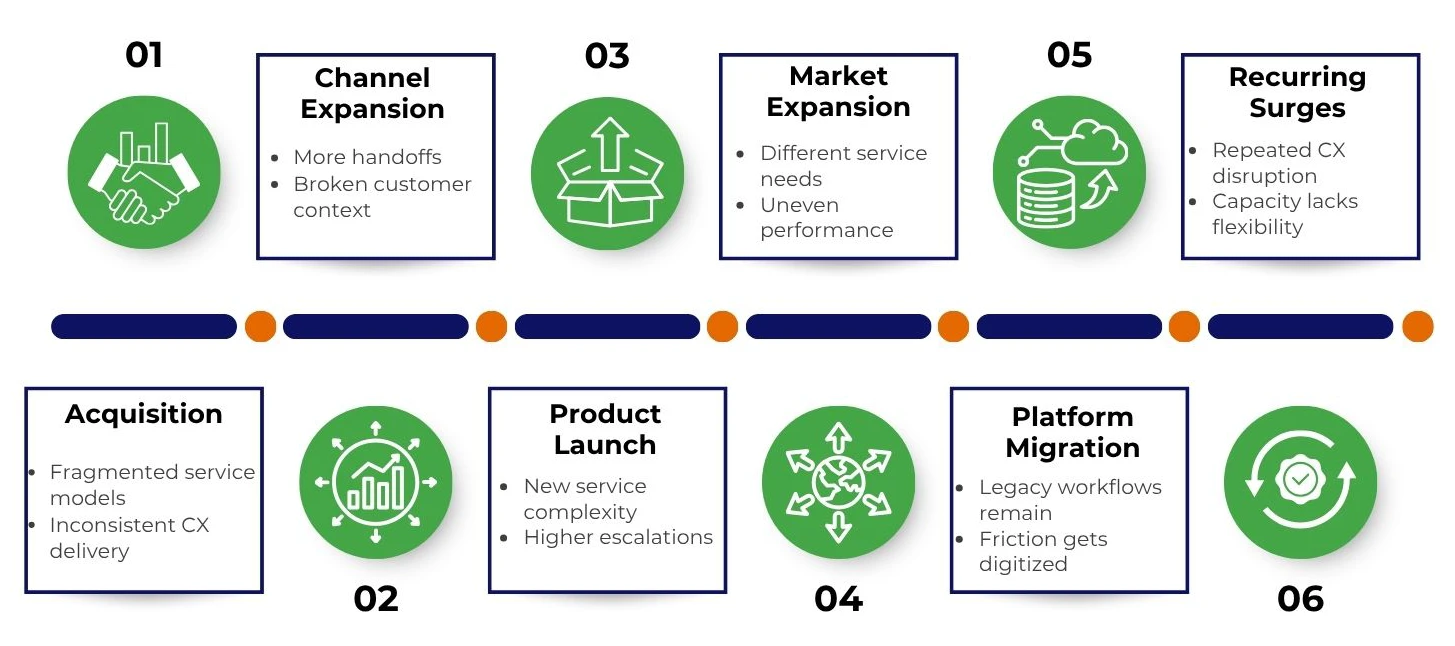
1. Acquisition Can Unify the Business Before It Unifies the Customer Operation
An acquisition may create one commercial organization while leaving multiple service models behind. Different brands can retain different policies, systems, escalation rules, quality standards, and ownership structures, creating inconsistent outcomes even when the customer promise is shared.
The operating consequence is fragmentation: duplicated workflows, unclear accountability, uneven reporting, and higher cost-to-serve across inherited processes. If leaders cannot compare performance or govern customer work consistently across the combined business, integration has not yet reached the operating level.
Executive signal: CX performance still varies materially by brand, inherited team, or process after commercial integration.
2. Channel Expansion Changes Ownership and Workflow, Not Just Access
Adding chat, SMS, messaging, or social channels increases more than interaction volume. It changes how customer context moves, how work is routed, when cases shift channels, which service standards apply, and how quality is evaluated across different interaction types.
The structural problem appears when the interaction layer expands faster than the operating layer behind it. Repeat contacts, channel switching, transfers, and unresolved cases can rise because ownership, workflow, knowledge access, and reporting were designed for a simpler channel mix.
Executive signal: New channels are increasing handoffs or repeat work instead of improving resolution.
3. Product Launches Can Change the Work Before They Change the Volume
A major launch or portfolio expansion can introduce unfamiliar contact reasons, new knowledge requirements, exception paths, complaint patterns, and downstream dependencies before total volume becomes alarming.
That complexity often appears in escalation rates, QA variation, longer resolution cycles, or new back-office workload. Scaling only the frontline can leave product specialists, case-resolution teams, quality controls, and reporting structures operating against assumptions built for the previous portfolio.
Executive signal: Launch-related complexity is spreading into escalations, resolution work, or quality performance even when overall volume remains manageable.
4. Market Expansion Changes the Service Model, Not Merely Coverage
Expansion into new geographies or customer segments can change operating hours, service expectations, languages, regulatory requirements, escalation authority, and the economics of serving different customer groups. A model optimized for one market may not transfer cleanly to another.
The operating challenge is balancing consistency with necessary variation. Over-standardization can ignore market requirements; excessive localization can create fragmented processes, uneven SLAs, and weak enterprise visibility.
Executive signal: Growth is producing persistent differences in SLA performance, escalation patterns, or service quality across markets or segments.
5. Platform Migration Is the Moment to Challenge Legacy Customer Workflows
A CRM or contact-center migration can modernize infrastructure while preserving old operating constraints. Rebuilding existing routing rules, handoffs, queue structures, integrations, and reporting inside a new platform may simply digitize yesterday’s friction.
The larger opportunity is to redesign how work should move before configuring how the technology will support it. Ownership, workflow, automation, knowledge access, quality visibility, and reporting should reflect the future operating model, not the limitations of the system being replaced.
Executive signal: A new platform is live, but transfer patterns, manual workarounds, reporting gaps, or unresolved ownership issues remain largely unchanged.
6. Repeated Surge Events Should Be Designed Into the Operating Model
Outages, recalls, promotions, and other spikes are often treated as temporary exceptions. That is reasonable when they are rare. It becomes a structural issue when the same volatility repeatedly disrupts service levels, escalation teams, back-office queues, complaint handling, or management reporting.
If every surge requires emergency staffing, manual triage, or tolerance for growing backlogs, the operation lacks designed flexibility. Capacity planning matters, but so do cross-trained workflows, escalation rules, case prioritization, quality controls, and visibility into where demand is moving.
Executive signal: Recurring spikes repeatedly destabilize multiple CX processes rather than creating a short-lived frontline queue.
The Strongest Signal Is When CX Stops Scaling with the Business
An operating-model problem becomes visible when growth or complexity makes customer operations harder to govern, less consistent, and more expensive to manage. At that point, local fixes may relieve symptoms while leaving the underlying economics, accountability, and workflow dependencies unchanged.
The leadership decision is not simply how much capacity to add. It is which customer processes must be redesigned, connected, or managed together so the operation can support the next stage of the business with stronger visibility, consistent service, and clearer control.
Design CX for the Business You Are Becoming
For organizations reaching that point, the response may require more than internal process changes or isolated staffing.
Premier NX can support connected customer operations across customer service, back-office processes, quality, analytics and reporting, and technology-enabled workflows, combining operational delivery with the disciplines needed to improve and scale the work.