


Key Takeaways
- 1Finance hiring works when added capacity improves performance; repeated pressure after new hires can signal a deeper operating constraint.
- 2Growth, M&A, and added complexity can change the finance requirement, making role-by-role expansion less effective.
- 3When pressure spans connected processes, leaders should shift the focus from individual vacancies to where the work and exceptions originate.
- 4From there, finance can redesign how recurring work is standardized, owned, and resourced to scale more effectively.
Adding finance headcount is often the right response to growth. If a stable process is handling materially more volume, another accountant or Accounts Payable (AP) resource may be exactly what is needed.
The decision changes when added headcount stops changing the operating result. If the team grows but close pressure, reconciliation backlog, exception volume, rework, and leadership intervention remain largely unchanged, finance may be adding labor without adding operating leverage.
That is why we diagnose the work before opening another requisition.
Distinguishing Capacity Needs from Structural Finance Constraints
A genuine capacity problem should respond predictably to capacity. The workflow is defined, controls are clear, exceptions are manageable, and performance has deteriorated mainly because volume increased. Add the right resource and throughput, timeliness, or service levels should recover.
A structural constraint has a different signature: the same pressure returns after the hire.
For a CFO or Controller, that distinction is more useful than headcount growth itself. A larger team is not evidence that finance is inefficient. But if each additional resource is absorbed without a corresponding improvement in close timing, reconciliation completion, exception aging, reporting reliability, or management workload, the underlying constraint deserves a different diagnosis.
The question becomes: what exactly is the next hire expected to improve, and can the process convert that capacity into better performance?
When Business Change Alters the Finance Requirement
Certain business events do more than increase finance workload. They can change how the work needs to be structured and managed.
- M&A and multi-entity growth can introduce different systems, controls, approval structures, reporting practices, and ways of working. Adding resources around each inherited process may increase capacity while making those differences permanent.
- Rapid growth can expose workflows that only worked at lower volumes, increasing manual intervention and exception handling.
- ERP transitions can create a redesign opportunity, but moving legacy processes onto a stronger platform does not make them more scalable.
When these changes are met only with role-by-role hiring, finance may add labor without reducing complexity. The result is a larger team that still depends on senior leaders to resolve recurring exceptions, corrections, and escalations.
Incremental hiring can preserve fragmentation when business complexity has already changed the finance requirement.
Reframing Finance Capacity Around the Work
Once pressure spans multiple finance activities, the unit of analysis should shift from the individual vacancy to the work driving the requirement.
Instead of expanding AP, AR, reconciliations, reporting, and close support separately, finance can evaluate them as connected execution areas with shared dependencies in data, controls, systems, and oversight.
This changes the decision’s scope. Capacity is no longer defined only by how many people are required, but by which processes to standardize, where accountability should sit, and what level of operational support is needed to run them consistently at scale.
Designing Finance Operations for Greater Scale
Once finance pressure reflects business complexity rather than an isolated workload gap, the response needs to address how recurring work is structured, connected, and delivered.
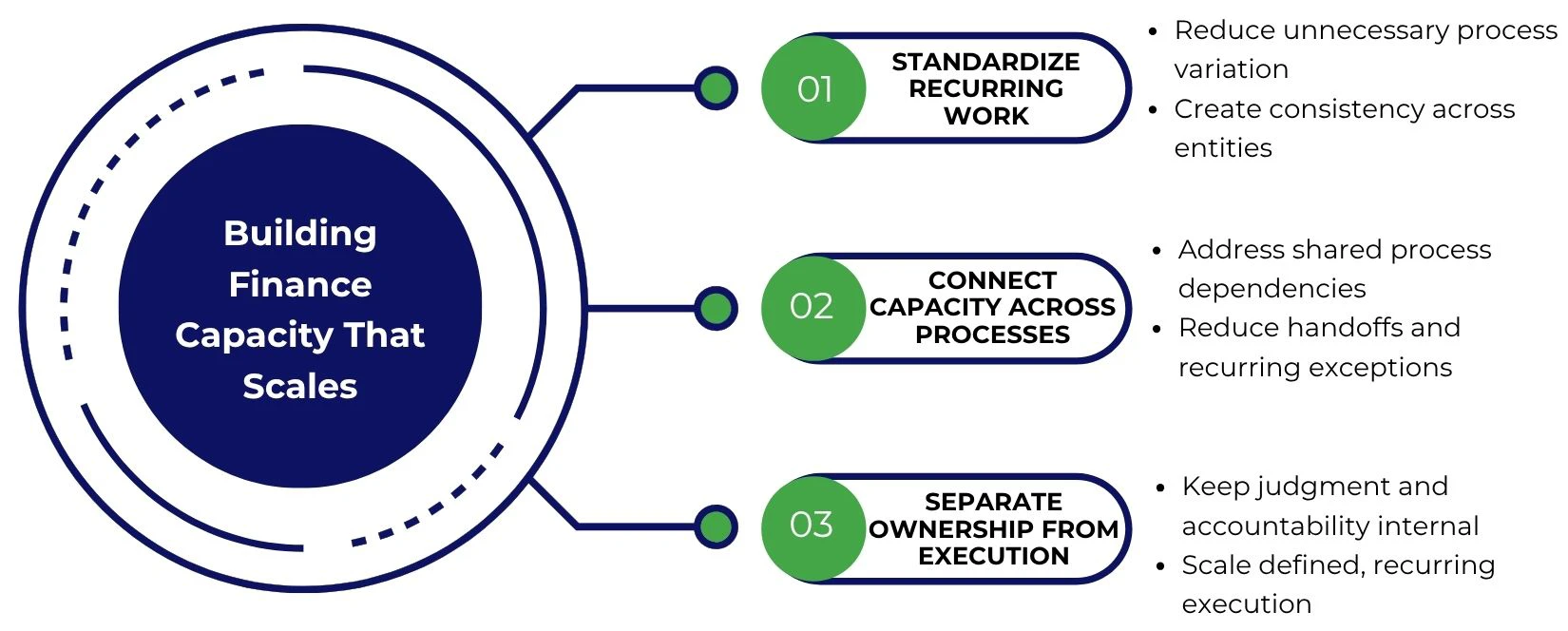
Better finance scale starts with better operating design.
Standardize and Consolidate Recurring Finance Work
Different entities or business units often inherit different workflows, approvals, and reporting practices. Scaling each variation independently adds coordination cost.
The priority is to reduce unnecessary variation so recurring finance work runs consistently across the organization.
A finance operation scales more effectively when recurring work follows consistent processes wherever business requirements allow, rather than requiring additional resources to support every inherited way of working.
Organize Capacity Around Connected Finance Processes
AP, AR, reconciliations, accounting, and close support may sit in separate roles, but their performance is interconnected. Capacity decisions should reflect those dependencies rather than treating every bottleneck as an independent staffing request.
This is also where technology creates leverage by reducing manual handoffs, repetitive work, and avoidable exceptions within a well-defined process.
Separate Strategic Ownership From Scalable Execution
Not every finance activity needs the same delivery structure. A useful distinction is between work that requires internal judgment and business context, and recurring execution that can be standardized and scaled.
For example:
- Retain internally: financial judgment, strategic decisions, policy, business partnering, and executive accountability.
- Scale operationally: repeatable transaction processing, reconciliations, reporting support, and other defined recurring activities.
The objective is a finance operation that can absorb greater scale without recreating the same capacity problem at every stage of growth.
Scaling Finance Beyond Incremental Headcount
Redesigning finance only creates value if the new way of working can be executed consistently as the business grows. That is where the decision moves beyond process design to who will provide the operating capacity, discipline, and continuity behind it.
For mid-market companies, that does not have to mean continuing to build every recurring finance capability internally.
Premier NX supports that operating shift by taking on defined, recurring finance processes across areas such as core accounting, reporting and compliance, treasury and cash management, and procurement and expenditure management.
The value is in supporting multiple connected processes with dedicated capacity, consistent execution, quality controls, and reporting, rather than filling one vacancy at a time. Finance leadership retains ownership of strategy and judgment while operational capacity can expand with the needs of the business.
Make the Next Hire Pass a Different Test
The issue is not whether finance should grow. The issue is whether growth in finance capacity improves finance performance.
If another resource restores performance in a sound process, hire. If the same exceptions, rework, close pressure, and management intervention keep returning, review the work before adding another layer.
Before opening the next finance requisition, determine whether it will expand the capacity of a sound process or compensate for a constraint the business has outgrown.