

Key Takeaways
- 1Customer satisfaction improves when contact center operations are designed to reduce friction across systems, workflows, and decisions.
- 2The strongest CX models connect automation, data, technology, and human expertise instead of optimizing each in isolation.
- 3Resolution quality is a better indicator of CX performance than activity metrics alone.
- 4As routine work is automated, human expertise becomes more concentrated in complex, high-impact interactions.
Customer satisfaction improves when contact centers reduce operational friction, not simply when they add channels, agents, or automation. The highest-performing models integrate automation, customer context, analytics, integrated technology, resolution-centered processes, and human judgment into a single operating system designed around better outcomes.
That distinction matters because most CX failures are not caused by a single bad interaction. They are caused by handoffs, disconnected data, inconsistent decisions, avoidable repeat contacts, and processes optimized for activity rather than resolution.
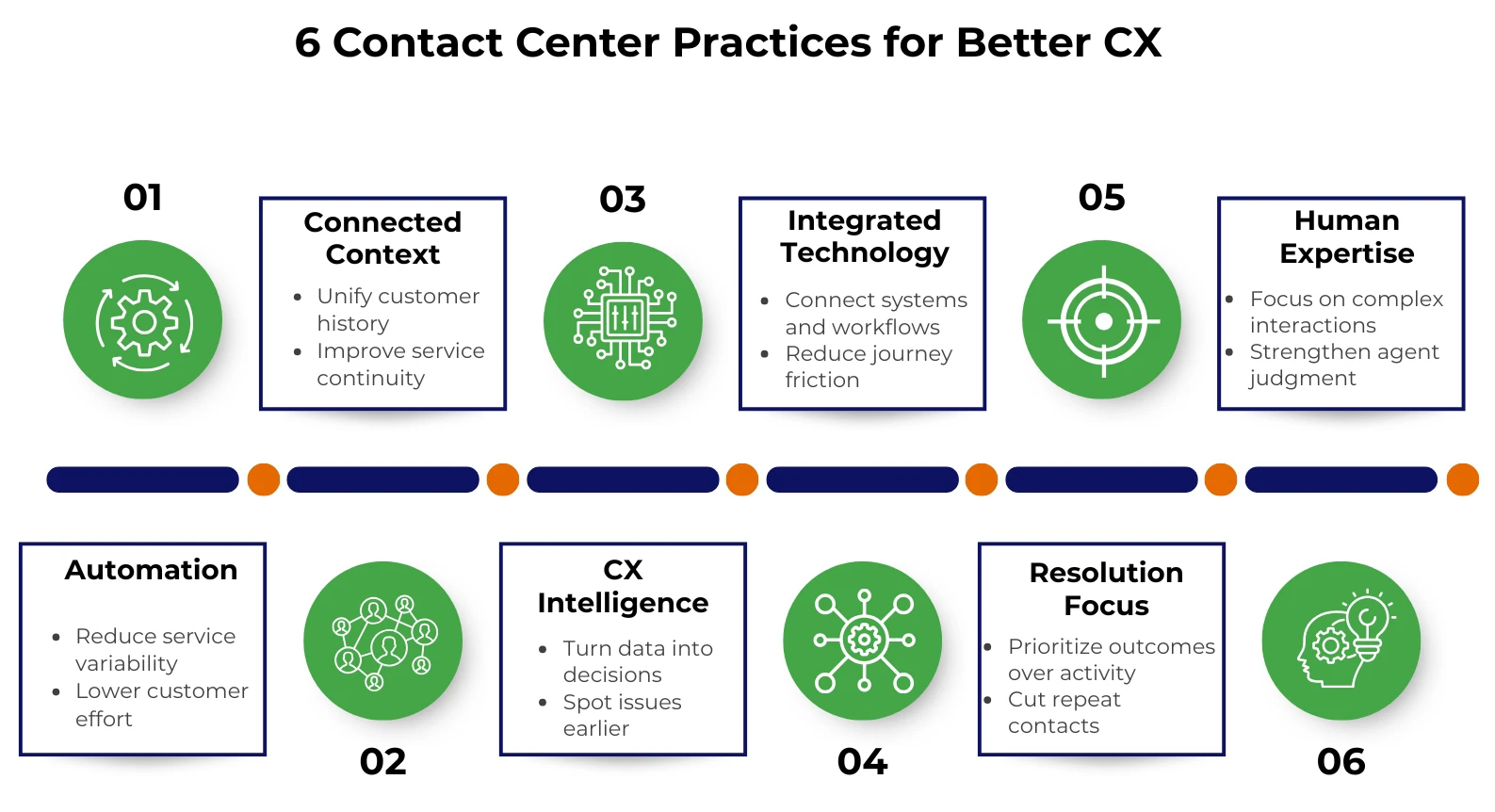
Better CX starts with reducing friction across every interaction.
1. Automation as a CX Performance Lever
Automation creates the most value when it makes repeatable service work more consistent. Routing, case creation, status updates, self-service, scheduling, and agent assistance should reduce unnecessary decisions and eliminate predictable failure points.
The executive question is not, “How much can we automate?” It is, “Where does variability create customer effort?”
CX impact:
- More predictable service performance at scale
- Lower friction across repeatable customer journeys
- Greater consistency across channels and volumes
2. Connected Customer Context Across Every Interaction
Omnichannel service is not the same as omnichannel continuity.
Customers experience the business as a single company, even when internal systems divide their journey among voice, chat, email, billing, technical support, and back-office teams.
A connected customer context layer gives every interaction access to relevant history, intent, status, and prior actions. That reduces the need for repeated explanations while improving decision quality across teams.
CX impact:
- Fewer repeated explanations and redundant steps
- Greater continuity across channels and teams
- More context-driven service decisions
3. Decision-Grade CX Intelligence From Contact Center Data
Contact centers generate enormous amounts of behavioral data, but reporting alone does not create insight.
CX analytics should influence resource allocation, workflow design, or intervention priorities. If a dashboard does not change one of those decisions, it is reporting infrastructure, not decision intelligence.
CX impact:
- Earlier visibility into systemic CX issues
- More precise prioritization of improvement efforts
- Stronger decisions based on behavioral and operational evidence
4. Modernize the Contact Center Around Integrated Technology
A modern contact center is not defined by having a cloud platform. It is defined by whether systems, workflows, data, and people can operate as one environment.
Technology fragmentation creates hidden customer effort through duplicate work, stale information, unnecessary transfers, delayed follow-up, and inconsistent decisions.
CX impact:
- Fewer breaks across the customer journey
- More scalable service performance
- Stronger consistency across channels and systems
5. Engineer Service Processes Around Resolution, Not Activity
Many contact centers still optimize what is easiest to count: calls handled, tickets closed, utilization, or handle time.
Those metrics matter, but they can reward motion without improving the customer outcome.
Resolution-centered operations ask different questions:
Did the issue stay resolved? Was the handoff necessary? Did the customer contact us again? Did the process finish correctly downstream?
CX impact:
- Fewer avoidable handoffs and repeat contacts
- Faster progression from issue to resolution
- Better alignment between operational metrics and customer outcomes
6. Human Expertise as a Strategic Layer in Tech-Enabled CX
As AI and automation absorb more predictable work, human expertise becomes more valuable.
The agent’s role increasingly concentrates around exceptions, ambiguity, retention, de-escalation, complex troubleshooting, and high-value interactions.
That requires a different workforce strategy. Technology should reduce low-value cognitive load while providing agents with better context, decision support, and authority where judgment matters.
CX impact:
- Stronger outcomes in complex customer situations
- More effective handling of exceptions and escalations
- Higher value from every human-assisted interaction
The Premier NX View: CX Is an Operating-System Problem
Customer satisfaction is rarely transformed by a single platform, script, staffing change, or AI deployment.
It improves when technology, analytics, process discipline, quality management, and human expertise are connected around the customer outcome.
Premier NX helps mid-market organizations move beyond traditional contact center delivery by combining technology, analytics, automation, process optimization, and human expertise to build CX operations that are more adaptive, scalable, and insight-driven.
Ready to identify where your contact center operating model may be limiting customer satisfaction?