

Key Takeaways
- 1IT outsourcing improves execution, not broken operating models.
- 2A strong IT operating model defines ownership, governance, and business outcomes.
- 3Success should be measured by business impact—not just operational metrics.
- 4Continuous improvement keeps IT outsourcing aligned with evolving business needs.
Most IT outsourcing initiatives fail because organizations outsource execution before they define ownership, governance, workflows, and business outcomes.
An outsourcing provider can improve service delivery, but without a clear operating model, faster execution rarely translates into better business results.
For mid-market organizations, IT outsourcing is often viewed as a way to expand support capacity, access technical expertise, reduce infrastructure strain, or accelerate digital initiatives. But IT outsourcing does not fix unclear workflows, fragmented system ownership, weak governance, or inconsistent service expectations. In many cases, it exposes them.
That is why the success of an IT outsourcing initiative is often determined long before a provider is selected. It begins with an operating model that defines how technology works, who owns outcomes, and how performance is measured.
Why IT Outsourcing Doesn’t Always Improve IT Performance
IT outsourcing can add capacity, but it cannot fix unclear accountability, fragmented workflows, weak governance, or technology priorities that are disconnected from business goals.
When IT teams struggle, the warning signs are usually clear: backlogs grow, projects slow down, ticket volume rises, teams feel stretched, and leaders lose visibility.
The common response is to add resources through IT outsourcing.
But capacity is not always the constraint. More people cannot fix unclear accountability, fragmented workflows, weak governance, or technology priorities that are disconnected from business goals.
Many organizations think they have a staffing problem when they actually have an operating model problem.
What Is an IT Operating Model in Outsourcing?
An IT operating model is the framework that defines how technology drives business value.
In IT outsourcing, it answers five critical questions:
- Who owns decisions?
- What stays internal?
- What should be outsourced?
- How is performance measured?
- How do IT outcomes support business goals?
Without these answers, organizations often improve operational metrics while business performance remains unchanged.
Tickets close faster, systems stay online, and support requests move efficiently, yet leadership sees little impact on productivity, customer experience, innovation, or cost efficiency.
An effective operating model closes that gap. It gives leaders visibility into whether IT outsourcing is simply maintaining operations or creating measurable business progress.
How mature is your IT operating model?
Before moving forward with an outsourcing initiative, evaluate your organization’s readiness with our free IT Outsourcing Operating Model Quick Assessment.
What High-Performing IT Outsourcing Models Get Right
High-performing IT outsourcing models succeed because they establish clear governance, retain strategic ownership, mature operational processes, and measure success by business outcomes rather than activity.
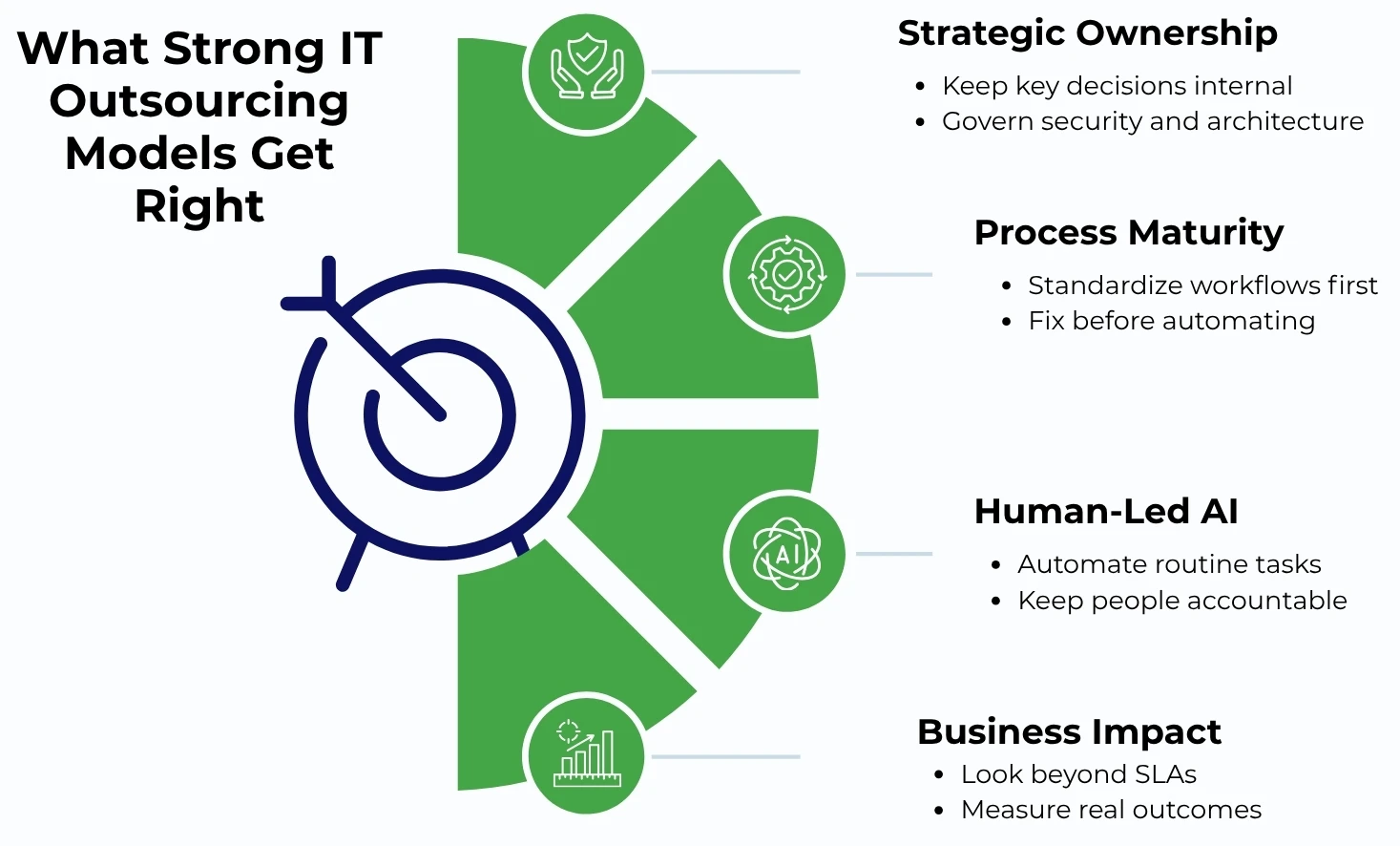
Four practices that drive successful IT outsourcing
Technology Ownership Does Not Get Outsourced
External teams can manage daily operations. They should not make business-critical decisions.
Security exceptions, access decisions, change approvals, architecture priorities, and business-critical escalations need clear internal ownership. Without that, IT outsourcing becomes task execution without strategic control.
AI and Automation Follow Process Maturity
Human-in-the-Loop AI is an operating model where automation handles routine tasks while people maintain oversight, judgment, and accountability.
Many organizations attempt to deploy AI before defining processes. That creates new problems rather than solving existing ones.
Successful AI adoption requires:
- Defined workflows
- Clear exception handling
- Escalation rules
- Ownership accountability
- Performance measurement
AI amplifies operational maturity. It does not replace it.
Measure Business Outcomes, Not Just SLAs
Service Level Agreements (SLAs) are important, but they are not the destination.
High-performing organizations connect IT support to outcomes leaders actually care about: reduced downtime, faster onboarding, fewer repeat incidents, stronger security discipline, smoother digital initiatives, and better productivity across teams.
How Do You Turn an IT Operating Model Into Operating Discipline?
A strong IT operating model becomes an operating discipline when it is reviewed, measured, and improved continuously as systems, workflows, risks, and AI capabilities evolve.
At Premier NX, that rhythm is shaped through Premier PRIME:
- Plan: Align technology initiatives with business objectives.
- Recommend: Identify right-fit platforms, automation opportunities, and support models.
- Implement: Deploy solutions securely with clear ownership and adoption plans.
- Manage: Provide ongoing operational support, governance, and visibility.
- Enhance: Continuously optimize processes, integrations, and performance.
PRIME helps ensure IT outsourcing is not treated as a one-time handoff, but as a structured operating model that can adapt, scale, and keep technology aligned with business outcomes.
Build the Model Before You Scale the Work
IT outsourcing does not fail because external teams lack capability. It fails when organizations attempt to scale execution before defining how technology creates business value.
For mid-market organizations, the opportunity is not just to outsource IT work. It is to create a structured model where technology ownership is clear, AI supports the right workflows, human judgment remains in the loop, and IT performance is measured by business impact.
That is the difference between outsourcing as coverage and outsourcing as an operational advantage.
Ready to assess whether your IT outsourcing model is built to scale?