


The CPG industry in 2026 is being shaped by AI adoption, omnichannel complexity, rising operational costs, and shifting consumer expectations. Brands that focus on operational agility, customer experience, and data-driven execution will outperform competitors.
Traditional growth models built on scale, shelf space, and brand familiarity are weakening as buyers demand better value, faster access, personalization, and convenience across every channel.
For modern CPG brands, growth now depends on more than product availability. It requires sharper forecasting, cleaner data, stronger inventory visibility, efficient retail execution, and faster operational decisions.
Brands that connect consumer insight with agile execution will be better positioned to protect margins, improve resilience, and capture new growth opportunities.
This blog explores the key trends, challenges, and opportunities defining the next phase of the consumer packaged goods industry.
What are the Key Trends Shaping the CPG Industry in 2026?
The key trends shaping the CPG industry in 2026 include AI-driven operations, omnichannel commerce, changing consumer expectations, tighter margins, supply chain visibility, and faster digital execution.
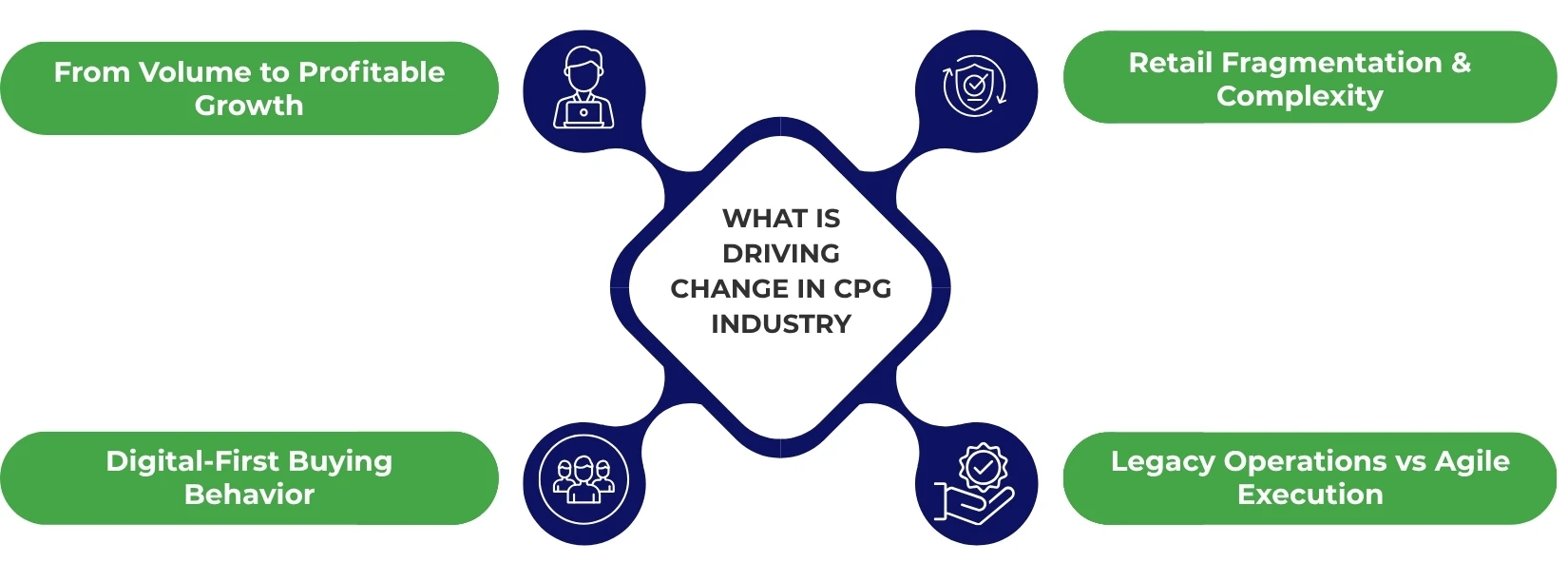
Growth Is Moving From Volume to Efficiency
CPG brands can no longer depend only on mass distribution, broad promotions, and high sales volume. Rising costs have made profitable growth more important than top-line growth.
Digital-First Consumers Are Raising Execution Pressure
Consumers now discover, compare, and buy across stores, marketplaces, social platforms, and direct channels. Brands must manage pricing, content, inventory, and service consistency across every touchpoint.
Retail Fragmentation Is Making Operations Harder
Every retail channel has different data, demand signals, performance metrics, and fulfillment expectations. This makes forecasting, inventory planning, and campaign execution more complex.
Legacy Models Are Slowing Decisions
Traditional CPG operating models were built for predictable demand and long planning cycles. Modern brands need faster decisions, cleaner data, and more agile execution to stay competitive.
Why Is Consumer Loyalty Declining in the CPG Industry?
Consumer loyalty is declining in the CPG industry because customers now evaluate brands through value, convenience, availability, trust, personalization, delivery experience, and service quality across every purchase channel.
- Value now includes service quality: Consumers are not only comparing price. They are also evaluating availability, delivery reliability, return convenience, and issue resolution.
- Brand switching is easier across digital channels: Marketplaces, retail apps, and social platforms give shoppers more alternatives, making poor service or delayed fulfillment more costly.
- Customer expectations are becoming channel-agnostic: Shoppers expect the same product information, support quality, and response speed whether they buy through retail, ecommerce, or DTC channels.
- Personalization depends on clean customer data: Relevant offers, retention campaigns, and product recommendations require accurate data, organized customer records, and consistent engagement workflows.
- Social proof is influencing purchase decisions faster: Reviews, ratings, creator content, and peer recommendations can quickly increase demand, requiring responsive support and operational coordination.
- Convenience is now a loyalty driver: Fast responses, easy replenishment, clear order updates, and reliable customer care help turn one-time buyers into repeat customers.
How is AI Transforming the Consumer Packaged Goods (CPG) Industry?
AI is transforming the CPG industry by helping brands forecast demand, track inventory, personalize customer engagement, optimize pricing, and automate workflows. It turns disconnected operational data into faster, more accurate decisions across channels.
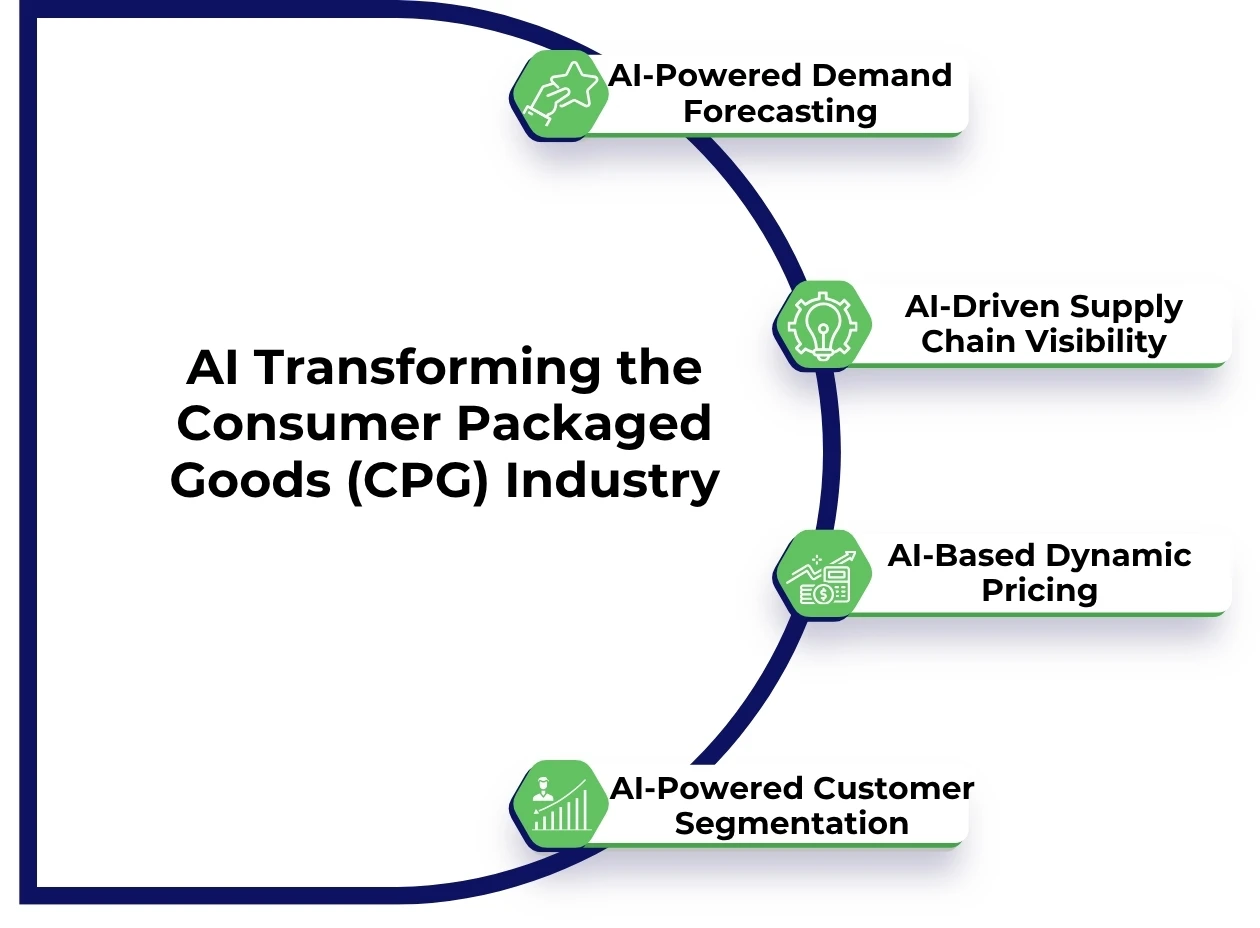
AI-Powered Demand Forecasting in CPG
AI helps brands analyze purchasing behavior, promotions, seasonality, retailer activity, and external demand signals to improve forecasting accuracy. This reduces stockouts, excess inventory, and slower planning cycles.
AI-Driven Supply Chain Visibility and Inventory Management
Modern AI systems improve visibility across warehouses, suppliers, fulfillment centers, and retail channels. Brands can identify disruptions, inventory gaps, and replenishment risks faster and respond with greater operational agility.
AI-Based Dynamic Pricing for CPG Brands
AI-powered pricing models help brands respond faster to competitor pricing, regional demand shifts, promotional performance, and margin pressure without relying on static pricing strategies.
AI-Powered Customer Segmentation and Personalization
AI enables automated customer segmentation based on purchasing behavior, preferences, engagement history, and buying patterns. This improves targeting precision, retention, and conversion efficiency.
Why is Omnichannel Commerce Reshaping CPG Growth Strategies?
Omnichannel commerce is increasing pressure on CPG brands to improve inventory visibility, fulfillment coordination, and customer experience across channels.
- Direct-to-consumer (DTC) growth is increasing operational demands: Brands now manage customer support, fulfillment visibility, returns, and retention directly instead of relying only on retailers.
- E-commerce expansion is creating execution complexity: Managing marketplaces, retailer platforms, and brand-owned channels requires faster reporting, pricing updates, inventory tracking, and order coordination.
- Social commerce is accelerating buying decisions: Consumers increasingly purchase products through creator content, live shopping, and social recommendations, forcing brands to respond faster to demand spikes and engagement trends.
- Inventory synchronization is becoming critical: Inaccurate inventory visibility across stores, warehouses, ecommerce platforms, and fulfillment partners increases stockout risks, delayed orders, and customer dissatisfaction.
- Digital shelf performance now affects revenue visibility: Product availability, reviews, images, search rankings, and fulfillment speed directly influence conversion rates across digital retail environments.
- Channel fragmentation is increasing operational pressure: Each sales channel operates with different customer expectations, reporting requirements, fulfillment models, and service standards, making coordination more difficult at scale.
What are the Biggest Challenges Facing the CPG Industry Today?
The biggest challenges facing CPG brands include rising operational costs, fragmented data systems, inventory visibility issues, and increasing customer experience expectations across multiple channels.
Rising Operational Costs and Margin Pressure
Higher transportation, labor, packaging, and fulfillment costs are reducing profitability. Many brands are being forced to improve operational efficiency while maintaining service quality and delivery speed.
Inventory Visibility and Supply Chain Coordination
Managing inventory across retailers, warehouses, ecommerce channels, and fulfillment partners has become more complex. Limited visibility creates stock imbalances, delayed fulfillment, and forecasting inefficiencies.
Omnichannel Execution and Customer Experience Pressure
Consumers expect consistent service, product availability, faster responses, and seamless experiences across every buying channel. Supporting these expectations requires stronger operational coordination and scalable customer support.
Fragmented Data and Slower Decision-Making
Disconnected reporting systems, retailer data, and operational workflows make it harder for CPG brands to respond quickly to demand changes, inventory issues, and customer behavior trends.
Why are Supply Chain Visibility and Inventory Optimization Critical for CPG Brands?
Supply chain visibility and inventory optimization help CPG brands reduce stockouts, control fulfillment costs, and respond faster to demand shifts.
For CPG brands, supply chain performance directly affects product availability, customer satisfaction, and margin protection. When inventory data is delayed or fragmented, teams struggle to identify where stock is sitting, which orders are at risk, and which channels need replenishment.
As sales expand across retailers, marketplaces, ecommerce channels, and fulfillment partners, inventory management becomes harder to control manually. Brands need accurate reporting, clean data, and coordinated back-office workflows to keep products moving without overstocking, understocking, or delaying customer orders.
What Growth Opportunities Exist for Modern CPG Brands?
Modern CPG brands can unlock growth by strengthening ecommerce execution, improving customer retention, coordinating inventory and fulfillment. They can use analytics for faster decisions, and scaling support operations through automation and flexible workforce models.
- E-commerce and DTC support: Brands can grow faster by improving order coordination, customer support, returns handling, and product information accuracy across digital channels.
- Customer retention and engagement: Repeat purchases depend on fast responses, personalized communication, loyalty support, and consistent issue resolution after the sale.
- Inventory and fulfillment coordination: Better coordination across warehouses, retailers, ecommerce platforms, and fulfillment partners helps reduce delays, stockouts, and customer dissatisfaction.
- Analytics and reporting: Clean reporting helps brands track demand, campaign performance, service levels, fulfillment issues, and customer behavior with greater accuracy.
- AI-enabled workflow automation: Automating repetitive tasks like data entry, reporting, customer routing, and order updates improves speed, accuracy, and team productivity.
- Scalable back-office operations: Flexible support teams help CPG brands manage seasonal peaks, channel expansion, and growing transaction volumes without overextending internal resources.
How can CPG Brands Stay Competitive in a Rapidly Changing Market?
CPG brands can stay competitive by improving operational visibility, responding faster to customers, using data for better decisions, automating repetitive workflows, and scaling support across retail, ecommerce, and DTC channels.
- Improve operational visibility: Real-time reporting, inventory tracking, and performance monitoring help teams respond faster to demand and fulfillment changes.
- Strengthen customer experience across channels: Consistent support, faster response times, and seamless engagement improve retention and brand trust.
- Use data to support faster decisions: Better analytics and centralized reporting help brands identify trends, forecast demand, and reduce operational delays.
- Scale support operations efficiently: Flexible operational support models help brands manage seasonal demand, ecommerce growth, and expanding customer expectations without increasing internal complexity.
- Optimize back-office and fulfillment workflows: Streamlined processes improve order accuracy, coordination, and overall operational efficiency across retail and ecommerce channels.
- Adopt AI and automation strategically: Automating repetitive processes and improving data accuracy allows teams to focus on higher-value operational and customer-focused activities.
Frequently Asked Questions (FAQs)
Conclusion
The CPG industry is becoming more operationally complex as brands manage changing consumer expectations, omnichannel commerce, fulfillment pressure, and rising competition. Growth now requires stronger visibility, faster customer support, accurate reporting, scalable workflows, and better coordination across retail, ecommerce, and DTC channels.
Modern brands need a partner that can help simplify execution while improving efficiency, responsiveness, and customer experience.
Premier NX supports this shift with scalable business process solutions, data-driven insights, customer experience support, and operational expertise designed to help CPG brands adapt, compete, and grow.
Ready to strengthen your CPG operations? Contact Premier NX to explore how our tailored support solutions can help your brand scale with confidence.
About the Author

Lisa Murray is a Consumer Goods Industry Advocate at Premier NX, helping North American CPG brands strengthen support for consumers, retailers, internal teams, and day-to-day operations. Focus centers on building scalable onshore, offshore, and right-shore service models that improve trust, efficiency, insight, and growth across the business.