

Key Takeaways
- 1Volume spikes reveal whether a CX model is truly resilient or only stable during normal demand.
- 2Adding more agents helps, but resilience depends on visibility, consistency, and clear escalation.
- 3Automation can absorb volume, but protecting customer trust still requires clear escalation paths and human judgment during high-impact moments.
- 4Mid-market companies need a CX model designed to scale without losing control, consistency, or the human touch.
Customer experience models fail during volume spikes when teams cannot maintain visibility, consistency, escalation discipline, and human judgment under pressure.
For mid-market companies, the answer is not simply adding more agents; it is building a surge-ready CX operating model that can scale without sacrificing service quality, cost control, or customer trust.
A product recall, billing cycle, service disruption, or successful campaign can quickly overwhelm support queues. Leadership adds coverage, extends hours, and pushes harder.
Yet service quality still declines.
That is because a customer volume spike is not only a contact center event. It is an operating-model stress test.
When that model is not built for pressure, the result is inconsistent messaging, fragmented workflows, delayed escalations, reactive decisions, and customer trust declining when confidence matters most.
Why More Agents Alone Do Not Solve CX Volume Spikes
More coverage may help, but coverage alone does not create resilience.
Mid-market leaders need a CX operating model that can maintain consistency, control risk, and give leadership clear visibility into where customer pressure is building.
A resilient model includes:
- Multichannel customer care that stays consistent across touchpoints
- AI-enhanced knowledge access and agent-assist tools
- Defined escalation paths for high-risk or sensitive issues
- Human-in-the-loop support for moments requiring judgment
- Operational visibility that helps leaders act before quality declines
The goal is not more headcount. It is a usable, scalable CX capability.
What Breaks When Customer Volume Surges
When volume spikes, pressure rarely stays inside the contact center. It spreads across the operating model.
The most common breakdowns are:
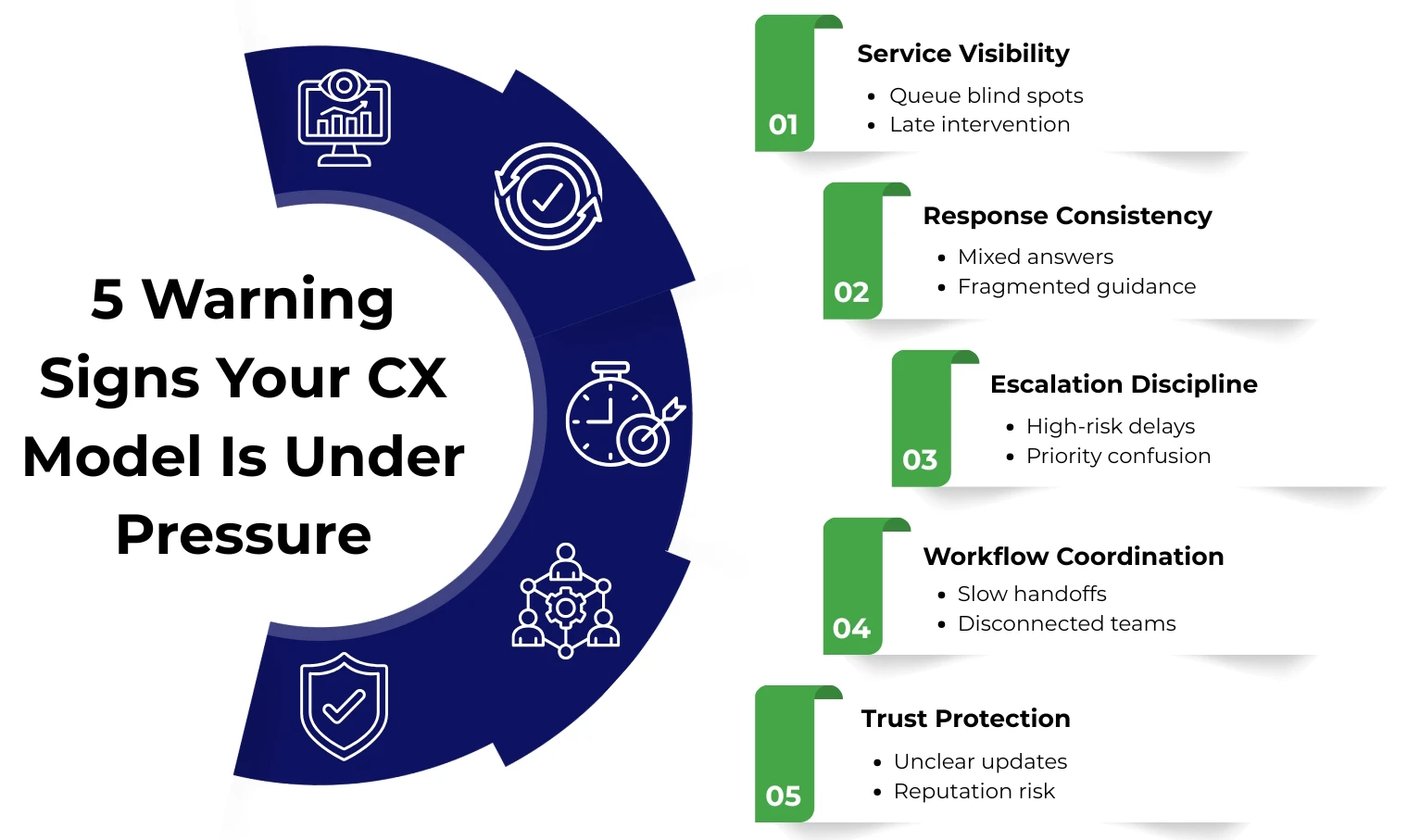
Service Visibility
Leaders cannot clearly see which issues are driving demand, where queues are forming, or which interactions require urgent intervention.
Response Consistency
Customers receive different answers across channels when teams rely on disconnected guidance, fragmented knowledge sources, or manual updates.
Escalation Discipline
High-risk and routine issues begin competing for the same attention, making it harder to prioritize sensitive, revenue-impacting, or compliance-related cases.
Workflow Coordination
Cases that require input from finance, fulfillment, operations, compliance, technology, or leadership slow down when handoffs are not designed for surge conditions.
Trust Protection
During product recalls, billing issues, or service disruptions, unclear communication can turn a service delay into a reputation risk.
A volume spike is not only an operational event. It is a trust event.
Download the CX Surge Risk Map
Use the CX Surge Risk Map to see where pressure may threaten visibility, consistency, escalation, workflow coordination, human touch, and flexible capacity.
The CX Surge Resilience Model
Surge-ready CX operations are not just better staffed. They are better connected. Premier NX frames surge-ready service around three pillars: operational clarity, experience consistency, and human-centered scale.
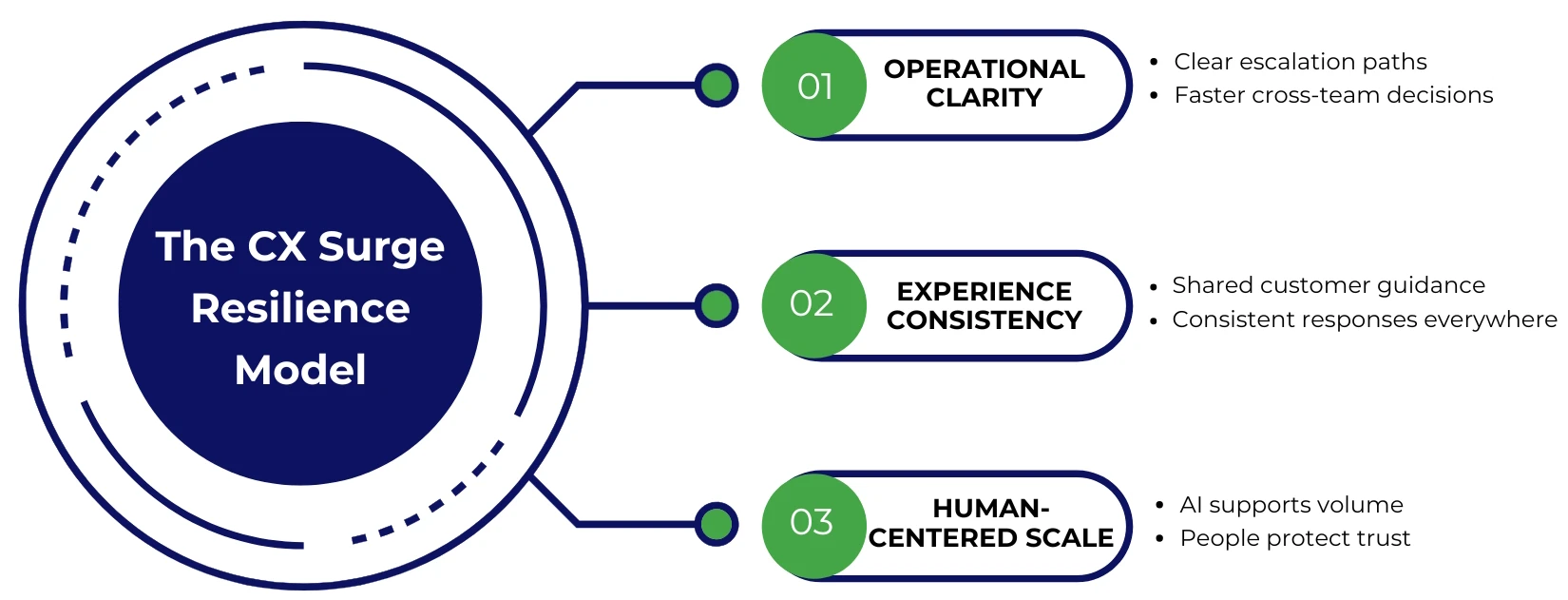
1. Operational Clarity
Operational clarity means every team knows what to prioritize, route, resolve, and escalate before demand rises.
A surge-ready CX model operates as a single connected business system. Customer support, fulfillment, finance, operations, technology, and leadership move from the same playbook.
That means:
- Escalation paths are clear before demand rises
- Teams know who owns each decision
- Updates move quickly across departments
- High-risk issues reach the right people before trust is affected
If pressure rises, does your organization move faster together or slower in pieces?
2. Experience Consistency
Experience consistency means customers receive clear, reliable responses regardless of channel, agent, queue, or location.
During a surge, inconsistency increases repeat contacts, handle time, customer frustration, and avoidable escalations.
Consistency requires:
- A shared knowledge base
- Clear response guidance
- Active QA standards
- Agent-assist tools that reduce guesswork
- Reporting that shows where variation is increasing
During a spike, visibility is not just a reporting function. It is a leadership capability.
3. Human-Centered Scale
Human-centered scale means using technology to absorb volume while keeping human judgment close to high-impact customer moments.
AI can route inquiries, surface knowledge, flag repeat issues, and move routine work faster. But when an interaction involves risk, emotion, retention, compliance, or brand trust, customers need more than automation.
The strongest model has clear handoff points:
- Routine requests move through guided workflows
- Sensitive issues escalate to trained specialists
- Agents work from consistent knowledge and context
- Leaders can identify which interactions require intervention
Technology handles pressure. People protect the relationship.
Capacity Should Flex Without Fracturing
Flexible capacity is not just the ability to add more people. It is the ability to add support without losing control.
In a surge-ready model, additional support plugs into the same workflows, knowledge base, QA standards, escalation paths, and service expectations already guiding the core team.
So when volume rises, the customer experience does not depend on who answers first. It depends on whether the operating model can maintain consistent answers, clean handoffs, and steady service levels across channels.
The Premier NX Perspective: CX Resilience Without Enterprise Complexity
Mid-market companies should not need enterprise-level overhead to protect service quality during demand spikes.
Premier NX supports CX resilience as a seamless extension of your business, not a replacement for it.
That means:
- Connected workflows that reduce delays and fragmented ownership
- AI-supported execution through knowledge access, agent assist, automation, and smarter routing
- Analytics and reporting that give leaders clearer visibility into volume, quality, and risk
- Human-in-the-loop support for escalations, retention moments, and sensitive interactions
- Flexible global delivery that helps teams scale without losing service continuity
CX resilience is now a business requirement: staying clear, coordinated, and human when pressure rises.
Assess Your CX Surge Readiness
If you want a clearer view of whether your CX operating model can handle volume spikes without sacrificing service quality or customer trust, book a complimentary CX operating model review with our team.
We’ll evaluate your workflows, escalation structure, visibility gaps, and support model, and then outline practical next steps to improve coordination, consistency, and scale.