


Outsourced technical support helps businesses scale support capacity and expertise as demand outgrows internal team capabilities.
As ticket volumes increase and customer expectations rise, internal teams struggle to maintain speed and consistency. Support starts impacting product teams, response times slow, and service quality becomes uneven.
Outsourced technical support introduces trained resources, structured processes, and scalable coverage across channels and time zones. It allows businesses to handle growth without building full in-house support operations.
Success, however, depends on clear scope, effective onboarding, and strong performance management. Without these, outsourcing can create gaps rather than solve them.
What are Outsourced Technical Support Services?
Outsourced technical support means a third party handles technical issues, user queries, and support operations on your behalf.
Instead of building an internal support function, businesses plug into an external team that already has the people, processes, and infrastructure in place.
This isn’t just “answering tickets.” It’s structured support delivery:
- First-line help desk
- Technical troubleshooting
- Escalation management
- Omnichannel support
- Customer interaction handling
The real shift? You move from reactive support to a managed, scalable support system.
What Services are usually Included?
Outsourced support typically covers the full support lifecycle, from basic queries to technical resolution.
Core services include:
- Help desk and service desk operations
- Phone, email, chat, and messaging support
- Product troubleshooting and issue resolution
- Account access and password resets
- Device, software, and network support
- Ticket triage and escalation routing
- Knowledge base and self-service support
Stronger providers go beyond handling tickets; they reduce ticket volume by improving workflows and documentation.
Who Uses Outsourced Technical Support?
Outsourced support is used by businesses that need to scale support faster than they can hire internally.
Common adopters:
- Startups building support without a heavy upfront cost
- SMBs managing growing ticket volumes
- SaaS companies supporting active user bases
- E-commerce brands handling high query spikes
- Companies needing 24/7 or multi-region coverage
How Outsourced Technical Support Works
Outsourced technical support runs on a structured model where external teams handle support delivery based on defined scope, workflows, and performance metrics.
It’s not ad-hoc, it’s engineered. A typical flow looks like:
- Scope is defined → what to support, channels, hours, ticket types
- Provider is trained → product, workflows, brand voice
- Support goes live → across agreed channels
- Tickets are routed → by tier, complexity, and urgency
- Performance is tracked → using SLAs and KPIs
The difference between success and failure? How well this system is designed and managed, not just who answers tickets.
Common Outsourcing Models
The outsourcing model you choose directly impacts cost, communication, and service quality.
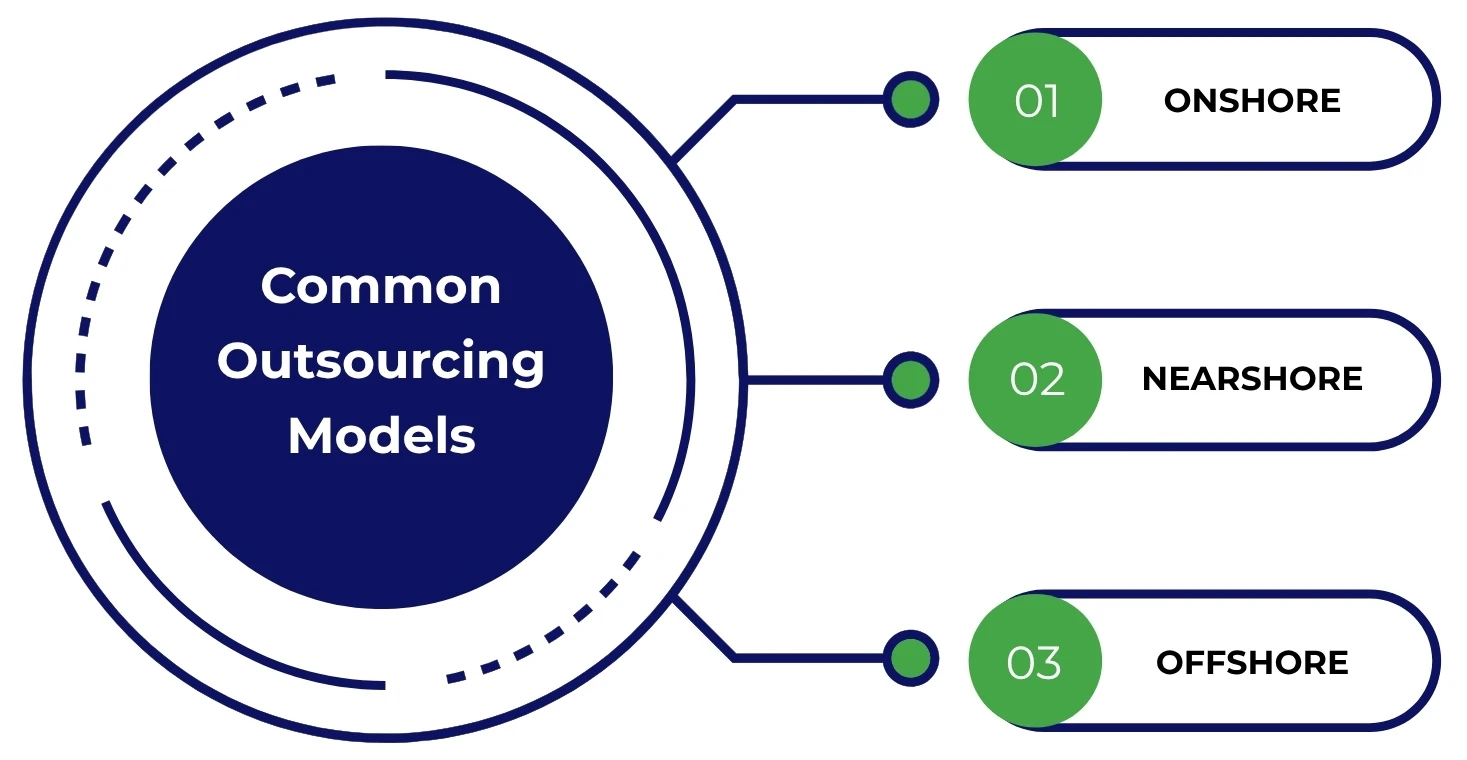
- Onshore
Same country support. Strong alignment, fewer communication gaps, but the highest cost. - Nearshore
Nearby regions or time zones. Balances cost with easier collaboration and overlap. - Offshore
Lowest cost potential. Works well at scale but requires strong training, QA, and process control to avoid quality gaps.
There’s no “best” model, only what fits your complexity, budget, and customer expectations.
Individual Agents vs. Full BPO Team
| Aspect | Individual Agents (Staff Augmentation) | Full BPO/Contact Center |
|---|---|---|
| Scope | Limited/Overflow support | End-to-end support operations |
| Management | Managed internally | Managed by the provider |
| Deployment Speed | Quick to onboard | Requires a structured setup |
| Scalability | Limited, depends on internal capacity | High, built for scale |
| Operational Support | Minimal (no QA, reporting layers) | Includes QA, reporting, workforce mgmt |
What are the Different Support Tiers in Outsourced Technical Support
Technical support is structured in tiers to efficiently route issues, reduce resolution time, and prevent unnecessary escalation.
A well-designed tier system ensures:
- Simple issues don’t clog technical teams
- Complex problems reach the right expertise faster
- Support scales without breaking workflows
Tier 0: Self-service
Self-service enables users to resolve common issues instantly without involving an agent.
Includes:
- Knowledge bases and FAQs
- Service catalogs
- Community forums
- AI chatbots
When done right, Tier 0:
- Reduces ticket volume significantly
- Improves response speed
- Frees up agents for higher-value issues
Tier 1: Basic help desk
Tier 1 handles high-volume, repeat issues and acts as the first point of contact.
Typical queries:
- Password resets
- Account access issues
- Basic setup and onboarding help
- Known issues with standard fixes
Its primary role is triage and quick resolution, not deep technical work.
Tier 2: Technical support
Tier 2 handles issues that require deeper investigation and technical expertise.
Examples:
- System outages or failures
- Software bugs or update issues
- Permissions and configuration problems
- Device or network troubleshooting
This is where structured troubleshooting and root-cause analysis begin.
Tier 3: Expert support
Tier 3 involves engineering-level expertise for complex or critical issues.
Handled by:
- Product engineers
- Infrastructure specialists
- Senior technical experts
Used for:
- Unresolved escalations
- System-level failures
- Edge-case technical issues
These are low-volume but high-impact tickets.
Tier 4 or external support
Tier 4 includes external vendors or specialized partners beyond your internal or outsourced teams.
Examples:
- Third-party software providers
- Hardware vendors
- Cloud or infrastructure partners
They act as the final escalation point when issues fall outside internal control.
What are the Benefits of Outsourced Technical Support Services?
Outsourced technical support improves cost efficiency, scalability, and service quality by shifting support operations to specialized teams.
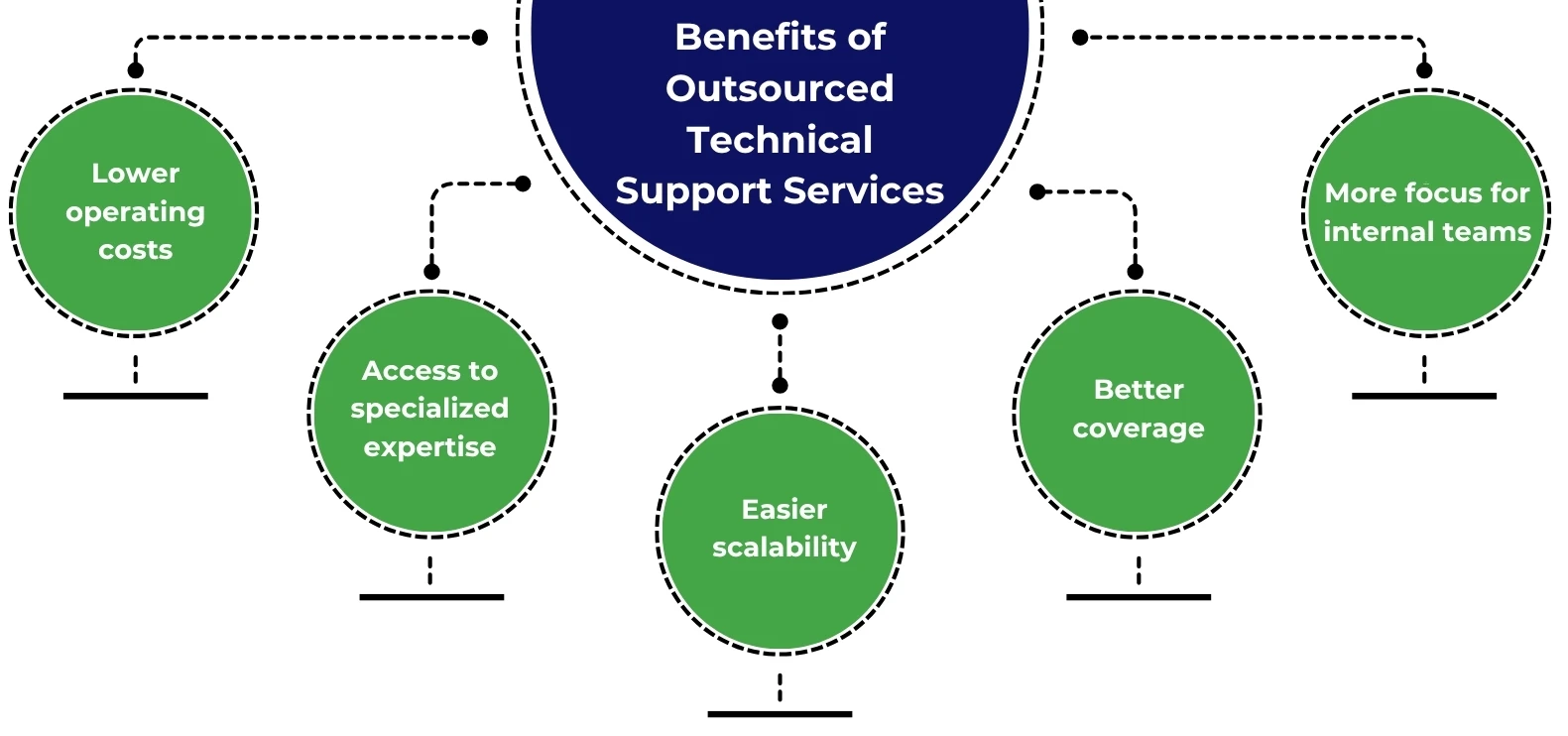
Lower operating costs
Outsourcing converts fixed support costs into variable costs by eliminating the need to hire, train, and maintain internal infrastructure.
Access to specialized expertise
Providers bring trained agents, proven workflows, and hands-on experience, reducing ramp time and improving resolution quality from the start.
Easier scalability
Support capacity can be adjusted quickly based on demand, allowing businesses to handle growth, launches, or spikes without delays.
Better coverage across channels and time zones
Outsourcing enables consistent support across multiple channels and regions, including 24/7 availability without overextending internal teams.
More focus for internal teams
Internal teams spend less time on repetitive support tasks and can focus on product development, operations, and strategic priorities.
What are Risks and Challenges to Consider while Outsourcing Technical Support Services?
Outsourced technical support introduces operational risks if not managed with clear processes, strong oversight, and continuous quality control.
Less day-to-day control
Outsourcing reduces direct visibility into daily operations, which can lead to an inconsistent customer experience if training, QA, and governance are not tightly managed.
Product learning curve
Even experienced providers require time to understand your product, workflows, and customer expectations, which can impact early-stage performance.
Security and compliance exposure
Handling customer data externally increases risk, especially in regulated industries, making ongoing monitoring and strict compliance controls essential.
Quality inconsistency or attrition
Without structured onboarding and continuous performance management, service quality can fluctuate, especially with agent turnover.
When Should a Business Outsource Technical Support?
A business should outsource technical support when demand exceeds internal capacity, impacting response time, quality, or scalability.
Outsourcing typically becomes necessary when support slows growth or diverts resources from core operations.
Key signs it’s time to outsource
- Ticket volume is growing faster than your team can handle, leading to delays and backlog
- You need after-hours or 24/7 support, but lack the internal bandwidth
- Your team is spending too much time on repetitive, low-value issues
- You want to support customers across multiple channels or languages
- You need to scale quickly without building and managing a full support team
At this stage, outsourcing is less about cost and more about maintaining service quality while scaling efficiently.
How to Choose the Right Outsourced Technical Support Provider
Choosing the right provider depends on how well their model aligns with your support needs, complexity, and long-term growth plans.
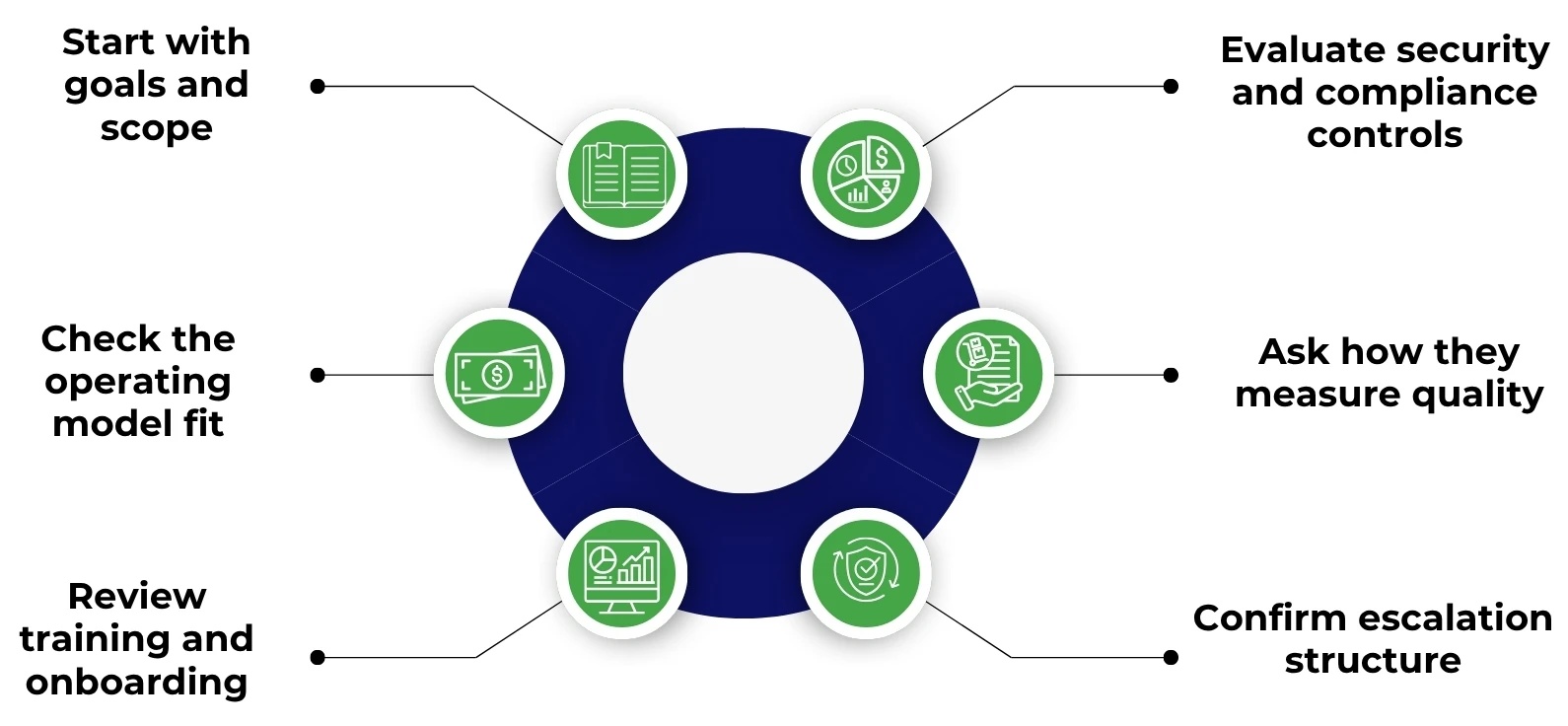
Start with goals and scope
Define exactly what you are outsourcing, including channels, hours, ticket types, and what remains in-house. Clarity here prevents misalignment later.
Check the operating model fit
Select the right structure based on your needs; onshore, nearshore, or offshore; individual agents or a full BPO; technical-only support or broader CX coverage.
Review training and onboarding
The provider should demonstrate a clear process for learning your product, workflows, escalation rules, and brand voice, with minimal ramp time.
Evaluate security and compliance controls
Look for structured governance, audit readiness, and clear accountability for handling sensitive data, especially if you operate in regulated environments.
Ask how they measure quality
Strong providers track performance through QA frameworks, CSAT, resolution time, SLA adherence, and analysis of recurring issues.
Confirm escalation structure
Ensure there is a defined process for handling Tier 1, Tier 2, Tier 3, and external escalations to resolve complex issues without delay.
Which KPIs Should You Track?
Tracking the right KPIs ensures outsourced support delivers speed, quality, and consistency aligned with business expectations.
Key KPIs to monitor:
- First response time – How quickly a customer gets an initial reply
- Average resolution time – How long it takes to fully resolve an issue
- SLA compliance – Whether agreed response and resolution targets are met
- First contact resolution – Percentage of issues solved in the first interaction
- CSAT (Customer Satisfaction) – Direct feedback on support experience
- Ticket backlog – Volume of unresolved or delayed tickets
- Escalation rate – How often issues move beyond initial support tiers
- Knowledge base effectiveness – How well self-service reduce ticket volume
- Security incident trends and audit findings – Indicators of risk and compliance gaps
What are the Pricing Factors for Outsourced Technical Support Services?
Outsourced technical support costs depend on scope, complexity, and service model rather than fixed pricing benchmarks.
Key factors that influence cost
- Support hours and 24/7 coverage – increases staffing and operational costs
- Ticket volume – higher volumes require more resources and impact pricing models
- Channels included – supporting phone, chat, email, and messaging adds complexity
- Technical complexity – advanced troubleshooting and higher-tier support cost more than basic help desk tasks
- Tier coverage – pricing varies depending on whether support includes Tier 1 only or extends to Tier 2 and Tier 3
- Language requirements – multilingual support requires specialized agents
- Geography and outsourcing model – onshore, nearshore, and offshore models have different cost structures
- Reporting, QA, and compliance requirements – deeper oversight, analytics, and governance increase operational effort
What are the best Practices for a Successful Outsourcing Technical Support Services Rollout?
A successful outsourcing rollout depends on structured onboarding, clear processes, and continuous performance management.
Key best practices
- Start with a pilot or limited queue – Test workflows and performance before scaling full operations
- Build a strong knowledge base first – Clear documentation reduces dependency on agents and speeds up onboarding
- Define SLAs and escalation paths early – Prevent delays and confusion in handling complex issues
- Treat outsourced agents like part of your team – Alignment improves consistency, ownership, and outcomes
- Review support data regularly – Identify gaps, trends, and areas for improvement
- Update documentation continuously – Keep support aligned with product and process changes
- Audit for risk and compliance on an ongoing basis – Ensure data security, quality standards, and regulatory alignment
What is the Difference between In-House and Outsourced Technical Support?
In-house offers control, outsourced provides scalability, and hybrid models combine both for balanced, growth-ready support.
| Aspect | In-House Support | Outsourced Support | Hybrid Model |
|---|---|---|---|
| Control | Full control over teams and processes | Limited direct control | Shared control |
| Cost Structure | High fixed costs (hiring, infrastructure) | Variable, optimized for scale | Balanced cost model |
| Scalability | Slow, requires hiring and training | Flexible | Flexible with internal stability |
| Expertise | Depends on internal hiring | Access to trained, specialized teams | Combines internal + external expertise |
| Coverage | Limited by internal capacity | 24/7, multi-channel, multi-region possible | Extended coverage with internal oversight |
Frequently Asked Questions (FAQs)
Outsourced technical support FAQs address common concerns around scope, cost, and performance expectations.
Conclusion
Outsourced technical support enables businesses to scale support operations efficiently while maintaining service quality and responsiveness.
As support demand grows, the challenge is no longer just handling tickets; it’s building a system that can manage complexity, volume, and customer expectations without slowing the business down.
Outsourcing, when done right, provides the structure, expertise, and flexibility needed to achieve this. The key is choosing the right model, defining clear processes, and consistently managing performance.
For growing businesses, it’s not just a cost decision; it’s a strategic move to sustain growth without compromising support quality.