


Key Takeaways
- 1Growth can create a visibility constraint before a production constraint.
- 2Spreadsheet dependence increases reconciliation and weakens confidence in operational data.
- 3Odoo connects production, inventory, procurement, sales, and finance in one operating environment.
- 4ERP value depends on clear processes, reliable data, and ownership—not software alone.
For many mid-market manufacturers, growth creates a visibility problem before it creates a production problem. As orders, suppliers, product lines, and schedules multiply, spreadsheets can still calculate the numbers, but they become harder to trust as the business’s operating view.
I see this point often in growing manufacturers. The factory may still have capacity, but the information needed to plan production, buy materials, commit to customers, and understand financial impact is spread across too many places.
Why Do Manufacturers Outgrow Spreadsheets?
Manufacturing decisions are tightly connected. Customer demand affects production. Production depends on materials. Materials depend on suppliers. Delivery commitments depend on all three.
When each function maintains its own spreadsheet, those connections become harder to see. Production may have one version of demand, procurement another, and finance a different set of assumptions.
The issue is not that spreadsheets stop working. Business-critical decisions simply start relying more on manual reconciliation.
IBM’s ERP guidance makes the broader point: ERP connects core business processes and data across functions. For manufacturers, that is where visibility starts to improve.
What Does Spreadsheet Dependence Cost?
Schedules may rely on outdated inventory data. Material shortages surface late. Companies hold excess stock as protection against uncertainty. Managers spend time validating reports instead of acting on them.
Output can still grow while confidence in the information behind operational decisions declines.
That is usually a more important warning sign than the number of spreadsheets being used.
What Visibility Does a Growing Manufacturer Need?
A manufacturer needs a current view of what is in stock, what is being produced, what customers have been promised, what materials are arriving, and how operational activity affects financial results.
When those answers come from separate files, decisions slow.
Deloitte’s work on ERP-enabled operating models reinforces the same principle: technology creates more value when processes, data, and ownership align with how the business runs.
How Does Odoo Connect Manufacturing Operations?
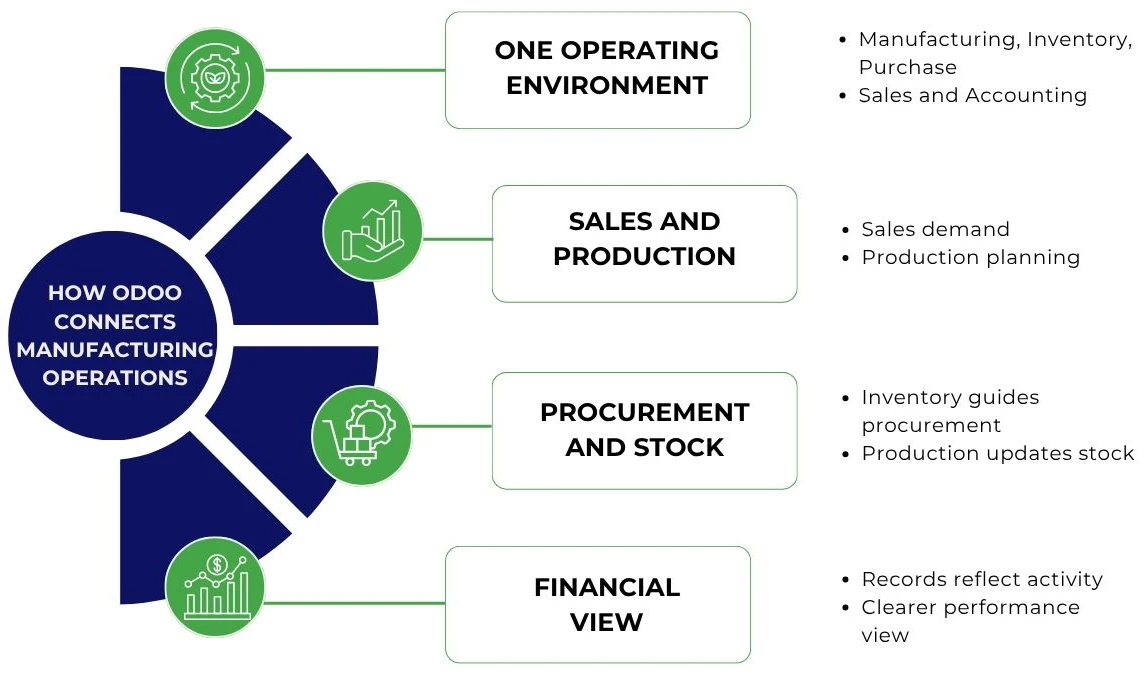
Odoo can connect Manufacturing, Inventory, Purchase, Sales, and Accounting within one operating environment.
Sales demand can inform production planning. Inventory can influence procurement. Production activity can update stock positions. Financial records can reflect operational activity without teams rebuilding the story manually.
Across this Odoo series, I have kept coming back to the same idea: finance, delivery, HR, integration, and now manufacturing create more value when the platform connects the work rather than digitising each function separately.
For manufacturers, that means a clearer view of demand, supply, production, and financial performance.
What Should Manufacturers Fix Before Moving to ERP?
ERP does not remove weak operating discipline.
Production processes need clear ownership. Inventory data must be reliable. Reporting standards need consistency. Teams need to agree on which system owns critical information.
If you ignore those basics, a new platform can digitise old confusion.
I would treat a move from spreadsheets to Odoo as more than a software replacement. It is a chance to decide how information should move through the business as complexity increases.
When Has a Manufacturer Outgrown Spreadsheets?
The clearest signal is the effort required to keep them trustworthy.
When teams spend more time reconciling versions and explaining differences than using the information to make decisions, the operating model needs a stronger foundation.
Odoo can provide that foundation by connecting production, inventory, procurement, sales, and finance around a shared operating view.
If your manufacturing team spends more time reconciling spreadsheets than acting on them, Premier NX can help identify where Odoo could reduce friction first and how to phase the transition around how your business actually runs.
About the Author

Sheraz Chaudhry is Head of Sales, Europe at Premier NX, a leading provider of technology-enabled outsourcing solutions. With a background that includes founding membership at The Resource Group and leadership roles at Nielsen, he brings deep expertise in revenue strategy, partnerships, and data-driven innovation to the leaders he works with today.