


Key Takeaways
- 1Evaluate CX outsourcing providers beyond cost, coverage, and headcount.
- 2Choose a CX partner that fits your service model and growth stage.
- 3Look for tailored delivery, human-led AI, and actionable CX insights.
- 4The right provider helps CX scale with consistency, visibility, and control.
Most customer service outsourcing fails, not because providers are bad, but because companies evaluate the wrong things. The proof? Missed SLAs, 40% more escalations, and a top agent walking out. You’re at $200M. Your service model thinks it’s $50M.
At a certain stage of growth, customer service outsourcing ceases to be a tactical decision and becomes a structural one.
For mid-market companies, typically between $100M and $1B in revenue, this shift happens quickly. Customer expectations rise, interaction volumes expand, and service delivery becomes harder to standardize across channels and teams. What once worked through effort and responsiveness begins to show strain.
Outsourcing is often introduced at this point, but the decision is frequently treated as a vendor selection exercise focused on coverage, cost, and deployment speed.
That framing is incomplete.
Because the real risk is not choosing the wrong provider, it is scaling a service model that was never designed to handle complexity in the first place.
Evaluating a customer service outsourcing provider, therefore, is not just about who can take on the work. It is about who can support and adapt to a service model that will continue to perform as the business grows in scale, variation, and operational demands.
Where Most Evaluation Processes Break Down
Despite this, evaluation rarely starts with the service model itself.
In the mid-market, decisions are often made at the point where complexity has already outpaced structure. Under that pressure, evaluation shifts toward what is easiest to compare: cost, headcount, and coverage.
Not because these define a strong partner, but because they are immediately visible.
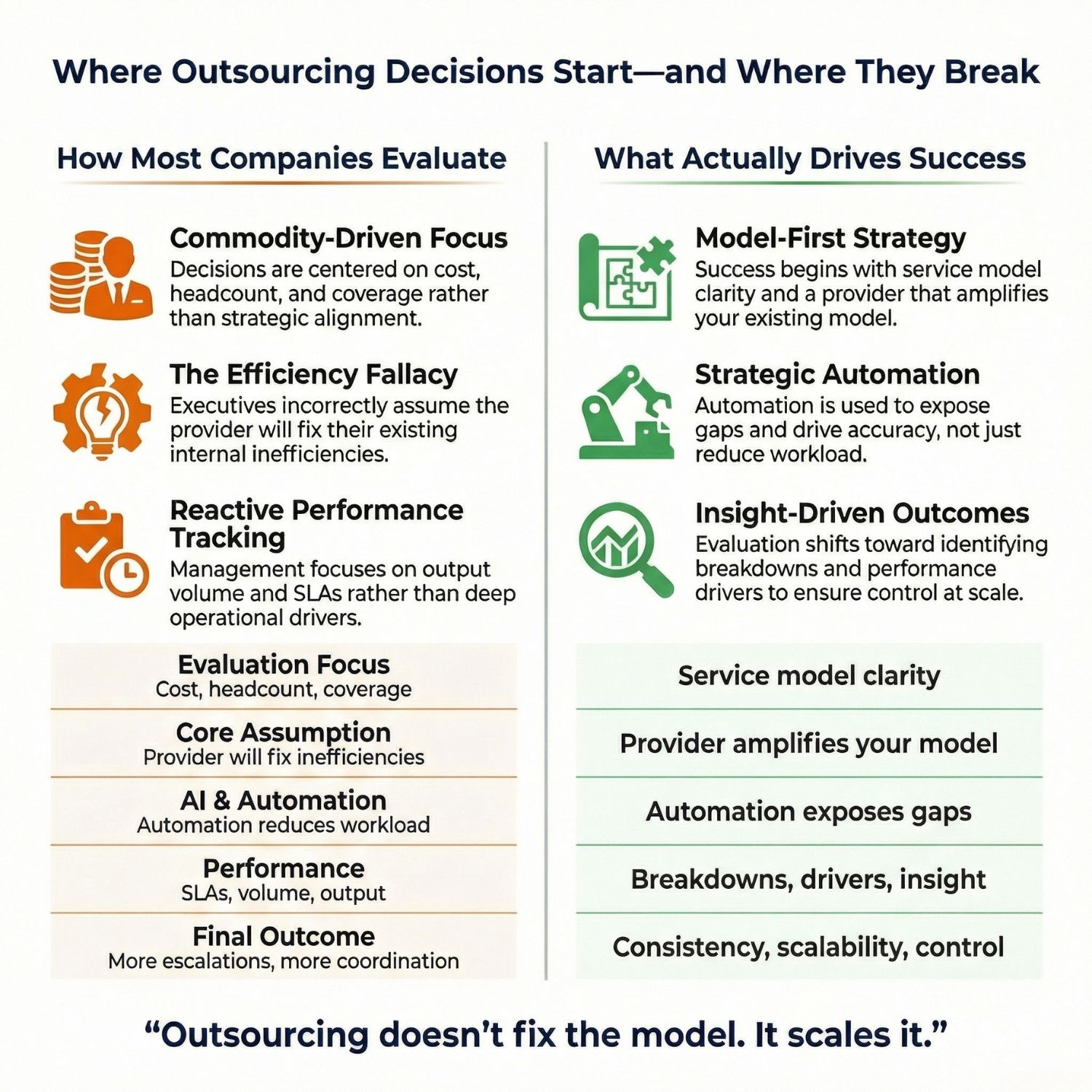
This is the “muddy middle.” The business has evolved, but the service model has not been clearly redefined. And when that clarity is missing, even the right provider is positioned to deliver the wrong outcome.
This Is Where Evaluation Goes Wrong
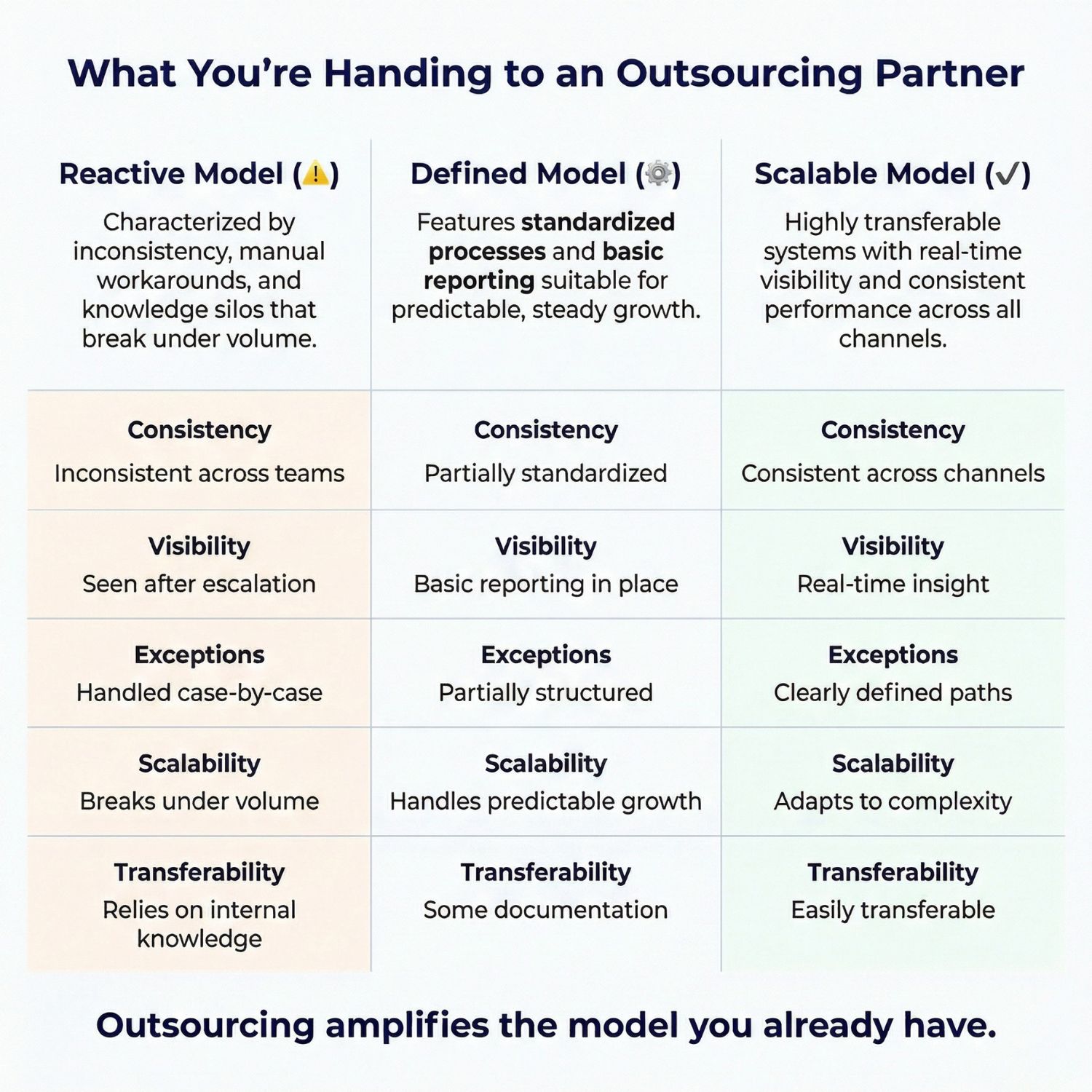
What are You Asking an Outsourcing Partner to Take On?
At this stage, the question is not just which provider to choose. It is whether what you’re handing off is clearly defined or already under strain.
A simple way to see where that shows up:
- Where does your service strain today; volume, variation, or visibility and what would a partner inherit?
- Are your outcomes consistent or would a provider be relying on individual judgment to maintain them?
- When something falls outside the norm, is it absorbed by the model or escalated to the provider to resolve?
- Would your current operation run predictably under a partner or require constant oversight from your team?
- If you outsourced this today, would it scale cleanly or expose the gaps you already feel internally?
4 Ways to Evaluate a Customer Service Outsourcing Provider
Choosing a customer service outsourcing provider is no longer a matter of comparing capabilities.
As many operators experience, the real challenge emerges later, when growth exposes gaps in consistency, visibility, and control.
In that context, evaluation becomes a question of alignment:
How well a partner fits the way your customer service function needs to operate as complexity increases.
1. Standardized Delivery—or Built Around Your Customer Experience?
Customer service outsourcing providers typically operate on predefined models, processes, scripts, and workflows built for scale. Few adapt to how your business actually serves customers.
Standardized models optimize for efficiency across clients
Tailored models reflect your customer journeys, edge cases, and service expectations.
Misalignment shows up quickly in escalations, exceptions, and cross-channel inconsistency.
2. AI Application, With Human Accountability
AI is widely deployed across customer service outsourcing. The difference lies in how it is developed and applied.
- Standard models rely on predefined automation
- Advanced models refine AI through an AI Innovation Lab, testing agent-assist, routing, and knowledge systems against real interactions
AI should reduce effort without breaking experience.
Human-in-the-loop remains essential:
- to handle exceptions
- to preserve context
- to ensure decisions reflect real customer scenarios
3. Analytics and Insight—Not Just Reporting
Reporting is standard in customer service outsourcing. Insight is not.
Activity metrics: volume, tickets, and SLAs show what happened. They do not explain why.
What matters is whether the model provides:
- visibility into recurring customer issues
- clarity on escalation drivers
- insight into where customer journeys are breaking
Without this, outsourcing manages workload but does not improve it.
4. Embedded Into Your Customer Service Operation—Or Managing It From Outside?
Customer service outsourcing can operate as an external layer or as part of your operation.
- External models handle interactions separately
- Embedded models work within your CRM, workflows, and customer journeys
When delivery sits outside, your team manages coordination. When it is embedded, that layer disappears.
This is what determines whether outsourcing reduces or increases complexity.
What the Right Partner Actually Enables
When customer service outsourcing is structured correctly, it shifts from execution to enablement.
- Consistency across channels, teams, and customer scenarios
- Measurability beyond volume, clear visibility into performance drivers
- Scalability without adding coordination overhead
At that point, leadership is no longer managing operations; it is improving outcomes.
Customer service stops being a cost center. It becomes a lever for retention, efficiency, and growth.
Evaluate for the Model You Need Next
Customer service outsourcing decisions fail when made under immediate pressure rather than based on long-term design.
The real work starts before evaluation.
- Where is your customer service model breaking under scale?
- What should be standardized and what should remain differentiated?
- What should your internal teams no longer have to manage?
Without that clarity, providers are compared on surface metrics, and the model stays the same.
The right partner aligns with a defined direction and helps operationalize it.
A structured evaluation approach like the one we bring to Premier NX helps you identify what your model needs to become next, so that when you choose a partner, the decision is clear.
What’s next is not more capacity.
It’s a customer service model built for the next stage of growth.