
Many mid-market businesses begin with a practical question: Can Odoo integrate finance, HR, and operations into one system?
At first, the focus is on implementation. Which modules should go live first? How should workflows be configured? What data needs to move? Who owns the rollout?
Then, go-live happens.
Finance is live. HR processes are embedded. Operations start flowing through the platform. Odoo is no longer a project. It becomes part of how the business runs.
That is when the more important question emerges.
It is no longer, “Does Odoo work?”
It becomes, “How do we operate well around it?”
That is where long-term value is created.
Odoo Success Does Not End at Go-Live
Gartner has noted that ERP value is not realised at go-live. It needs to evolve with the organisation, and the strongest outcomes come when ERP initiatives stay aligned to business goals.
That is especially true with Odoo. Once the system is embedded, workflows change, reporting logic is refined, data definitions settle, and access rules evolve. None of these shifts feels dramatic on its own, but together they shape how the business actually operates.
For growing businesses, this is often the point where the conversation changes. The question is no longer whether the software works. It is whether the business has enough structure around the platform to keep operations clear as complexity increases.
The Operating Layer Most Businesses Do Not Plan For
This is the operating layer.
It sits above the technology and determines how finance, HR, and operations work together in practice. Most mid-market businesses do not explicitly staff for this layer. The need emerges gradually, once the system becomes central to daily execution.
When friction appears, the response is often familiar: add another tool.
A reporting layer. A workflow app. A system to fill a gap.
But more tools do not always create more clarity. Everest Group has noted that businesses often fail to realise the full value of enterprise platforms when the right governance mechanisms are not in place. Without an operating framework, complexity is not removed. It is simply redistributed.
Why the Right Odoo Partner Matters
This is why the partner decision matters.
Everest Group has observed that organisations increasingly want partners who go beyond implementation and stay aligned to business outcomes. Odoo’s own partner model reflects the same idea, positioning partners as long-term collaborators who support the business beyond installation.
That matters because businesses do not stand still after go-live. Teams change. Priorities shift. Reporting needs become more demanding. The way the platform is used has to adapt to the organisation.
For mid-market businesses, the challenge is rarely just access to software. It is creating enough structure around the platform so that finance, HR, and operations can work from the same logic as the business grows.
How Premier NX Supports Odoo Beyond Implementation
Premier NX supports organisations throughout the full Odoo lifecycle through the Premier PRIME framework: Plan, Recommend, Implement, Manage, and Enhance. Rather than treating implementation as the finish line, this approach supports how the platform is introduced, run, and improved over time.
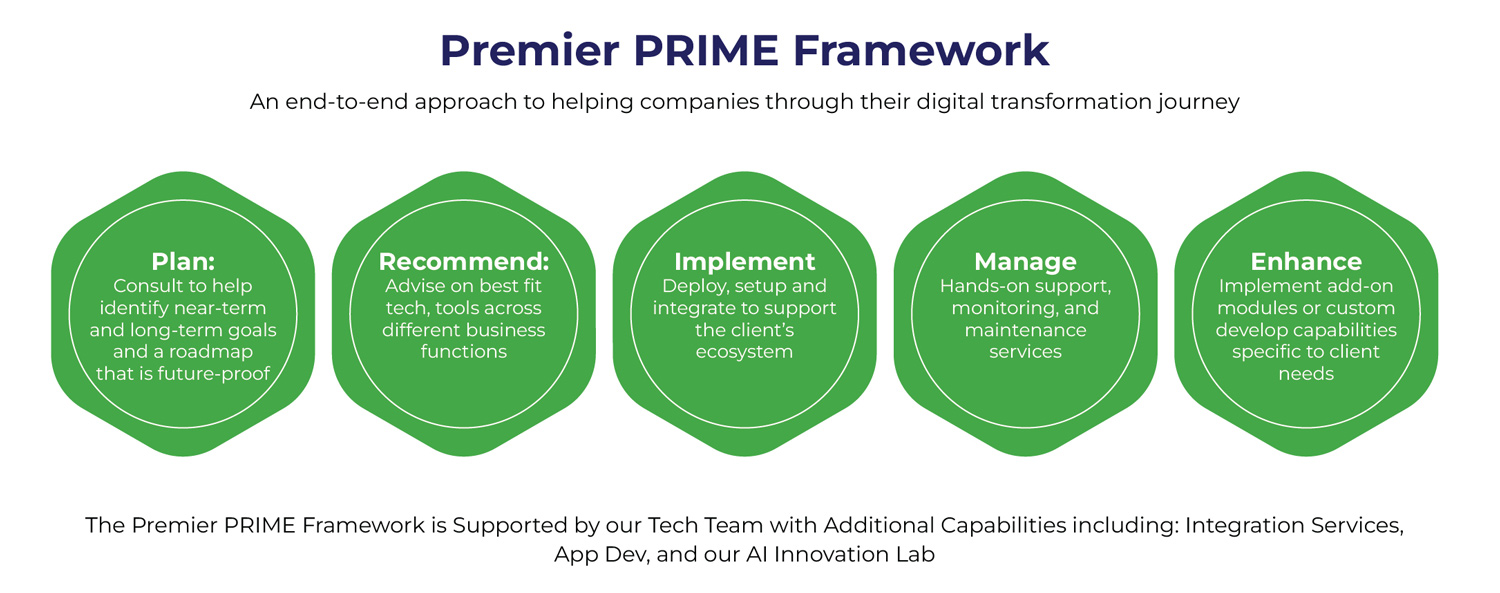
In practice, that means helping leadership teams define ownership across functions, align decisions inside the system, establish shared data logic, and manage change in a way that feels controlled rather than disruptive.
What Happens After Odoo Goes Live
Deloitte has similarly found that the right operating model and organisational structure are critical to capturing ERP benefits during and after implementation. Governance, in that context, is the infrastructure that enables daily operations to run smoothly and consistently.
That is what separates a system going live from a business running well.
Odoo provides the platform.
The harder question is who helps the business operate well on it.
Premier NX helps mid-market businesses implement, manage, and improve Odoo through a structured lifecycle approach designed for long-term operational value.
- Gartner – Enterprise Resource Planning insights
- Gartner – Hype Cycle for Operational Models
- Everest Group – Enterprise platform adoption and ecosystems research
- Odoo – Official Partner Programme
- Deloitte – Redesigning operating models to unlock ERP benefits
- Deloitte – Governance Framework
- McKinsey & Company – The ERP platform play
- McKinsey & Company – Nextgeneration operating model
- Boston Consulting Group – Platform operating model
About the Author

Sheraz Chaudhry
Head of Sales, Europe at Premier NXSheraz Chaudhry is Head of Sales, Europe at Premier NX, a leading provider of technology-enabled outsourcing solutions. With a background that includes founding membership at The Resource Group and leadership roles at Nielsen, he brings deep expertise in revenue strategy, partnerships, and data-driven innovation to the leaders he works with today.