

Most finance and accounting outsourcing doesn’t fail at onboarding; it fails to change how the finance function operates.
The proof is rarely visible on day one.
It shows up later:
- When close cycles don’t shorten
- When reporting still depends on manual intervention
- When finance leaders spend more time coordinating work than acting on it
For mid-market companies ($100M–$1B in revenue), outsourcing is often introduced to relieve pressure from growing transaction volumes, tighter reporting timelines, and increasing operational complexity.
But here’s the question most leadership teams don’t ask early enough:
Is the partner reducing workload or redesigning how finance actually works?
Because the difference isn’t in what gets delivered; it’s in how the finance function behaves once the work is live.
When do the signs that you’ve found the Right Finance & Accounting Partner become visible?
At the point of selection, most finance and accounting partners appear equally capable.
They can:
- Process transactions
- Support the close
- Generate reports
Transition plans are structured. SLAs are defined. Early delivery often meets expectations. But performance at the task level is not the same as transformation at the system level.
The real difference emerges once finance is operating under pressure:
- Does the close compress or still depend on the last-mile effort?
- Does reporting stabilize or require ongoing adjustments?
- Does leadership step away or stay involved in coordination?
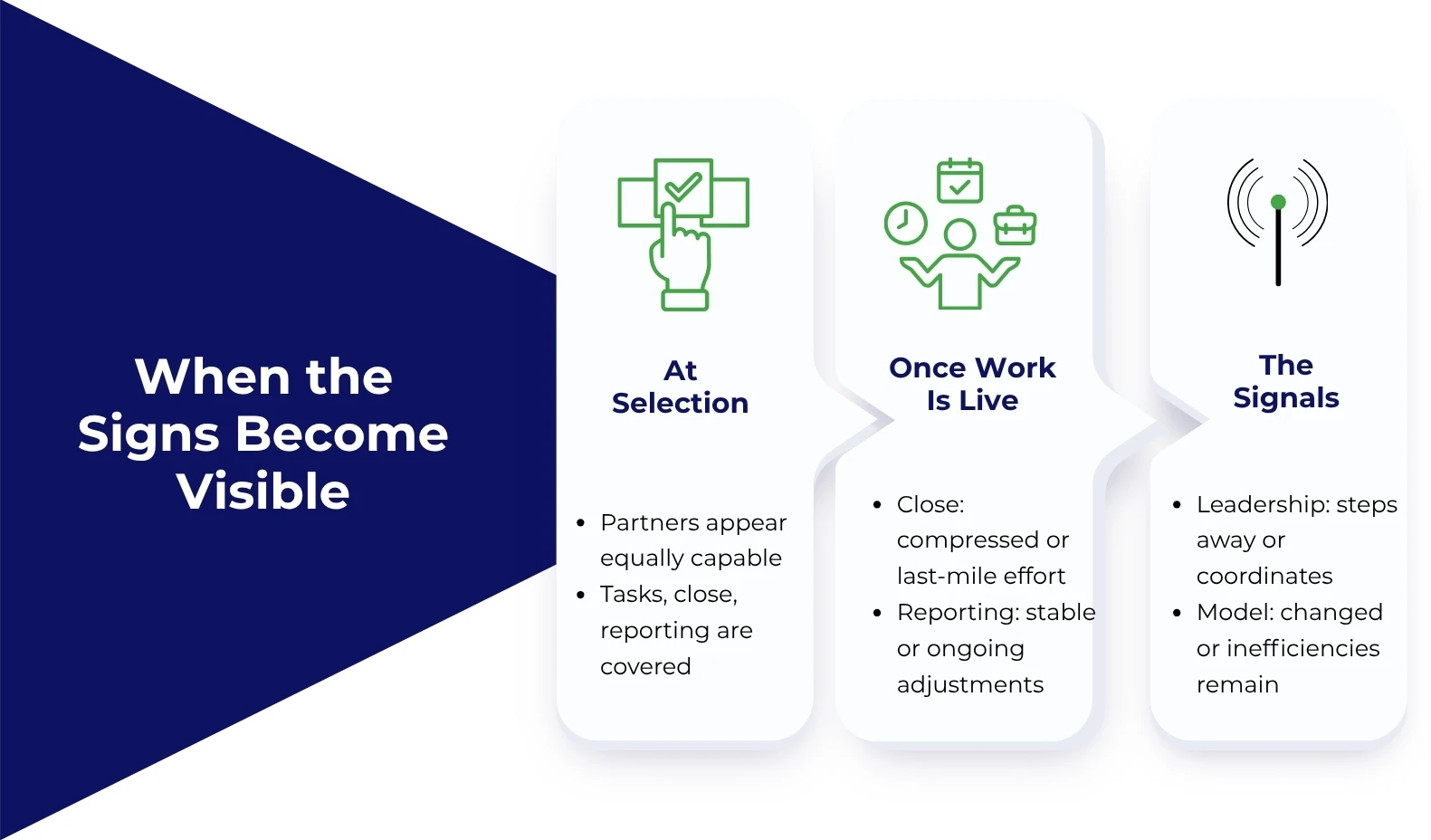
These are not execution gaps.
They indicate whether the operating model has changed or inefficiencies have simply been relocated.
And for mid-market finance teams, that distinction directly impacts decision speed, audit confidence, and scalability.
What Signals You’ve Found the Right Finance & Accounting Partner
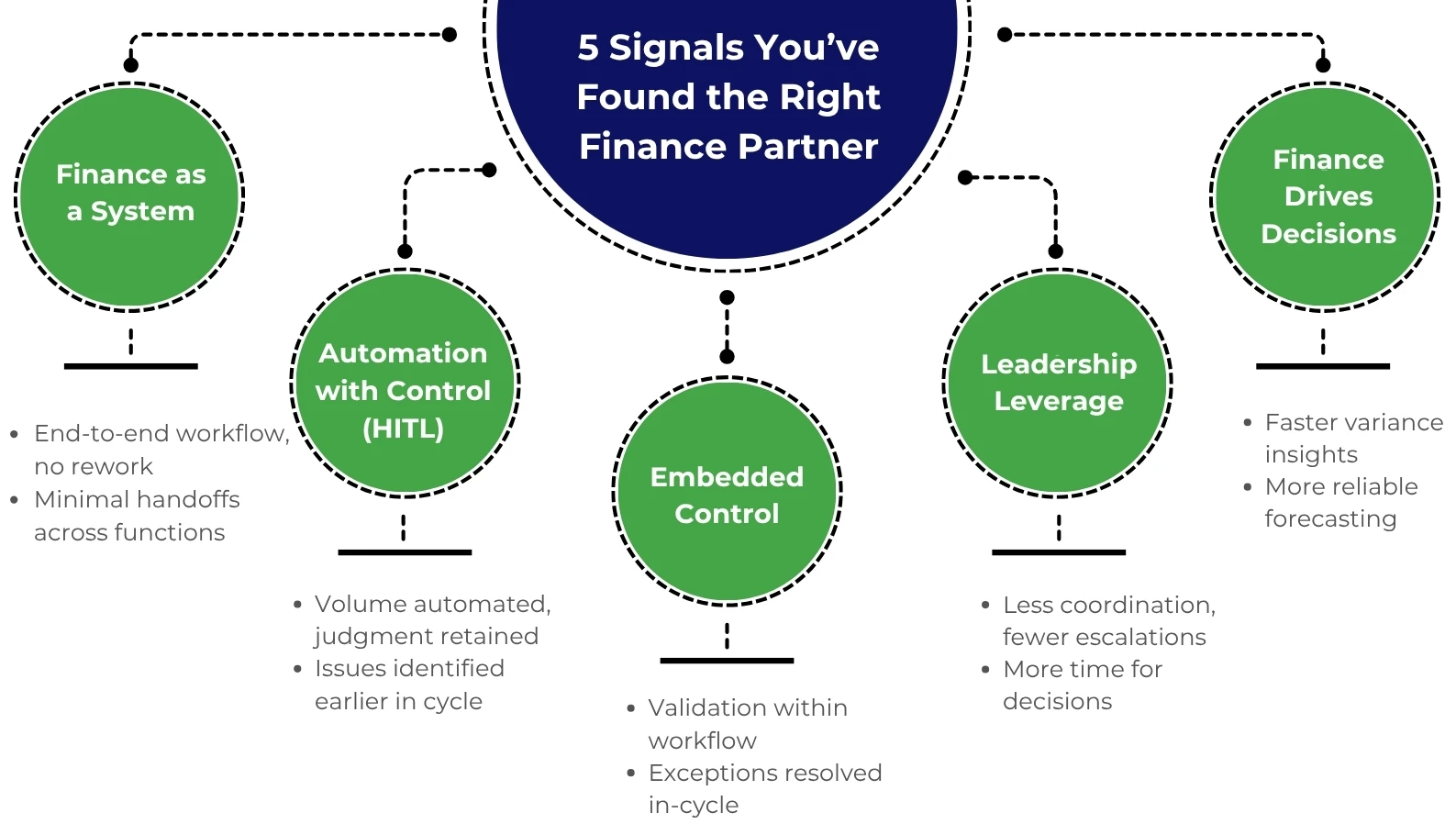
1. Finance Operates as a Single System—Not a Set of Functions
Weak model
AP, AR, reporting, and FP&A operate separately. Finance becomes a coordination layer.
Signal
Work flows end-to-end, from transaction processing through close to reporting and analysis without rework between stages.
What changes
- Fewer reconciliation gaps
- Minimal handoffs between teams
- Consistent output across the cycle
Why it matters
For leadership, this is not just operational efficiency; it’s reliability. When finance operates as a system, reporting becomes something you can act on rather than validate.
2. Automation Handles Volume—While Human Judgment Stays in Control (HITL)
In weaker models, automation is either overextended (creating blind spots) or underutilized (leaving processes manual and slow).
In the right model, there is a clear separation:
- High-volume, repeatable work is automated
- Exceptions, approvals, and compliance remain under experienced human oversight
What changes:
- Processing speeds up without loss of control
- Issues are identified earlier in the cycle
- Fewer corrections surface at close
Why it matters
Automation should accelerate finance, not obscure it. The question for leadership is not how much is automated, but:
Where does accountability sit when something goes wrong?
3. Control Is Embedded—Not Deferred to Audit
In weaker setups, control becomes visible only when something breaks—often during audit or reporting deadlines.
In stronger models, control is built into how work is executed daily.
Signal
- Validation happens within the workflow, not after it
- Exceptions are identified and resolved in-cycle
- Audit readiness becomes a byproduct, not a separate effort
What changes
- Reduced audit friction and fewer last-minute adjustments
- Greater confidence in reported numbers
- Lower risk exposure tied to reporting errors or delays
Why it matters
For CFOs and controllers, control is not just compliance; it’s risk management. When embedded correctly, it reduces both operational strain and financial exposure.
4. Leadership Time Shifts from Coordination to Decision-Making
One of the clearest indicators of the right partner is where leadership attention goes.
Weak model
Finance leaders remain involved in:
- Chasing updates
- Resolving discrepancies
- Aligning teams across functions
Signal
Leadership disengages from coordination and re-engages at the decision level.
What changes
- Fewer escalation points during close and reporting
- Greater confidence in the underlying data
- More time spent on planning, forecasting, and strategic decisions
Why it matters
For mid-market organizations, leadership bandwidth is a constraint. When finance operates efficiently, it doesn’t just save time—it reallocates it to higher-value decisions.
5. Finance Starts Informing Decisions—Not Just Reporting Them
At a certain point, the role of finance begins to shift.
Reporting alone is no longer enough. Leadership needs forward-looking clarity: what’s driving performance, where margins are moving, and what decisions need to be made next.
That’s where the difference shows up.
Instead of staying within execution, the function starts contributing to FP&A:
- Variance explanations are clearer and faster
- Forecasts become more reliable, not just updated
- Data begins to support decisions, not just document them
Finance moves closer to the business. Not just closing the books but helping interpret what they mean.
What a Modern Finance & Accounting Partner Actually Looks Like (The Premier NX Difference)
For mid-market organizations, the right partner is defined by how the finance function starts to operate with them in place. At Premier NX, we build partnerships around three core operational shifts:
- Built for the Mid-Market: Designed specifically for the complexity of mid-sized firms. We align with your broader business objectives, not just individual tasks, starting with focus and engineered to scale seamlessly as transaction volumes grow.
- An Integrated System, Not a Silo: Delivered as a complete, end-to-end finance system with structured control and data governance built directly into the workflow. We operate as a true extension of your team.
- Human-in-the-Loop by Design: We continuously evolve your function through tech-enabled efficiency, paired with rigorous human accountability. Success isn’t measured by SLAs alone; it is measured by actual financial outcomes and decision speed.
You Don’t See It in the Contract—You See It in the Function
The right finance and accounting partner doesn’t stand out in a proposal.
It doesn’t come from pricing models or capability decks. Those tend to look similar across providers.
The difference shows up once the work is live.
- How does the closing run?
- How does data move across the function?
- How much effort does it take to maintain control and get clarity?
Because the right partner doesn’t just support your model. They change how it works.
If your finance function is still spending more time coordinating work than acting on insights, it’s time to elevate your expectations. A true partnership with Premier NX isn’t about simply lifting and shifting your tasks; it’s about integrating a tech-enabled finance system designed specifically to scale with your mid-market growth.
Stop settling for task execution. Let’s build a finance function that drives the business.