


Key Takeaways
- 1Rising service pressure may reflect avoidable demand created by the operation rather than a genuine shortage of capacity.
- 2Broken handoffs, missing context, and inconsistent decisions can turn a single customer need into repeat contacts, rework, and escalation.
- 3That additional work consumes paid capacity and increases the total cost of achieving a resolved customer outcome.
- 4Leaders should diagnose the real constraint first, then apply process, technology, governance, or workforce where it will create the greatest value.
When customer demand rises and service performance deteriorates, adding capacity is an understandable response. Sometimes it is also the correct one. A healthy operation can simply outgrow the workforce available to support it.
The risk is treating every workload increase as proof of a staffing shortage. Repeat contacts, transfers, rework, delayed back-office actions, and inconsistent decisions can create demand the operation itself generates. In those conditions, new resources may reduce queue pressure while leaving the causes of customer effort, resolution delay, and cost-to-serve intact.
For senior leaders, the more useful question is whether legitimate demand has exceeded the capacity of a healthy operation or whether the operating environment is making the business look understaffed.
When Service Pressure Reflects More Than Demand
The contact center is often where operational friction becomes visible, not where it begins.
A customer may call because a back-office action wasn’t completed, return because prior context didn’t follow the case, transfer because ownership is unclear, or escalate because policy was interpreted differently across teams. Each event increases frontline workload even though the source may sit elsewhere in the customer journey.
If leadership measures only queues, handle times, and contact volumes, it may see the symptom accurately while diagnosing the source incorrectly.
The Operating Conditions Headcount Cannot Correct
Additional capacity is most effective when the operating environment around it is already coherent. Where that environment is fragmented, headcount can increase activity without improving the conditions that determine resolution.
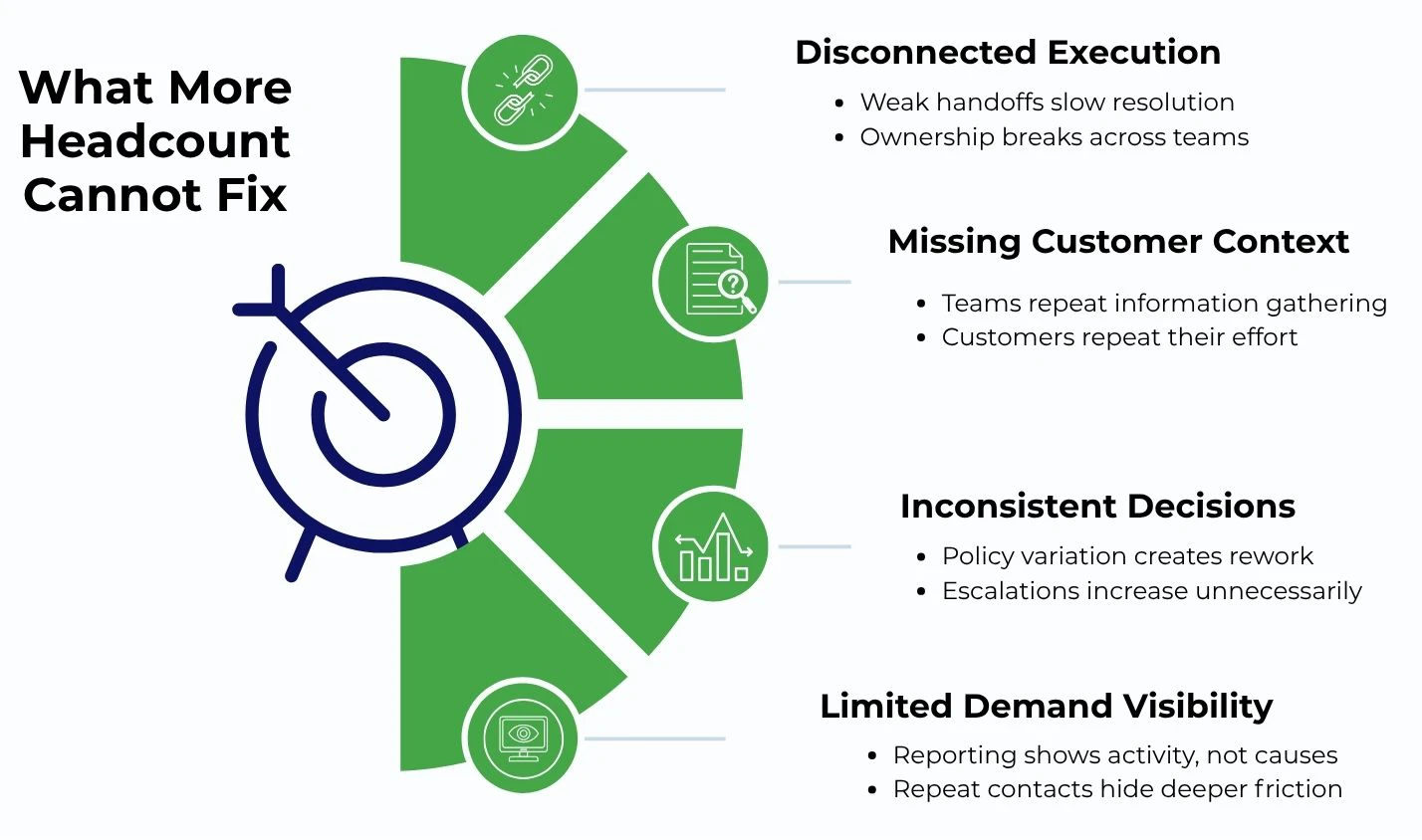
Fix the friction before scaling the workforce
- Disconnected execution across the customer journey. Customer issues often move across Contact Center, Consumer Affairs, Back Office, and other functions. If ownership, handoffs, or dependencies are weak, service performance is constrained beyond the front line.
- Insufficient context at the point of action. If history, transaction status, prior commitments, or case decisions do not move with the customer, teams spend paid time reconstructing information and customers repeat effort.
- Variation in guidance and decision-making. Inconsistent knowledge, policy interpretation, or decision rights can create reversals, escalations, and avoidable follow-up even when individual teams appear productive.
- Limited visibility into the drivers of demand. QA, analytics, and service-level reporting can show how work is handled without necessarily showing why customers return, transfer, or escalate.
More people can process more activity. They cannot, by themselves, remove the mechanism creating unnecessary activity.
The Economic Cost of Treating Design Failures as Capacity Gaps
If one customer need requires three interactions instead of one, the business is not only paying for two additional contacts. It is also paying for the routing, documentation, supervisory attention, QA, escalation handling, and back-office work attached to them. If the underlying failure persists as volume grows, that effort becomes embedded in the cost base.
This is why throughput alone can mislead. A team may increase contacts handled per day while the cost of reaching a resolved customer need continues to rise. For a COO or CCO, the more consequential measure is the organizational effort required to achieve resolution.
Workforce should scale with legitimate demand and business growth, not with preventable demand created by the resolution process.
What Leaders Should Examine Before Expanding Capacity
Before committing additional headcount, leadership should determine whether the operation can convert more capacity into better customer outcomes or whether new resources will simply enter the same constraints.
Three questions matter most:
- Can the organization resolve work end to end? Customer issues often cross frontline, back-office, Consumer Affairs, and specialist teams. If ownership, context, and accountability break across those boundaries, capacity added at one point will have limited effect on the total resolution cycle.
- Are decisions consistent at scale? Knowledge, policy interpretation, and decision rights should produce comparable outcomes across teams and channels. If they do not, growth in volume can amplify variation as quickly as it increases throughput.
- Does leadership have visibility into what is driving demand? QA, analytics, SLAs, and automation should do more than monitor activity. They should help distinguish legitimate demand from avoidable demand, identify where friction originates, and show whether operational changes are reducing the cost and effort required to resolve customer needs.
Redesign Where Necessary, Add Capacity Where It Creates Value
The response should be proportional to the constraint. Where process is creating rework, improve the process. Where teams lack reliable information at the point of action, strengthen the information and technology layer. Where several functions shape the same result, align governance, quality, and accountability. Where demand has genuinely exceeded available capacity, add or reposition workforce.
This avoids two expensive mistakes: attempting broad transformation when a targeted intervention would be sufficient, and building a permanently larger service organization around work that should not exist.
The Premier NX Perspective: Scale the Operation, Not the Friction
Premier NX approaches customer operations as an interconnected business function rather than a series of isolated staffing requests. Working as an extension of the client’s organization, Premier NX can support connected execution across Contact Center, Consumer Affairs, Back Office, Quality, Analytics, workforce execution, service levels, governance, and continuous improvement.
The objective is not simply to place resources where pressure is most visible. It is to help coordinate the processes, people, information, and performance disciplines that determine whether customer needs are resolved consistently and economically.
More Capacity Is Not Always the Answer
Additional agents may be exactly what the business needs. But when workload is amplified by how work is routed, owned, informed, governed, or measured, staffing the symptom can make the cost base larger without fixing the experience.
Understand whether the constraint is capacity or the operation surrounding it, then invest accordingly.