


Key Takeaways
- 1Finance transformation creates value beyond immediate headcount savings by changing how the function uses capacity and supports the business.
- 2Looking across connected processes can reveal hidden costs in rework, handoffs, dependencies, and recurring operational effort.
- 3Reducing unnecessary leadership intervention can free senior finance capacity for decisions that require greater judgment and focus.
- 4A stronger finance structure can improve both today’s cost base and the way finance costs scale as the business grows.
Headcount savings are often the easiest part of a finance transformation business case to quantify. They are real, relevant, and frequently compelling. But they can also limit the analysis too early.
When a CFO evaluates transformation through the cost of replacing one or two roles, the business case focuses on labor costs rather than the economics of the finance function. That may be appropriate for an isolated capacity gap. It is less useful when the underlying issue spans recurring processes, consumes management attention, or causes finance costs to rise with every increase in volume and complexity.
The Economics of Finance Extend Beyond Individual Roles
Finance may be budgeted by role, team, or process, but the economics of execution rarely remain within those boundaries.
AP, AR, reconciliations, reporting, and close operate through dependencies. Exceptions in one area can create investigation, rework, review, or coordination elsewhere. As that cross-process effort accumulates, so does the capacity required to manage it.
For CFOs, the distinction is important: the cost of a finance process is not always the same as the cost of the resources assigned to it. When recurring effort spans several connected processes, the transformation opportunity may be broader than an individual FTE comparison suggests.
Leadership Intervention is Part of the Cost Structure
Recurring operational issues can also consume senior finance capacity in ways that don’t show up in headcount calculations.
When Controllers, Finance Directors, or CFOs routinely step into reconciliation issues, close exceptions, manage fragmented handoffs, or run routine reviews, leadership attention effectively compensates for friction in recurring execution.
That intervention has an economic cost. Time spent maintaining day-to-day execution is capacity unavailable for forecasting, performance analysis, cash decisions, and other work that requires senior finance judgment.
Reducing unnecessary senior involvement does not always produce a direct FTE saving. It can still improve the function’s economics by reducing the leadership capacity required simply to keep recurring work on track.
Transformation Should Change the Finance Cost Trajectory
Reducing the current cost of finance execution is valuable. The larger question is whether transformation also changes how finance costs behave as the business grows.
If higher transaction volumes, additional entities, or greater operational complexity continue to require proportional increases in headcount and oversight, the run rate may be lower. Still, the underlying cost trajectory has changed little.
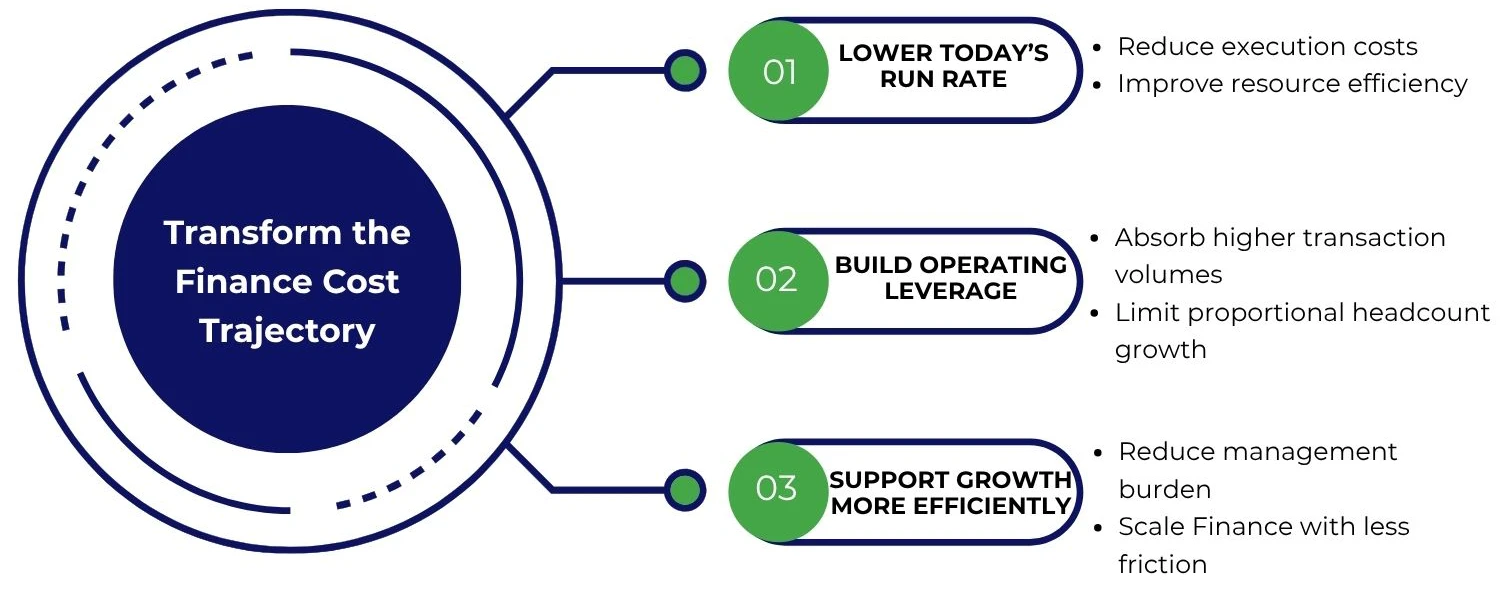
Move beyond savings toward a more scalable finance function
A stronger operating structure creates greater leverage. Finance can absorb more activity without requiring equivalent increases in resources or management effort.
That is where transformation moves beyond immediate savings. It can improve not only what Finance costs today, but how efficiently the function supports future growth.
Let the Economics Determine the Scope
Not every finance issue requires broad transformation. A vacancy, temporary backlog, or isolated capacity constraint may justify a targeted resource solution.
A broader evaluation becomes relevant when the same economic problem appears across several parts of Finance. CFOs should look for signals such as:
- recurring exceptions or rework across processes;
- repeated management intervention;
- fragmented ownership or handoffs;
- rising capacity requirements as transaction volumes grow; and
- multiple teams absorbing effort created by the same underlying issue.
If those problems are concentrated in one activity, keep the scope narrow.
If they extend across several connected processes, evaluating one vacancy or FTE at a time can leave part of the business case unexplored.
The economics of the problem should determine the transformation scope. Provider pricing should validate that business case, not define its boundaries in advance.
Broader Problems Create a Broader Value Case
When the same cost and capacity problem spans AP, AR, reconciliations, reporting, close, or other recurring finance activities, evaluating those processes together can reveal an opportunity that individual role comparisons may miss.
Headcount savings remain part of that opportunity. But a connected operating scope can also address the factors that create additional cost around the work: handoffs, recurring exceptions, inconsistent ownership, management intervention, and the capacity required to support increasing volume.
This is the distinction between lower-cost execution and a structurally stronger finance function. Moving work to a lower-cost delivery model can improve the current cost base. Improving how connected work is managed can also affect the capacity and oversight the function requires over time.
Premier NX can support recurring finance operations across connected processes through dedicated and co-sourced delivery, process discipline, quality assurance, continuous improvement, and, where appropriate, technology enablement. The objective is not to broaden every engagement, but to align the operating scope with the business problem.
Evaluate the Opportunity at the Right Level
Headcount savings remain an important part of the finance transformation business case. But when cost, capacity, and management effort are being created across connected processes, evaluating roles individually can capture only part of the opportunity.
The more useful question is whether Finance is simply being executed at a lower cost or whether the operating structure itself can require less effort, absorb more growth, and place fewer demands on internal leadership.
That distinction should determine how broadly you evaluate the transformation opportunity.
About the Author

As CEO, Ali Din oversees the overall strategy and direction for Premier NX. With senior leadership roles at global HR and recruiting platforms, Indeed and ADP. Ali has over 25 years of experience in the IT and advanced technology sector. Ali’s time is focused on transformation in the business, both for professional development and for clients, to enhance business outcomes.