


Key Takeaways
- 1Finance complexity can increase faster than headcount when acquired entities retain fragmented processes and controls.
- 2Adding capacity may solve an immediate staffing issue without addressing the operating structure creating the pressure.
- 3Assessing connected processes helps CFOs identify where standardization, shared delivery, and co-sourced execution may improve scalability.
- 4The real test of finance integration is whether the next acquisition can be absorbed without recreating the same operating complexity.
A private equity roll-up can consolidate ownership far faster than it consolidates finance.
Several acquired businesses may sit beneath one platform while still running different versions of AP, AR, reconciliations, close, approvals, and reporting. The CFO is still expected to produce one reliable financial view from processes that were never designed to work together.
The immediate concern may appear to be duplicated headcount. The more consequential issue is the coordination required to keep fragmented finance processes running.
If every acquisition adds more exceptions, manual work and management involvement, the business is scaling without creating equivalent operating leverage inside finance.
Fragmentation Costs More Than Headcount
Finance fragmentation shows up in longer close cycles, inconsistent reporting, repeated reconciliations, and routine issues escalating to senior leaders.
Adding another AP resource or close specialist may relieve immediate pressure. It does not address the different processes, responsibilities and controls creating that pressure.
A vacancy is a capacity issue. Fragmented finance operations are an integration issue.
The CFO’s question therefore shifts from “Which role do we need next?” to “Which parts of the combined finance function should operate differently before more capacity is added?”
That is the difference between filling a position and redesigning how finance supports the roll-up.
Move From Entity-Level Roles to Connected Processes
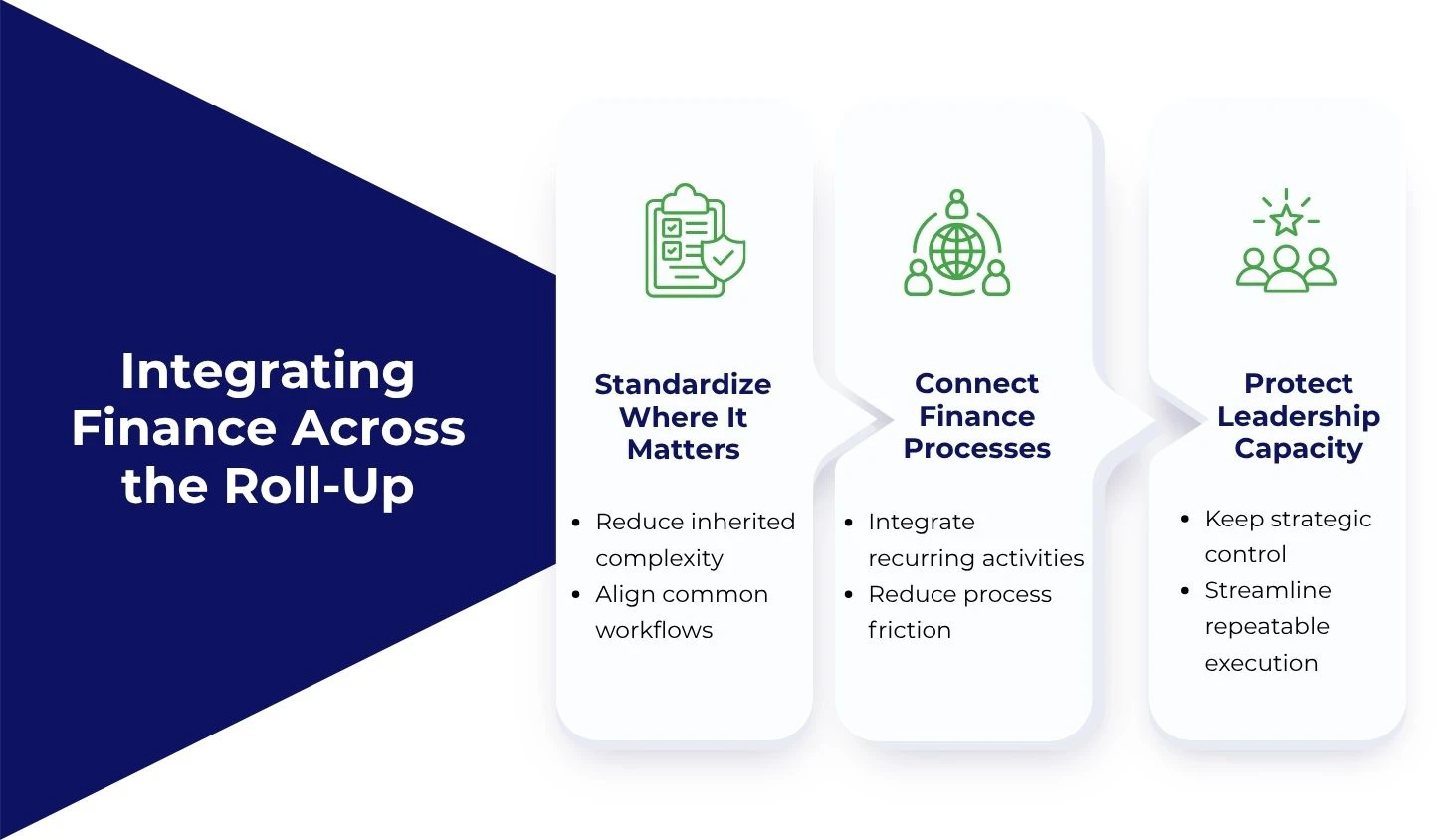
Post-acquisition integration does not require eliminating every local difference. Some variation may reflect legitimate business, regulatory, or control requirements. The challenge is separating necessary variation from practices that remain only because they were inherited through acquisition.
Where several entities perform similar recurring work, finance leaders should consider whether each business still needs a separate execution layer.
AP, AR, reconciliations, close support, payroll and recurring reporting are connected activities. Differences in timing, documentation, approvals and exception handling create friction between them. Improving one activity in isolation may simply move the problem elsewhere.
Build finance to scale with every acquisition
A more scalable approach organizes capacity around these connected processes. Common workflows, controls, service levels and escalation paths can then be applied across the agreed scope rather than recreated for each entity.
Finance leadership continues to own policy, governance, judgment and business decisions. Repeatable execution operates through a disciplined delivery structure that gives leadership visibility without requiring senior involvement in every task.
Technology Alone Will Not Integrate Finance
Acquired businesses may share the same ERP while retaining different approval paths, close practices, responsibilities and manual workarounds.
In that situation, the technology is consolidated while finance remains fragmented.
An ERP migration can create an opportunity to redesign the function, but technology will only support the model finance chooses. Operating leverage depends on how the combined business structures and manages work.
Start With a Finance-Function Assessment
Before quoting headcount, the organization should understand how finance currently operates across its entities.
An assessment should identify:
- where similar work is being performed more than once;
- where variation creates unnecessary coordination or risk;
- which activities require internal judgment and business knowledge;
- which recurring processes could move into a shared delivery model.
This gives the CFO a basis for comparing the current structure with the cost, capacity and governance of a more integrated approach.
That comparison can reveal where finance can reduce duplicated effort, free up leadership capacity, improve close reliability, and absorb future acquisitions without adding the same level of overhead.
The result is not simply a recommendation for more people. It is a clearer view of how finance should operate as the platform grows.
The Real Test Is the Next Acquisition
The success of finance integration is not measured only by whether the businesses already acquired have been stabilized.
The harder test is whether the next entity can enter the platform without requiring another layer of local processes, reporting effort, and management oversight.
Will finance require another layer of execution capacity, reporting effort, local process knowledge and management oversight?
Or can the new entity enter an established structure for executing, governing and measuring recurring finance work?
A scalable finance function should extend established processes and capacity to the new entity instead of rebuilding finance around every acquisition.
That is where integration becomes operating leverage.
Build Finance for the Next Stage of the Roll-Up
Premier NX helps PE-backed finance teams identify recurring work that can be standardized and bring connected processes such as AP, AR, reconciliations, and close support into a governed, co-sourced delivery model.
Finance leadership retains control of strategy, policy and decisions. Premier NX manages the agreed process scope, service levels and execution capacity required to support the combined organization.
If each acquisition is making close, reporting, or day-to-day finance management harder, another individual hire may not solve the underlying problem.