

Key Takeaways
- 1The right contact center partner reduces the causes of customer friction instead of simply adding capacity to handle more contacts.
- 2Effective AI strategy automates repetitive work while preserving human judgment and accountability for complex customer interactions.
- 3Customer interaction data creates business value when it directly improves staffing, coaching, QA, workflows, escalation, and automation decisions.
- 4Sustainable CX scale depends on stronger governance and faster insight-to-action, not continuous headcount expansion.
The right contact center outsourcing partner should do more than absorb customer demand. It should help your organization reduce avoidable demand, apply AI without weakening accountability, convert customer interactions into operational intelligence, and continuously improve the operating model that drives the customer experience.
That distinction matters because outsourcing capacity without addressing customer friction can make an inefficient operation cheaper without improving it.
For CX leaders evaluating a partner, the question is therefore no longer simply, “Can they handle our contacts?” It is, “Can they help us improve why those contacts happen, what we learn from them, and what’s next?”
Choose a Partner. Not Just a Provider.
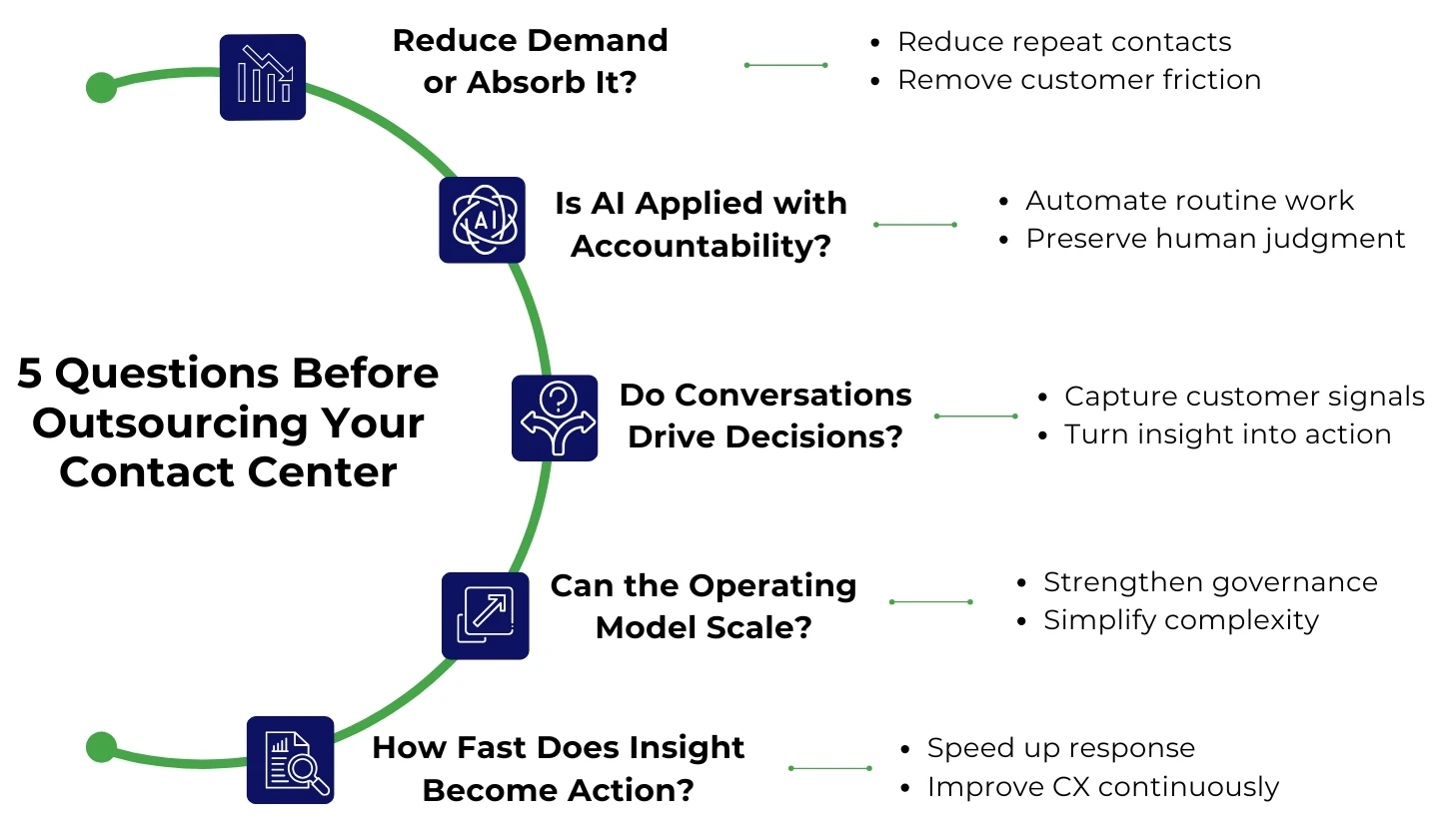
1. Will the Partner Reduce Demand or Simply Absorb It?
Contact volume is not always a capacity problem. Repeat contacts, avoidable escalations, unnecessary transfers, and recurring questions can indicate friction elsewhere in the customer journey.
A strategic partner should help distinguish necessary demand from avoidable demand and identify the operational causes behind both.
Look for evidence that the provider can:
- Identify recurring contact drivers and failure patterns
- Trace customer friction to workflows, policies, systems, or handoffs
- Feed those findings back into process improvement
- Measure whether interventions actually reduce repeat demand
2. Does Their AI Strategy Preserve Accountability?
The sophistication of an AI strategy is not measured by how many interactions it automates.
A better test is whether the operating model knows which decisions should be automated, augmented, or retained by people.
High-volume, predictable tasks are strong candidates for automation. Decisions involving ambiguity, customer consequence, exceptions, or judgment require a different threshold.
The principle is straightforward:
Automation should remove repetition, not accountability.
3. Can Customer Conversations Become Operational Intelligence?
Most contact centers already produce enormous amounts of customer data. The harder problem is converting it into decisions.
Calls, chats, escalations, quality evaluations, and customer feedback can expose emerging issues before they become visible through conventional business reporting. But collecting those signals has little value when they remain trapped inside dashboards.
A mature partner should connect interaction intelligence to:
- Quality assurance and coaching
- Workforce planning
- Workflow redesign
- Customer journey improvements
4. Is the CX Operating Model Designed for Complexity?
Scale does not simply increase volume. It increases the number of exceptions, handoffs, channels, dependencies, and coordination requirements.
That is why adding headcount to a weak operating model frequently produces diminishing returns.
The constraint is often governance rather than capacity.
As CX operations expand, leaders should examine:
- Who owns exceptions
- How work moves across teams and channels
- When escalations trigger
- Which metrics govern performance
- How changes are communicated and implemented
5. How Quickly Can Insight Change Execution?
Organizations rarely suffer from a complete absence of customer insight. More often, they suffer from excessive distance between learning something and changing something.
A contact center might identify a recurring problem today while staffing models, workflows, QA criteria, or automation rules remain unchanged for weeks.
A stronger partner should create feedback loops connecting customer signals with:
- Staffing
- QA
- Workflow
- Automation
Beyond Outsourcing. Building a More Effective Contact Center.
The most valuable contact center partner is not the one that helps you handle more customer friction. It is the one that helps you systematically remove it, making the operation more efficient with every interaction.
Premier NX helps mid-market organizations move beyond traditional outsourcing by combining technology, analytics, automation, and human expertise to support contact center operations that are more responsive, scalable, and insight-driven.
Ready to find the highest-leverage gaps in your contact center?