

Key Takeaways
- 1Lead-to-invoice flow connects the entire revenue journey from customer lead to final invoice within a single workflow.
- 2Disconnected CRM, sales, and finance systems create revenue friction, billing delays, and data inconsistencies.
- 3Odoo provides one source of truth for customer, deal, order, and invoice data across teams.
- 4Connected workflows improve revenue visibility, helping leadership align pipeline activity with financial outcomes.
- 5Mid-market growth is easier to manage when sales, operations, and finance work from the same process and data.
Odoo lead-to-invoice flow connects the full revenue journey, from customer lead to final invoice, within a single system. For mid-market businesses, this reduces manual handoffs, limits data re-entry, improves billing speed, and gives leadership clearer visibility from pipeline to revenue.
For growing companies, the revenue process often looks simple on paper.
You land a lead, close the deal, do the work, and send the invoice. Simple, right?
But as teams grow, sales, operations, and finance often begin working from different systems. That is where revenue delays, billing gaps, and reporting confusion begin.
What Is Lead-to-Invoice Flow in Odoo?
Lead-to-invoice flow is the process of turning a sales lead into a billed transaction.
In Odoo, this journey connects CRM, opportunity management, quotations, sales orders, financial validation, and invoicing.
Instead of rebuilding information at each stage, teams work from the same customer, deal, and transaction data. This helps reduce duplication and keeps the revenue process easier to track.
Why Disconnected CRM and Invoicing Slows Revenue
Lead-to-invoice problems usually arise when CRM, sales, operations, and finance are misaligned.
Customer details may be entered more than once. Deal terms may be missing or inconsistent. Finance may need to verify information manually before billing can happen.
The issue is not just administrative friction. It is a disconnected revenue workflow.
Research from IBM, NetSuite, Rapidi, and Citrin Cooperman consistently finds that when CRM and ERP systems are disconnected, businesses often experience increased manual effort, data errors, billing delays, and reduced revenue visibility.
How Odoo Connects CRM to Invoice
Odoo helps create a single structured path from sales activity to financial outcomes.
A lead captured in Odoo CRM can become an opportunity, move through the sales pipeline, generate a quotation, convert into a sales order, and then support invoice creation from the approved transaction.
A Structured Path from CRM to Invoice
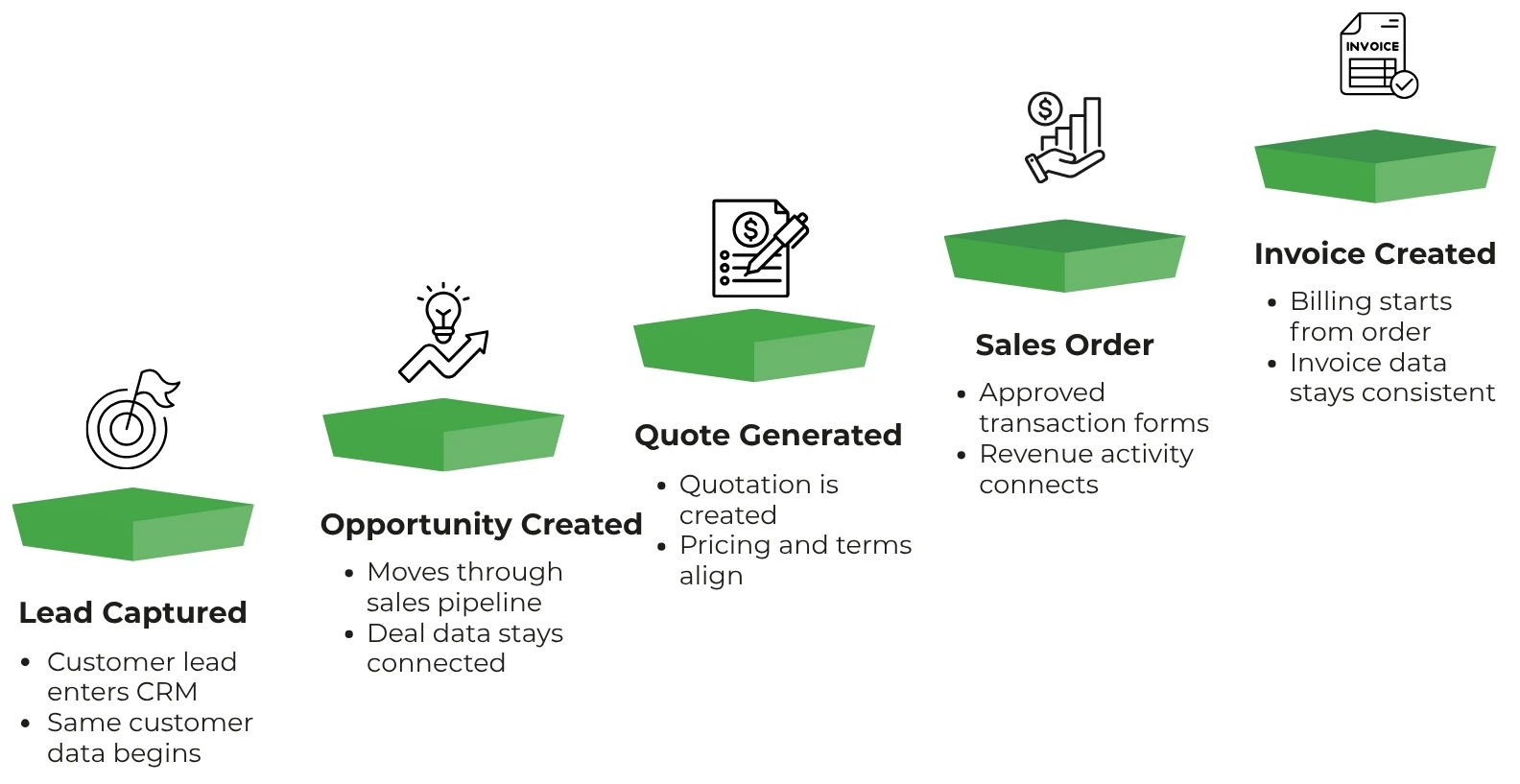
Because the data stays within one platform, teams do not need to recreate the same information across multiple tools.
Odoo creates one source of truth for customer, deal, order, and invoice data.
How Odoo Improves Revenue Visibility
Revenue visibility means leaders can see how sales activity turns into billable revenue.
With a connected Odoo workflow, pipeline data can align more closely with sales orders, billing can reflect approved pricing and terms, and finance and sales can work from shared records.
This matters because revenue visibility is not only a reporting concern. It affects staffing, planning, collections, customer experience, and leadership confidence.
What to Avoid When Implementing Odoo Lead-to-Invoice Workflows
Odoo can simplify the lead-to-invoice process, but only when the workflow is designed with governance in mind.
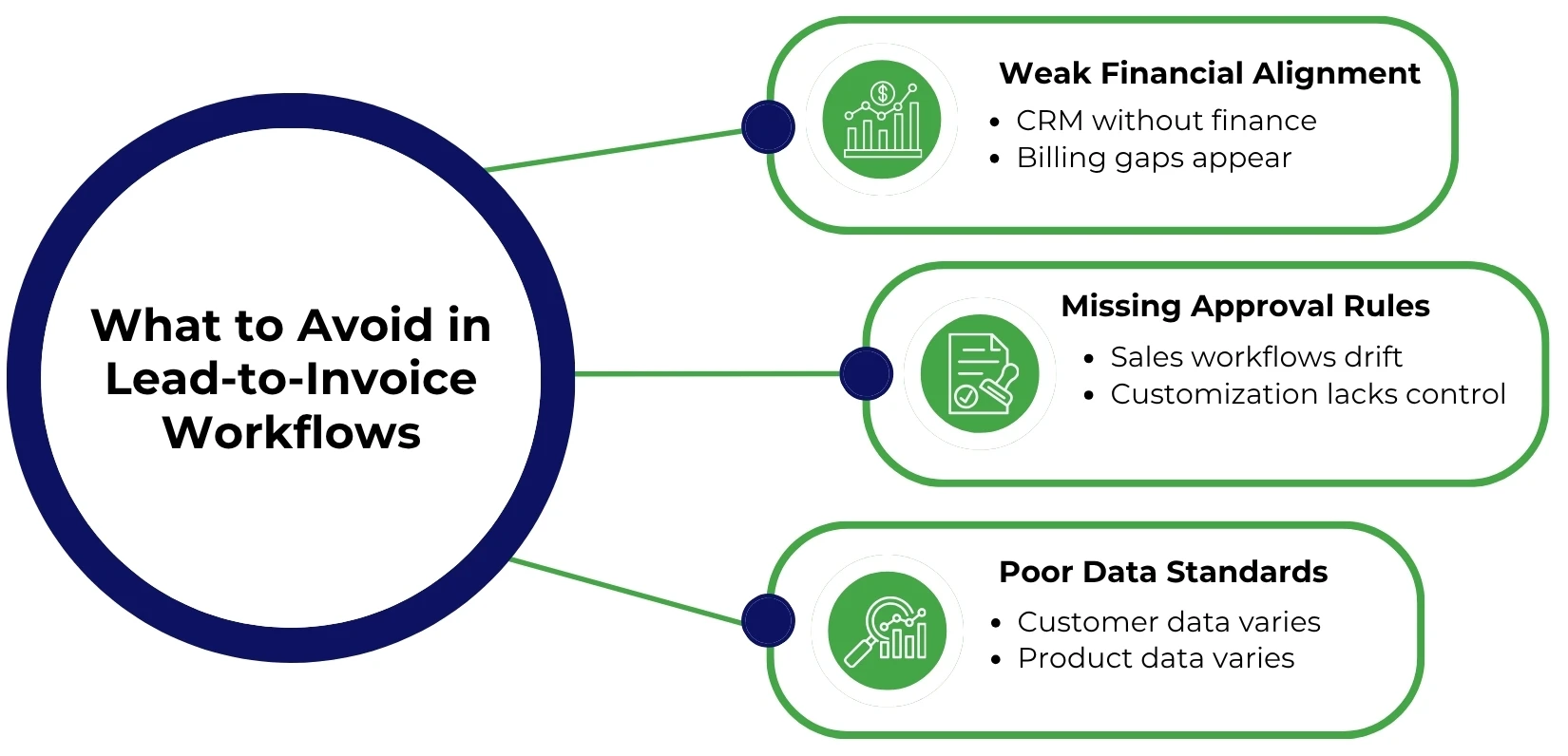
Common issues arise when CRM is implemented without financial alignment, sales workflows are customized without approval rules, or customer and product data standards are not enforced early on.
A connected platform still needs a governed process. Without clear rules, fragmentation can reappear inside the system.
How Premier NX Helps Mid-Market Teams Connect Revenue Workflows
The lead-to-invoice journey defines how a business turns opportunity into revenue.
For mid-market companies, growth increases the complexity of approvals, transactions, and billing. If the workflow is disconnected, growth creates more operational drag.
Revenue operations do not scale because teams work harder. They scale when a single workflow governs sales activity, operational execution, and financial outcomes.
Premier NX helps mid-market organizations examine how their sales-to-finance workflows operate, where handoffs create friction, and how systems like Odoo can support clearer process alignment.
Assess Your Lead-to-Invoice Workflow
If you want to see where your revenue process is slowing down, book a complimentary workflow review with our team.
We will evaluate how information moves from lead to quote to invoice, identify workflow gaps, and outline practical opportunities to improve visibility, efficiency, and revenue flow.
About the Author

Sheraz Chaudhry is Head of Sales, Europe at Premier NX, a leading provider of technology-enabled outsourcing solutions. With a background that includes founding membership at The Resource Group and leadership roles at Nielsen, he brings deep expertise in revenue strategy, partnerships, and data-driven innovation to the leaders he works with today.