


Key Takeaways
- 1Hidden contact center costs often begin with operational friction.
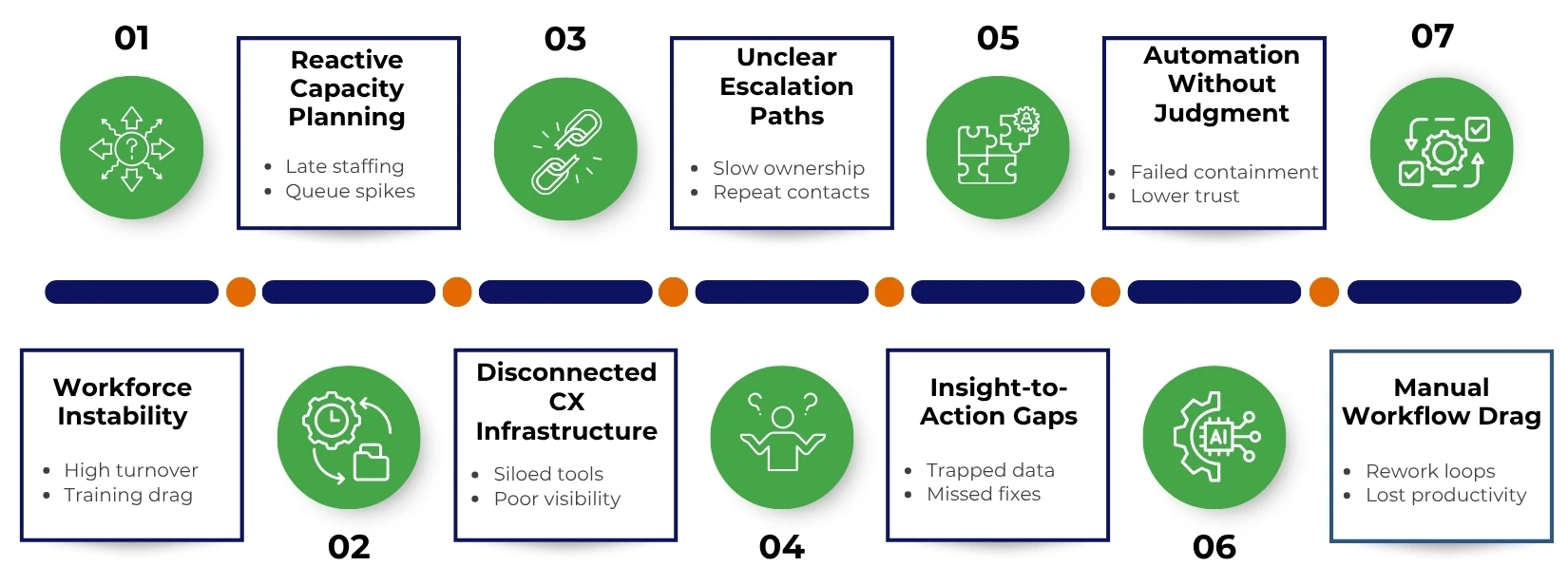
- 2Workforce instability, reactive staffing, and disconnected systems make service harder to scale.
- 3Slow escalations, trapped insights, and manual workflows quietly increase customer effort and operating cost.
- 4Reducing contact center cost starts by fixing friction across people, process, technology, and resolution ownership.
Hidden in-house contact center costs are the operational inefficiencies that raise service expense without appearing clearly in payroll, software, or support budgets.
They usually sit inside workforce instability, reactive staffing, disconnected systems, slow escalations, trapped insights, poorly designed automation, and manual workflow drag.
The fastest way to reduce hidden contact center costs is to identify where operational friction increases effort, slows resolution, weakens customer experience, or forces teams to add headcount before fixing process design.
For mid-market companies, these costs do more than raise spending. They make the contact center harder to scale, manage, and improve.
Where In-House Contact Center Costs Hide
Hidden in-house contact center costs often stem from operational gaps across people, processes, technology, and customer experience.
1. Workforce Instability: Reduce the Cost of Constant Rehiring
High turnover affects far more than hiring budgets.
When experienced agents leave, the business loses process knowledge, customer context, and frontline confidence. New hires require recruiting, training, nesting, coaching, and time to proficiency before they can perform at the level customers expect.
Primary impact: Service consistency, productivity, customer experience.
KPI focus: Attrition rate, employee retention, time-to-proficiency, QA score.
2. Reactive Support Capacity: Keep Service Levels from Breaking Under Demand
Reactive support capacity occurs when staffing decisions are made after queues, backlogs, or response times have already begun to suffer.
This creates a cycle where leaders are constantly trying to catch up. Agents become overloaded, service levels decline, abandonment rises, and managers spend more time firefighting than improving the operation.
Primary impact: Service levels, workforce efficiency, customer responsiveness.
KPI focus: Service level, occupancy rate, average speed of answer, abandonment rate.
3. Disconnected CX Infrastructure: Connect People, Channels, Data, and Workflows
Disconnected CX infrastructure means customer data, channels, reporting, and workflows do not operate as a single system.
The impact is easy to feel but hard to measure. Customers repeat information. Agents switch between tools. Managers lack a single view of performance.
Primary impact: Customer effort, operational efficiency, and agent productivity.
KPI focus: First contact resolution, channel transfer rate, average handle time, customer effort score.
4. Unclear Escalation Paths: Move Customer Issues to the Right Owners Faster
Escalations become a hidden cost when teams lack clear ownership, rules, or resolution paths.
Instead of solving the customer’s issue quickly, agents spend time finding the right person, waiting for approvals, or moving the case between teams. This increases handle time, repeat contacts, and customer frustration.
Primary impact: Resolution speed, customer satisfaction, operational accountability.
KPI focus: Escalation rate, resolution time, repeat contact rate, CSAT.
5. Insight-to-Action Gaps: Turn CX Data into Operational Improvement
Customer insights only create value when they lead to operational change.
Many contact centers collect QA scores, call notes, survey feedback, complaints, and performance reports. The problem is that this data often remains trapped in dashboards rather than improving coaching, workflows, scripts, staffing, or root cause resolution.
Primary impact: Decision-making, responsiveness, service improvement.
KPI focus: QA score, CSAT, forecast accuracy, coaching effectiveness.
6. Automation Without Human Judgment: Improve Speed Without Losing Trust
Automation improves efficiency by supporting the customer journey. It creates risk when it blocks judgment, empathy, or resolution.
Repetitive tasks, simple routing, status updates, and basic data capture are strong candidates for automation. Complex, emotional, or high-value interactions still need human judgment, empathy, and problem-solving.
Primary impact: Customer trust, resolution quality, operational efficiency.
KPI focus: Self-service success rate, escalation rate, customer satisfaction, containment rate.
7. Manual Workflow Drag: Remove Rework That Slows Frontline Execution
Manual workflow drag shows up in small tasks that quietly consume frontline capacity.
As support volume grows, repetitive updates, handoffs, and administrative work take time away from resolving customer needs.
Primary impact: Productivity, operating efficiency, and workforce utilization.
KPI focus: Cost per contact, average handle time, after-call work time, and agent utilization.
What to Retain In-House
Outsourcing should not remove control from the business. Mid-market leaders should retain decision-making authority over customer experience strategy, brand standards, risk tolerance, and customer promises.
Keep ownership of:
- CX strategy and customer promise
- Brand voice, escalation policy, and service standards
- Performance governance, KPI priorities, and improvement decisions
How Can Businesses Reduce Hidden In-House Contact Center Costs?
The real cost of an in-house contact center is not always labor. It is the friction between demand, ownership, systems, and resolution.
Premier’s point of view: contact center cost reduction should begin with operational friction, not headcount.