

Key Takeaways
- 1Odoo sequencing reduces rollout risk
- 2Finance creates the ERP foundation
- 3Phased rollout supports long-term value
Odoo’s modular design makes it possible to bring finance, CRM, sales, services, projects, and HR into one connected platform. But in my experience, rollout success often depends less on how many modules go live and more on the order in which they are introduced.
For mid-market businesses, the strongest Odoo rollouts usually start with a stable operating base and then expand in a sequence the business can absorb. Gartner’s ERP research has long emphasized the importance of aligning ERP initiatives with business goals. In contrast, IDC’s cloud ERP research points to the mid-market need for connected systems, clearer data, and better visibility across growing teams.
What Is Odoo Module Sequencing?
Odoo module sequencing is the decision of which Odoo modules should go live first and which should follow later.
This matters because finance, CRM, sales, services, and HR are connected operationally. If the first layer is weak, later modules often inherit the same problems: inconsistent data, unclear ownership, reporting gaps, and adoption friction.
A phased rollout gives each part of the business time to stabilise before the next one is added.
Why Finance Should Usually Come First in Odoo
For most mid-market businesses, finance is the right place to start.
Accounting, invoicing, expenses, chart of accounts, and transaction accuracy create the baseline for reporting across the business. If finance is not structured properly, every later module becomes harder to trust.
Finance is not just the accounting module. It is the control layer for the rest of the rollout.
When to Add CRM, Sales, Services, and HR
Once finance is stable, CRM and sales are often the next practical step. Lead management, pipeline tracking, quotations, and orders become more useful when they connect directly to financial records.
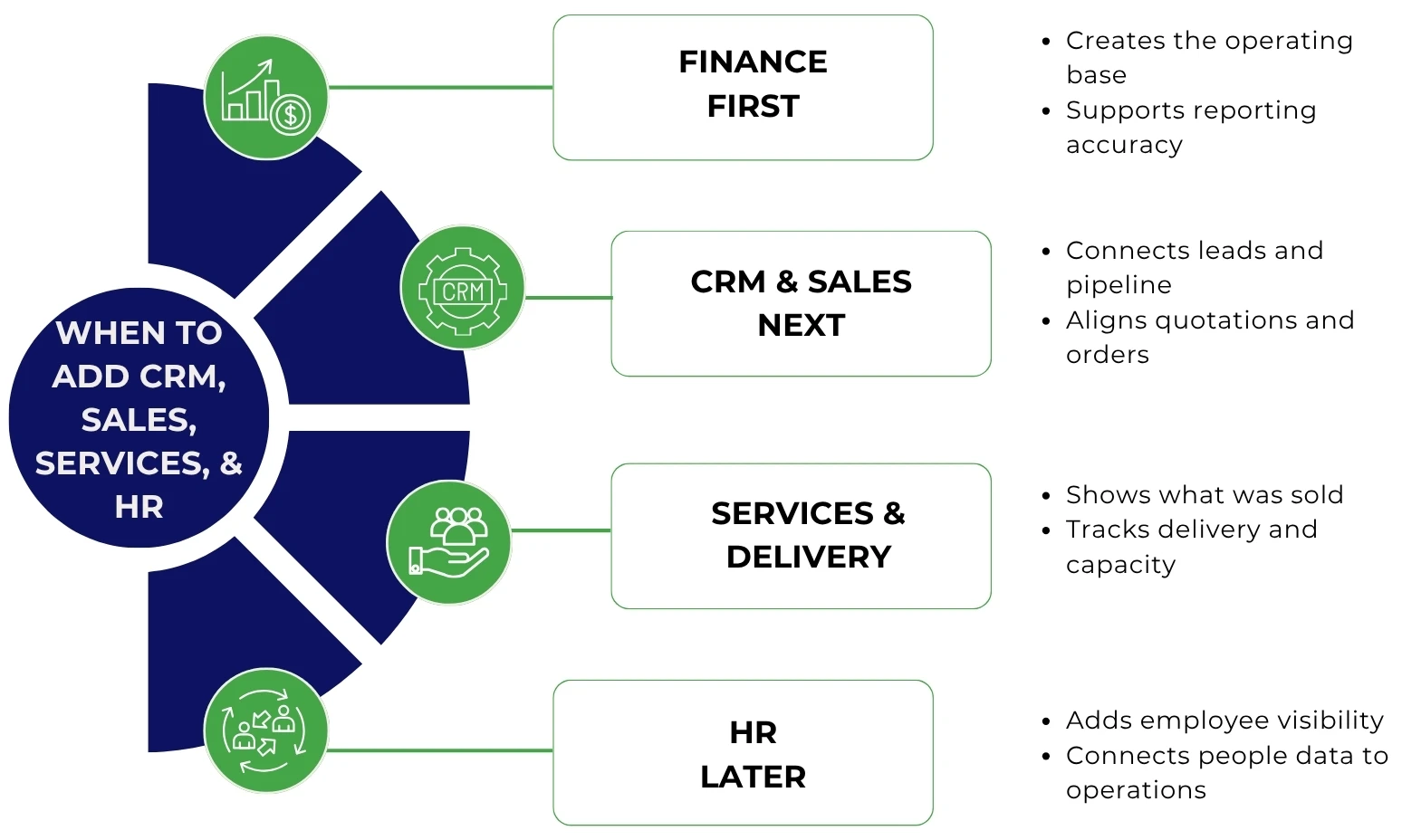
For service-led businesses, projects, timesheets, planning, and delivery workflows should usually follow once finance and revenue processes are stable. This is where Odoo starts to show delivery reality: what was sold, what is being delivered, where capacity sits, and where margin may be affected.
HR is important, but it is often more effective after the core commercial and operational flows are in place. Employee records, recruitment, time off, and workforce visibility become more valuable when connected to the broader operating model.
What to Avoid During an Odoo Rollout
One common mistake is assuming that because Odoo is modular, everything should move at the same time.
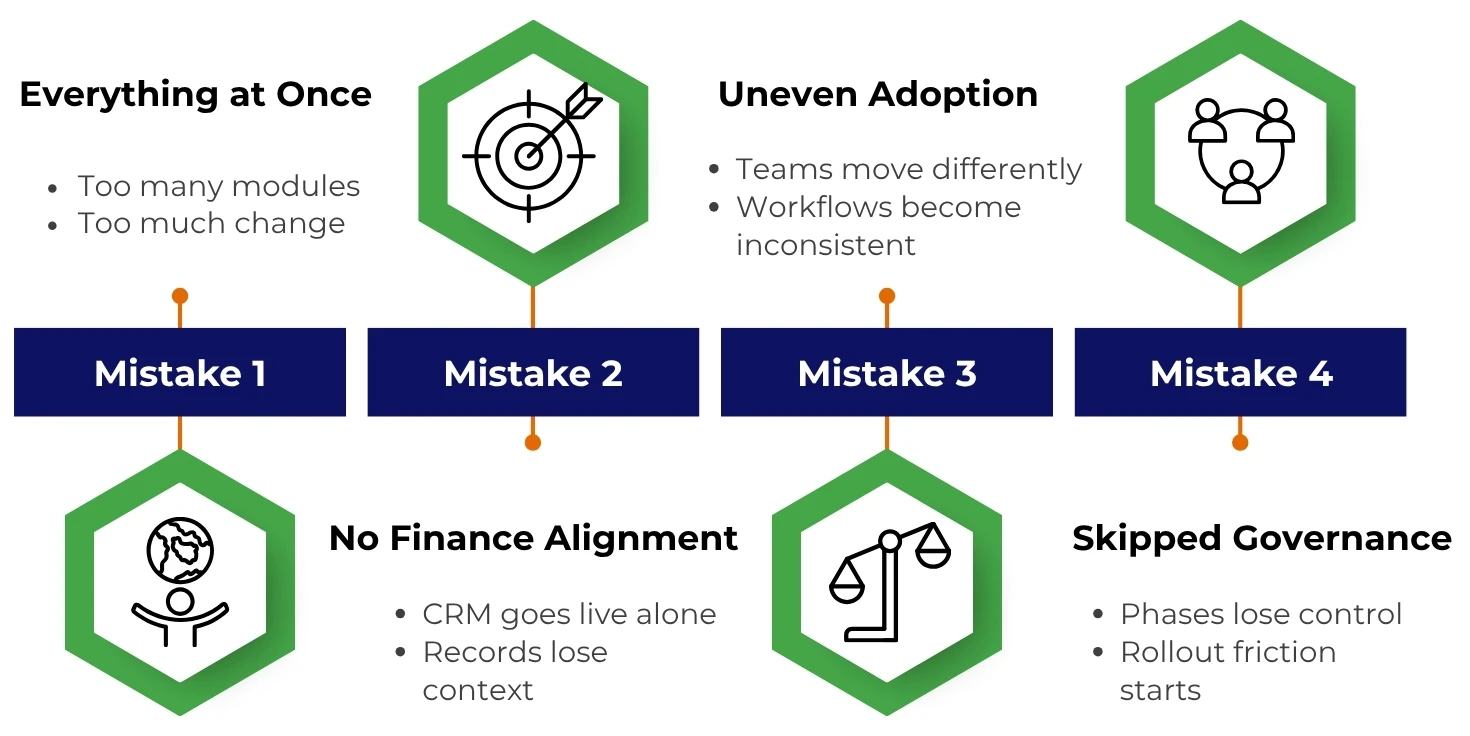
That is where rollout friction often starts. CRM may go live without financial alignment. Teams may adopt new workflows at different speeds. Governance between phases may be skipped.
A more practical path is to establish control first, connect revenue next, bring delivery into view, and then add workforce processes when the base is ready.
How Premier NX Supports Odoo Rollouts
At Premier NX, we view Odoo sequencing through an operational lens because rollout order affects how the business operates after go-live.
Our role is to help mid-market businesses implement, manage, and improve Odoo in ways that reflect how their businesses actually run. That includes rollout planning, module configuration, integration, process alignment, and post-go-live support.
Building Odoo Value One Layer at a Time
Odoo does not need to be implemented all at once to create value. For most mid-market organisations, value builds when the rollout is progressive, structured, and aligned to how work actually happens.
Speed still matters, but sequencing protects the rollout from unnecessary complexity. Each module should make the business easier to run, not harder to manage.
Looking at Odoo for your business? Talk through your rollout priorities with Premier NX and identify the next practical step for implementation, integration, or ongoing support.
About the Author

Sheraz Chaudhry
Head of Sales, Europe at Premier NXSheraz Chaudhry is Head of Sales, Europe at Premier NX, a leading provider of technology-enabled outsourcing solutions. With a background that includes founding membership at The Resource Group and leadership roles at Nielsen, he brings deep expertise in revenue strategy, partnerships, and data-driven innovation to the leaders he works with today.