


Key Takeaways
- 1Stable finance operations can quietly increase costs when manual effort and process friction continue growing beneath routine execution.
- 2Hidden inefficiencies often accumulate through static close cycles, reconciliation-heavy workflows, and limited operational visibility.
- 3Finance efficiency improves when organizations measure workflow performance, exception trends, and manual dependencies alongside financial outcomes.
- 4Scalable finance operations combine workflow visibility, human-in-the-loop automation, and operational support designed for long-term growth.
Stable finance operations can still hide rising costs. A close process may finish on time, reconciliations may get completed, and reports may reach leadership, while the effort required to maintain that stability continues to increase.
For CFOs, Controllers, VPs of Finance, and finance operations leaders, the question is no longer whether finance work is getting done.
The better question is whether finance is becoming more efficient, more measurable, and more scalable.
Many mid-market companies operate with finance processes that feel reliable because they are familiar. The team knows the workarounds. Exceptions get resolved. Reports are adjusted before leadership review.
But beneath that routine execution, manual effort can quietly slow reporting agility, weaken decision speed, and put pressure on margins.
Stable Finance Operations Can Create an Illusion of Efficiency
A finance process can be completed on time and still be more expensive than it appears.
Completion confirms output. It does not confirm efficiency, scalability, control, or the true cost of execution.
The hidden cost often sits in the work required to keep finance “stable”:
- Approvals that need repeated follow-up
- Reconciliations maintained outside core systems
- Exceptions resolved through manual intervention
- Reports adjusted before leadership review
- Process knowledge concentrated in a few key employees
None of these may disrupt the business today. But together, they make finance harder to measure, harder to improve, and more costly to scale.
That is the illusion: operations look steady, while the cost of maintaining that steadiness keeps rising.
Where Hidden Finance Costs Accumulate
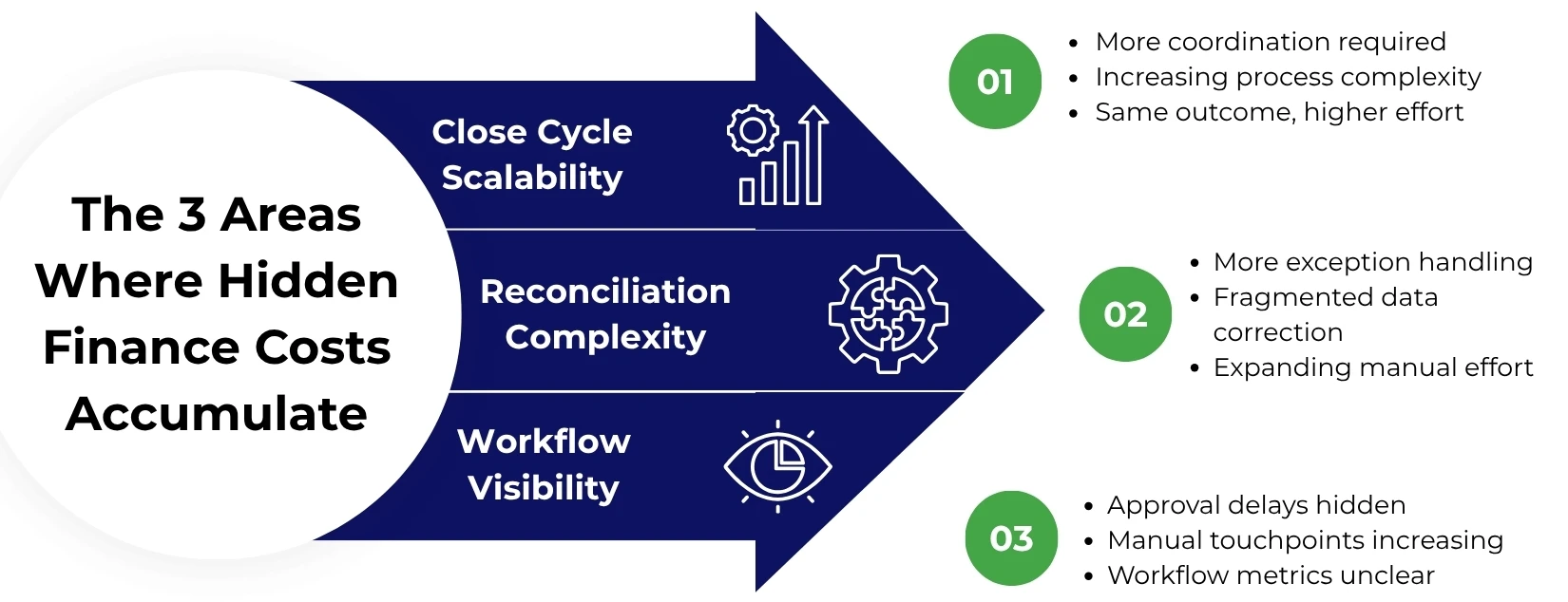
Hidden finance costs usually accumulate in three areas: close cycles, reconciliation work, and workflow visibility.
Close Cycles That Never Improve
A close process that remains unchanged for years may look disciplined. In reality, it may mean the finance team is absorbing more business complexity just to maintain the same timeline.
As transaction volume, entities, vendors, systems, and reporting requirements expand, leaders should ask:
How much additional effort is required to produce the same outcome?
Executive insight: The issue is not only how long the close takes. It is how much manual effort, dependency, and control are required to achieve the same timeline.
Reconciliation Work That Expands Quietly
Reconciliations are necessary. But reconciliation-heavy finance environments often point to deeper visibility, accuracy, and workflow issues.
As organizations grow, finance teams frequently spend more time:
- Validating mismatched information
- Managing exceptions
- Correcting incomplete entries
- Preparing supporting documentation
- Resolving discrepancies across systems
Executive insight: As the reconciliation effort continues to grow, finance often pays for process friction that leadership cannot see.
Limited Visibility Into Finance Efficiency
Most organizations measure financial outcomes carefully. Far fewer measure the operational efficiency of finance itself.
Leadership may know total finance spend without clearly understanding:
- cost per invoice processed
- exception volume trends
- approval cycle delays
- manual touchpoints across workflows
- reconciliation effort by process area
Executive insight: What finance cannot measure operationally, it cannot improve systematically.
A Practical Path from Stable to Scalable Finance Operations
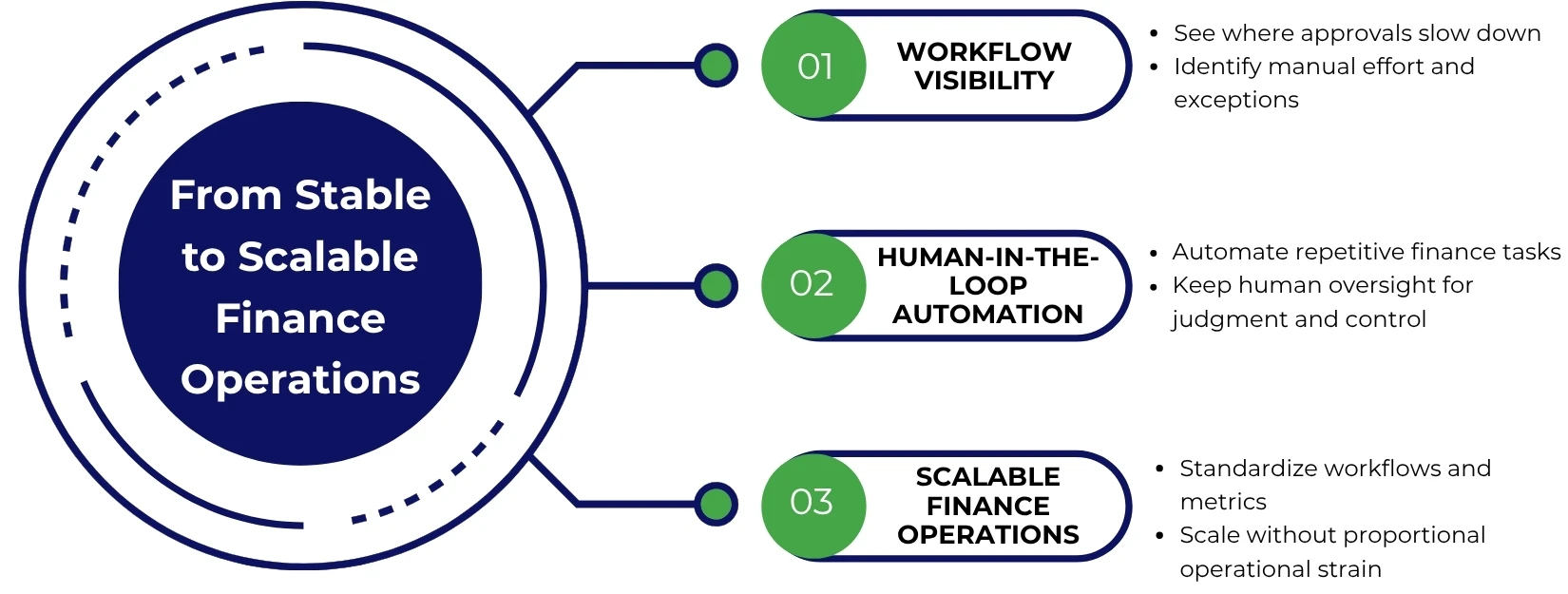
To reduce the hidden cost of stable finance operations, leaders need to move beyond task completion and focus on measurable improvement.
This does not require a complete overhaul. It starts with improving visibility, reducing repetitive effort, and building finance workflows that can scale with the business.
Stage 1: Move From Manual Stability to Workflow Visibility
Many finance teams deliver stable outputs but lack visibility into the effort required to maintain them.
Workflow visibility helps leaders see:
- Where approvals slow down
- Where reconciliations require intervention
- Where exceptions are increasing
- Which processes depend on offline work
Without visibility, inefficiency remains hidden inside routine execution.
Stage 2: From Repetitive Effort to Human-in-the-Loop Automation
Automation should reduce repetitive finance work without weakening oversight.
High-value use cases include:
- Invoice intake and routing
- Reconciliation support
- Exception classification
- Transaction validation
- Reporting preparation
Human judgment still guides approvals, exceptions, compliance review, and financial analysis.
The goal is not to remove people from finance operations. It is to give them better systems, cleaner workflows, and more time for higher-value work.
Stage 3: Move From Stable Finance to Scalable Finance Operations
A finance function may remain stable even as it becomes harder to scale.
Scalable finance operations require standardized workflows, integrated operational support, measurable efficiency metrics, reduced dependency on institutional knowledge, and support capacity designed for growth.
The goal is not simply to process more transactions. It is to build a finance operating model where growth does not proportionally increase operational strain.
The Premier NX Perspective: From Stable Finance to Self-Improving Finance
At Premier NX, stable finance is not the finish line. Finance stability should be measured by improvement.
For mid-market companies, the next step is not simply adding capacity. It is building finance operations that expose friction before it affects margin, control, or reporting agility.
A stronger finance operating model focuses on:
- reducing manual reconciliation effort
- improving close cycles year over year
- measuring cost per transaction and exception volume
- using automation with human oversight
- scaling support capacity without adding hidden complexity
Premier NX helps mid-market leaders uncover hidden inefficiencies, strengthen workflow visibility, and build tech-enabled finance operations with human-in-the-loop execution.
Finance Stability Should Be Measured by Improvement
For CFOs, Controllers, and finance leaders, the question is no longer whether finance operations are functioning.
The real question is whether the finance function is becoming:
- More efficient
- Less manual
- More measurable
- More scalable
Stable finance operations are not always scalable finance operations. Over time, manual effort, reconciliation drag, approval delays, and transaction-level inefficiencies can quietly limit performance.
Book a complimentary FAO Readiness Review with Premier NX. We’ll map your current workflows, visibility gaps, and support needs into practical next steps for a more scalable finance operation.
About the Author

As CEO, Ali Din oversees the overall strategy and direction for Premier NX. With senior leadership roles at global HR and recruiting platforms, Indeed and ADP. Ali has over 25 years of experience in the IT and advanced technology sector. Ali’s time is focused on transformation in the business, both for professional development and for clients, to enhance business outcomes.