



Key Takeaways
- 1In financial services, customer experience directly impacts trust, risk, cost, and revenue.
- 2CX breakdowns stem from fragmented data, disconnected workflows, and unclear escalation paths.
- 3Speed alone is not enough; context, clarity, and explainability are critical.
- 4Scalable CX requires a coordinated operating model combining data, AI, and human expertise.
Customer experience in financial services is often framed as a front-office priority, owned by service teams and measured through satisfaction scores.
That framing no longer holds.
In this industry, customer experience directly influences trust, regulatory exposure, operational cost, and revenue stability. Every interaction, whether it’s a balance inquiry, a disputed charge, or a loan decision, carries financial weight.
Customers are not just evaluating convenience. They are assessing whether the institution is reliable, secure, and in control.
And expectations have evolved.
Today, interactions must be fast, personalized, secure, and explainable simultaneously. Customers are increasingly comfortable with AI, but only when it is transparent and backed by clear escalation to human experts when needed.1
This is where many organizations fall short, not because of a lack of technology, but because their operating model was never designed to support this level of experience at scale.
The CX Problem Is an Operating Model Problem
Customer experience is often treated as a channel or technology challenge. But the breakdown rarely happens at the channel level.
It happens behind the scenes where systems don’t communicate, data is fragmented, and teams operate in silos. Many financial services leaders already recognize this, citing fragmented systems as a key barrier to delivering consistent experiences.1
- When customer data is incomplete, interactions become repetitive.
- When workflows are disconnected, resolution slows down.
- When escalation paths are unclear, confidence drops.
The experience reflects the structure behind it.
Where Customer Experience Impacts Financial Outcomes
Customer experience in financial services is not abstract; it shows up in business performance.
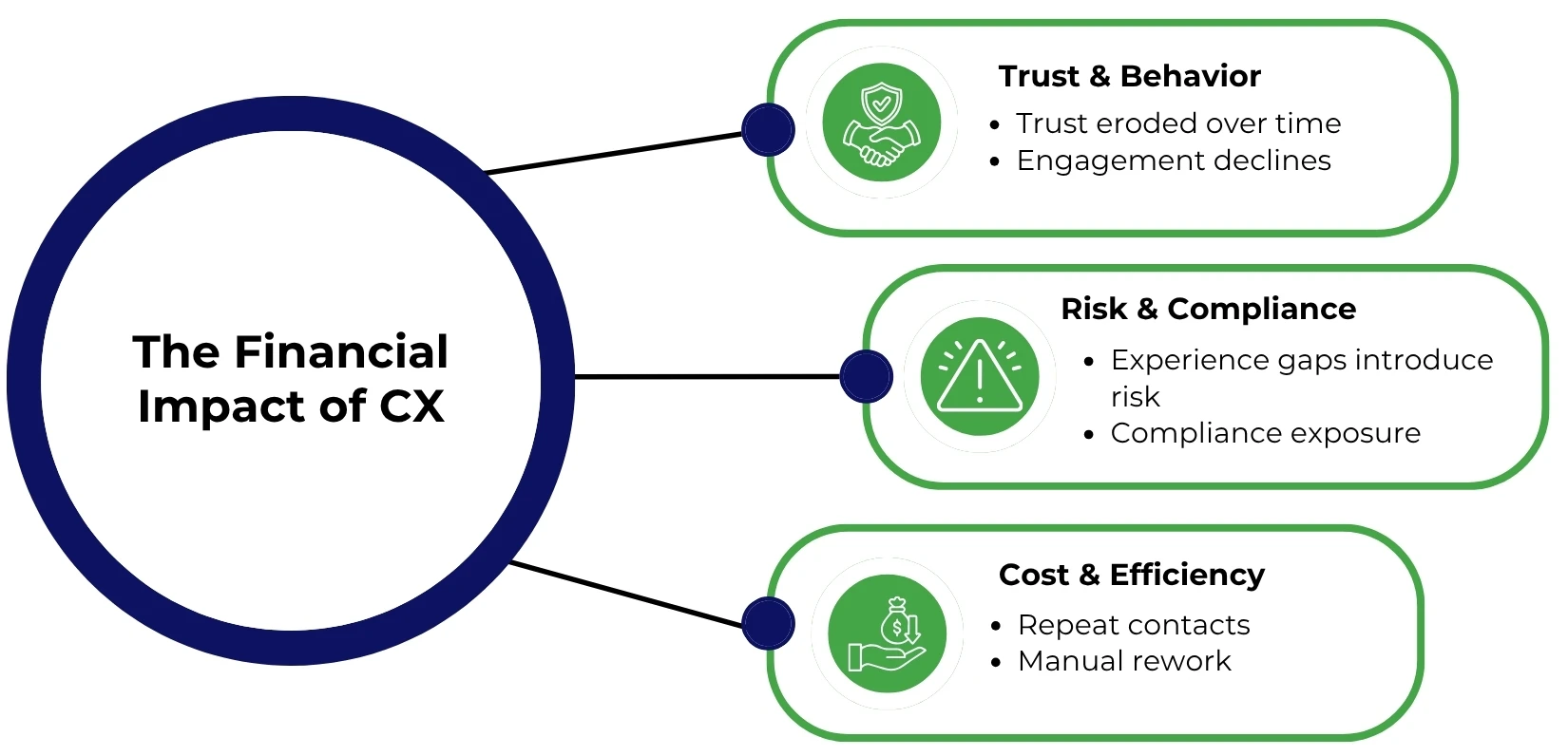
Trust is built or eroded over time. A single poor interaction may not cause immediate churn, but it changes behavior, engagement declines, tolerance decreases, and switching becomes more likely.
Experience gaps also introduce risk. Poorly explained decisions or inconsistent communication can create compliance exposure, especially as expectations for transparency increase around AI-driven interactions.1
Operational cost is equally affected. Broken experiences lead to repeat contacts, escalations, and manual rework.
Even speed has a different implication here. Delays don’t just frustrate, they create uncertainty. Customers expect immediate clarity, particularly in high-pressure situations. While self-service helps meet this demand, it only works when paired with seamless escalation to human expertise.1
From Channels to Context
For years, CX transformation has focused on expanding channels.
But channels are no longer the constraint.
Context is.
The ability to understand who the customer is, what has already happened, and what needs to happen next without forcing repetition defines a modern experience.
This is where contextual intelligence becomes critical. Organizations that can unify customer history and real-time signals resolve issues faster and build confidence through every interaction.
Without context, even fast responses fall short.
Why AI Alone Doesn’t Fix Customer Experience
AI plays a central role in modern CX, improving speed and enabling scale.
But it does not define the experience.
The real challenge is structural. Financial services leaders are increasingly prioritizing a balance between AI and human intervention, rather than choosing one over the other.
The difference comes down to clarity:
- When should AI handle the interaction?
- When should it escalate?
- How does context transfer without disruption?
Without that structure, automation increases activity rather than resolution.
Designing a CX Operating Model That Scales
Customer experience at scale is not delivered through tools alone; it is delivered through a coordinated model.
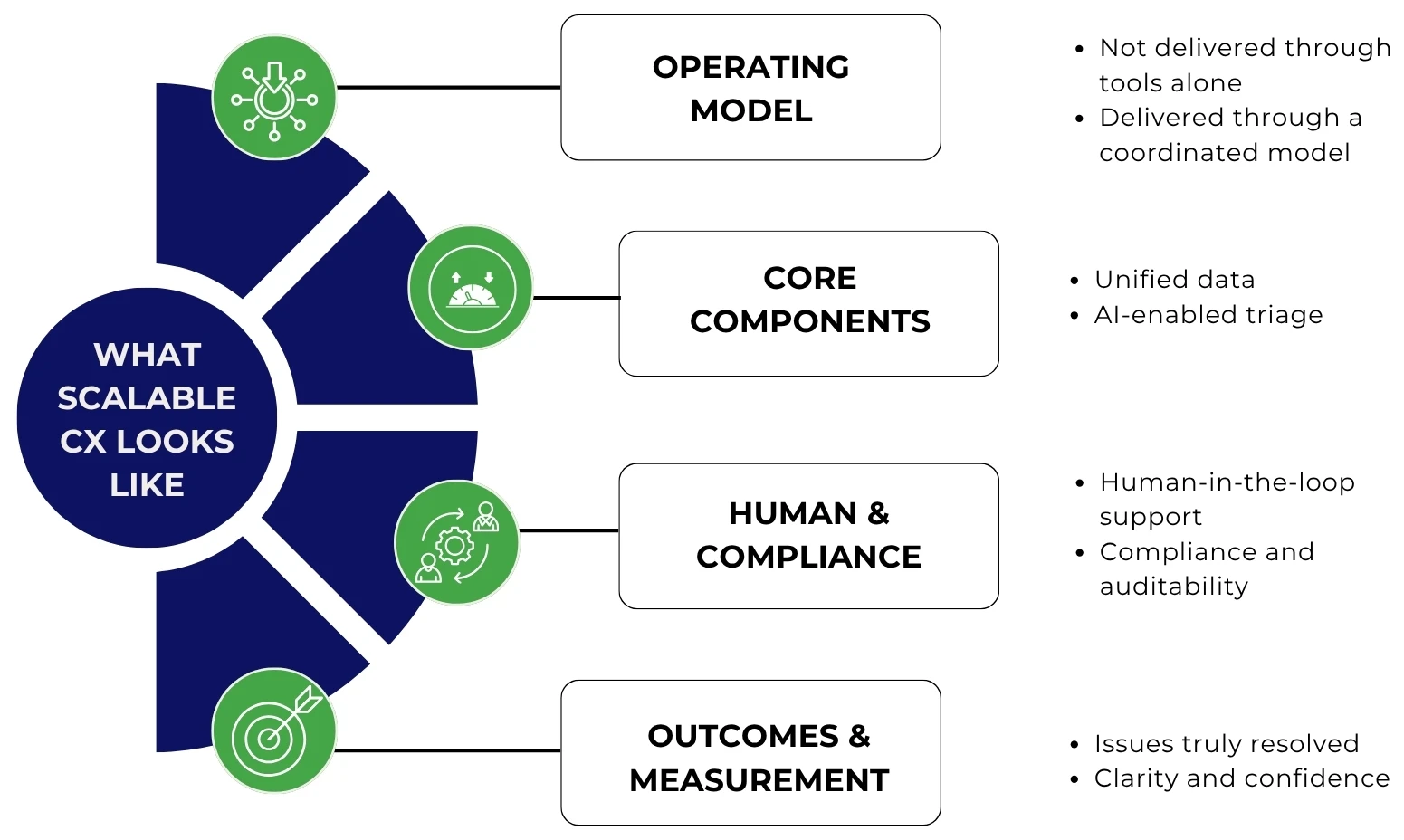
That model brings together unified data, AI-enabled triage, and human-in-the-loop support for complex or high-risk interactions. It also embeds compliance and auditability into workflows, rather than treating them as afterthoughts.
There is also a shift in how performance is measured. Beyond response times, organizations are focusing on whether issues are truly resolved and whether customers leave with clarity and confidence. Many are already adopting more advanced, AI-driven metrics to evaluate these outcomes.
The goal is not faster service. It has more reliable outcomes.
Why Most CX Transformations Stall
Most CX initiatives don’t fail due to a lack of intent; they stall due to approach.
Customer experience is treated as a support function instead of an operational capability. Technology is implemented without addressing system fragmentation. Automation is introduced without a clear escalation design. Metrics focus on speed rather than resolution quality.
These gaps don’t just limit progress; they compound over time.
CX Is No Longer a Front-Office Function
Customer experience now shapes how financial institutions manage trust, risk, compliance, and efficiency.
The shift is not about more channels or more automation. It is about aligning the operating model with modern expectations.
Because customer experience is not defined by what the customer sees.
It is defined by how well the organization is built to respond.
If customer experience hasn’t changed how your operations run, it isn’t a transformation; it’s an interface upgrade.