

Key Takeaways
- 1Outsourcing must evolve with your business, not just scale with it
- 2Stable performance is not enough; continuous improvement drives value
- 3Capability, not cost, defines a modern outsourcing partner
- 4If your partner isn’t shaping decisions, they’re limiting growth
At a certain stage of growth, typically between $100M and $1B in revenue, mid-market companies encounter a structural tension.
The business evolves faster than the systems and partners designed to support it.
Outsourcing is often part of that foundation. It performs until it plateaus.
As operations scale, complexity compounds across finance, customer experience, data, and technology. Yet many organizations continue to treat outsourcing as a static solution, rarely reassessed as business demands shift.
Ask yourself: When was the last time your partner meaningfully improved how your business operates, not just how much work it handles?
For mid-market companies operating with enterprise-level expectations, inaction carries a cost, slower decision cycles, rising inefficiencies, and lost opportunities to optimize.
The right partner should not simply execute tasks. It should expand capabilities, inform better decisions, and enable growth without adding complexity.
Reframing Outsourcing: From Cost Efficiency to Capability Advantage
For many mid-market organizations, outsourcing has traditionally been viewed through a single lens: cost efficiency.
As companies enter what many leaders call the “muddy middle,” growth accelerates, but the systems, processes, and teams supporting that growth struggle to keep pace. At this stage, efficiency alone is no longer sufficient. The focus shifts from reducing cost to building capabilities that support growth without introducing friction.
Today’s competitive landscape demands more:
- Advanced analytics to inform faster, better decisions
- Automation and AI to drive efficiency at scale
- Enhanced customer experience to retain and grow revenue
- Flexible infrastructure that adapts to demand
The most effective partners no longer operate as external vendors. They function as an extension of your business, combining:
- Technology that enables scale and efficiency
- Specialized talent aligned to your processes
- Operational insight that drives continuous improvement
This co-sourcing approach, which blends human expertise with technology, allows organizations to expand their capabilities rather than merely shift work elsewhere.
The Outsourcing Maturity Gap: 5 Signals It’s Time to Reevaluate Your Partner
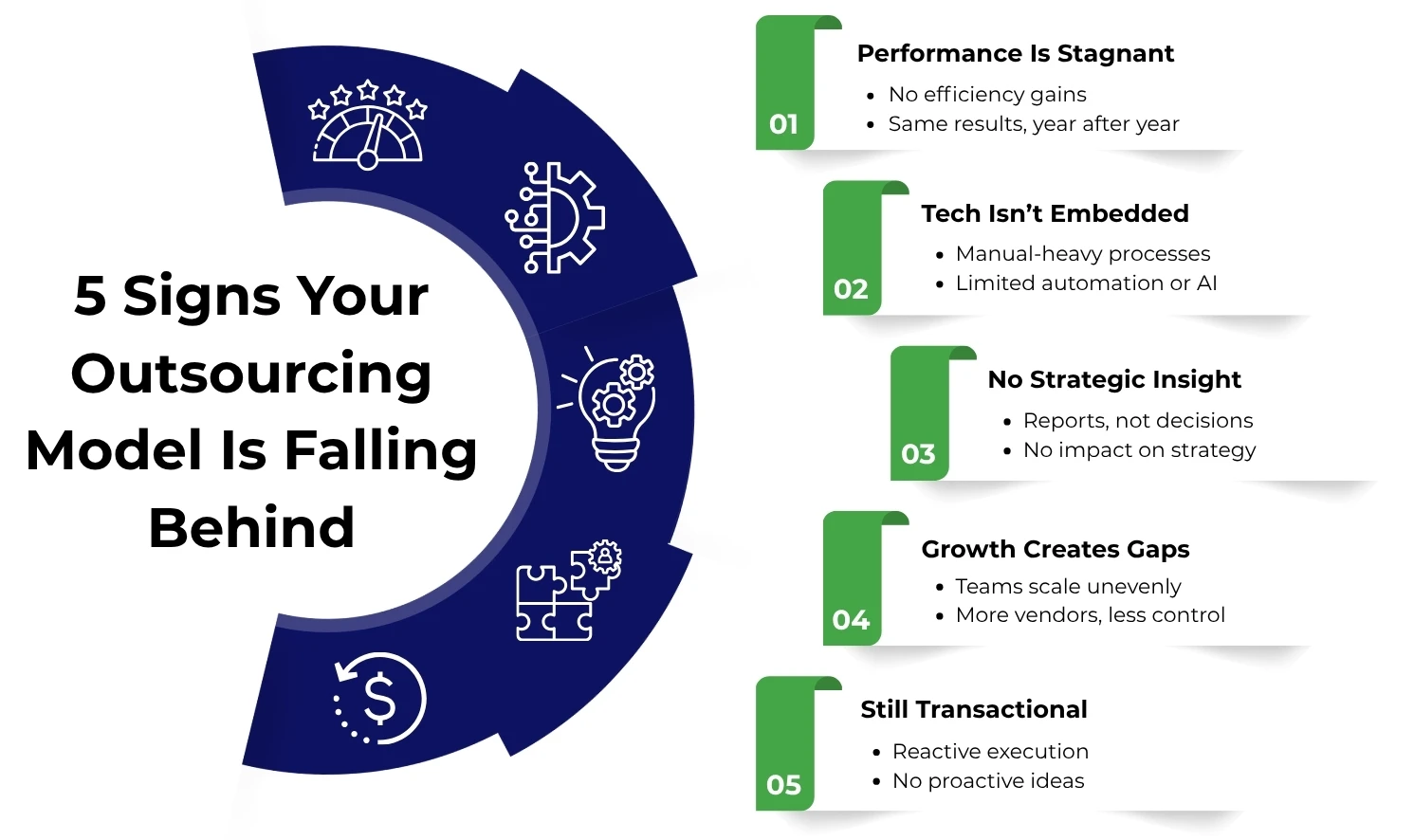
1. Performance Is Being Maintained, But Not Improved
At first glance, everything appears to be working. SLAs are met. Reports are delivered on time.
The issue is not failure. It is a lack of progress.
- Are processes improving year over year?
- Are error rates, cost per transaction, or cycle times decreasing?
If the answer is unclear, performance is being maintained, but not optimized.
Executive perspective: Maintaining performance keeps operations running. Improving performance is what drives margin expansion and efficiency gains.
2. Work Still Relies Heavily on Manual Effort
Why it matters:
Efficiency today is driven by automation, AI, and system integration, not manual effort alone.
- Heavy reliance on manual workflows
- Limited use of automation or AI augmentation
- No innovation roadmap tied to your operations
Executive perspective: When technology doesn’t reduce effort or increase accuracy, costs rise, and competitiveness declines over time.
3. Insight Is Missing from the Equation
Most partners can tell you what happened.
Far fewer can tell you what’s next.
If your outsourcing relationship is not informing decisions across revenue operations, finance, or customer experience, then it is disconnected from the outcomes that matter most.
The shift to look for:
From reporting activity to informing strategy.
Executive perspective: Data without insight increases reporting volume, not decision quality.
4. Growth Is Exposing Gaps You Didn’t See Before
At $100M, a single-function partner may have been sufficient.
At $300M or $500M, it starts to show.
- CX scales, but finance lags
- Sales grow, but ops can’t keep pace
- New systems create new silos
What changed? Not your partner, your business did.
And when your operating model evolves faster than your partner can expand, fragmentation follows.
More vendors. More handoffs. Less control.
Executive perspective: Fragmentation increases cost, reduces visibility, and slows execution across the organization.
5. The Relationship Hasn’t Kept Up with Your Business
Early on, execution is enough.
Later, it isn’t.
As your business matures, you need a partner who:
- Understands your model
- Anticipates challenges
- Brings ideas that you haven’t considered
If interactions are still transactional, task-based, reactive, and operational, you’ve outgrown the relationship.
The simplest test: Are they helping you think or just helping you do?
Executive perspective: Strategic partners expand capability. Transactional partners limit it.
What a Modern Outsourcing Partner Should Look Like
At a certain stage, the distinction becomes clear that not all outsourcing models are built for growth.
A modern partner operates differently:
- Integrated, not isolated — operating as an extension of your team, not a separate vendor
- Insight-driven, not task-driven — turning data into decisions, not just delivering reports
- Technology-enabled by default — embedding automation and AI to continuously improve outcomes
- Built for mid-market realities — delivering enterprise-level capability without unnecessary complexity
- Accountable to outcomes — measured by business impact, not just activity or SLAs
Where the Difference Actually Shows
Outsourcing rarely fails in theory. The gap becomes visible in execution.
- Does growth introduce clarity or complexity?
- Are decisions accelerating or slowing down?
- Is your leadership team focused on strategy or managing coordination across vendors?
This is where the difference becomes measurable.
The right partner does not simply remove work. It improves how the business operates. It reduces friction, shortens decision cycles, and strengthens alignment across functions.
If that shift is not happening, the issue is not performance. It is the model.
Outsourcing shouldn’t just support growth. It should enable it.
If you are reassessing what your next stage requires, it may be time to take a closer look at how your current model is performing.
About the Author
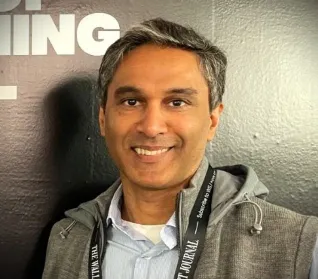
As CEO, Ali Din oversees the overall strategy and direction for Premier NX. With senior leadership roles at global HR and recruiting platforms, Indeed and ADP. Ali has over 25 years of experience in the IT and advanced technology sector. Ali’s time is focused on transformation in the business, both for professional development and for clients, to enhance business outcomes.