

Key Takeaways
- 1Businesses outsource document processing to improve accuracy, efficiency, and scalability.
- 2Document validation, workflow management, and exception handling strengthen operational control.
- 3Document standardization creates consistent processes across teams and business functions.
- 4Document intelligence transforms business documents into structured, actionable data.
Businesses outsource document processing to improve accuracy, accelerate turnaround, manage exceptions, standardize workflows, and convert unstructured documents into usable data. The strongest model combines client-owned governance with specialized teams, quality assurance, and intelligent automation.
When invoices, applications, claims, forms, or supporting documents move through fragmented systems, small processing problems quickly become operational risks. Delayed approvals, incomplete records, manual rework, and poor workflow visibility can affect financial reporting, customer service, compliance, and growth.
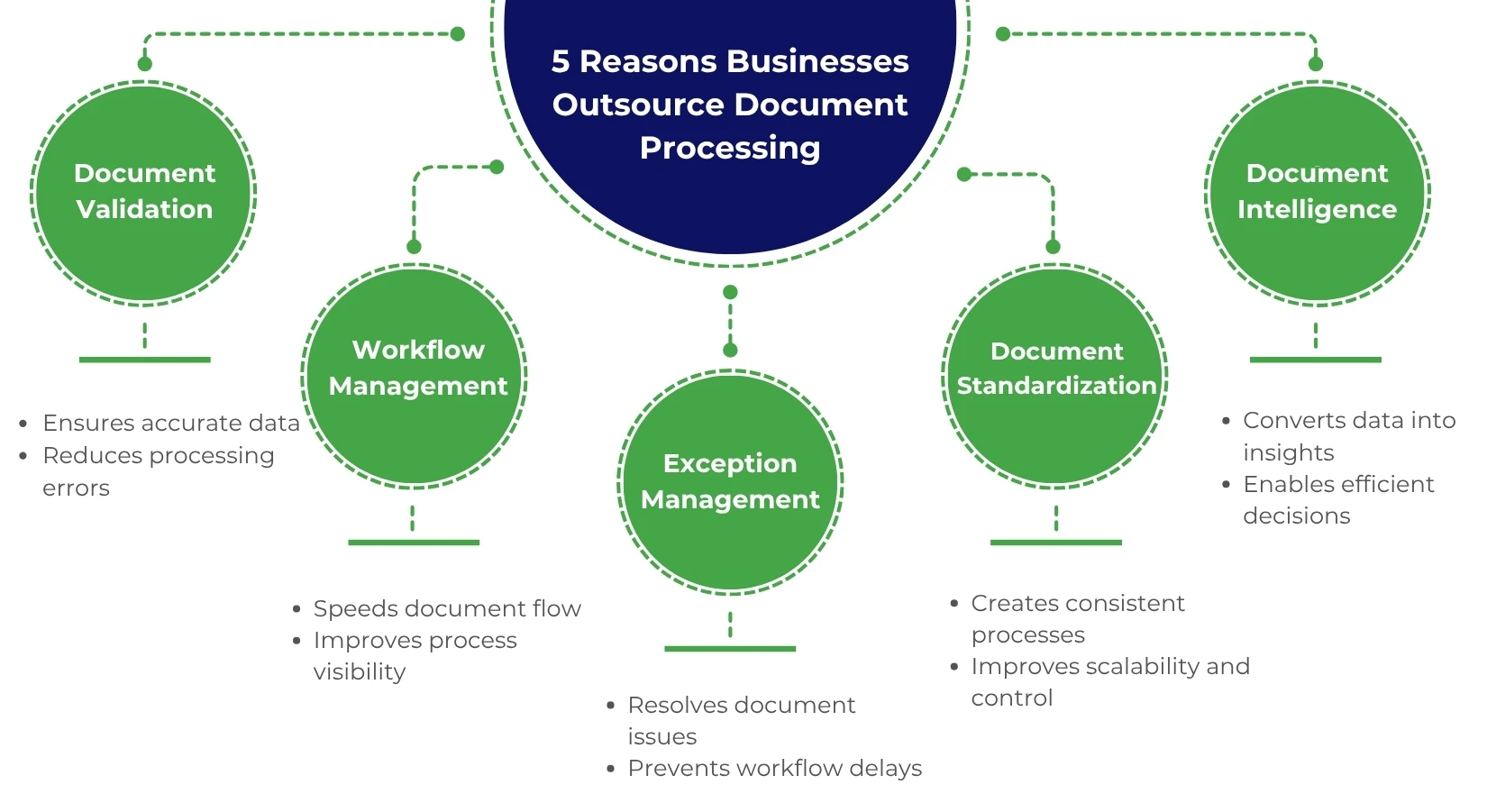
Five ways outsourcing improves document operations
1. Document Validation: Ensure Business-Critical Information Is Accurate
Document validation confirms that required information is present, correctly formatted, and consistent before it enters another business process. This can include checking invoice fields, customer records, supporting documents, account details, claim information, or approval requirements.
Why: Reliable document validation minimizes processing inconsistencies, improves data quality, and reduces the risk of errors affecting business operations.
Business value: Organizations strengthen data integrity, improve operational reliability, and establish greater confidence in business-critical information.
2. Workflow Management: Keep Documents Moving Efficiently
Document workflow management governs how information moves between intake, review, approval, processing, and completion.
Why: Well-defined workflows reduce unnecessary delays, improve coordination between teams, and support consistent document processing across the organization.
Business value: Organizations improve operational continuity, accelerate document turnaround, and maintain greater control over document-driven processes.
3. Exception Management: Resolve Processing Issues Before They Escalate
An exception is any document that cannot move through the standard process because information is incomplete, inconsistent, unclear, or outside established rules.
Automation can handle predictable documents efficiently. Exceptions still require judgment, investigation, communication, or escalation.
Why: Consistent exception handling improves processing reliability while reducing recurring issues that impact productivity and service delivery.
Business value: Organizations reduce operational disruptions, improve processing consistency, and maintain higher service levels across document operations.
4. Document Standardization: Create Consistent Business Processes
Document standardization creates consistent rules for how information is received, reviewed, named, classified, processed, retained, and escalated. This matters when multiple departments, locations, or teams handle similar documents differently.
Why: Consistency strengthens governance, improves collaboration, and reduces variation that can affect quality and operational performance.
Business value: Organizations achieve more predictable outcomes, stronger compliance, and a more scalable document processing environment.
5. Document Intelligence: Transform Documents Into Actionable Data
Document intelligence uses technologies such as optical character recognition, artificial intelligence, and machine learning to extract, classify, and organize information from structured and unstructured documents.
Why: Better access to structured document data enables faster decisions, improved visibility, and more informed business planning.
Business value: Organizations unlock greater value from document assets while improving reporting, operational insight, and cross-functional collaboration.
What Should Businesses Keep In-House?
Businesses should retain ownership of decisions that define risk, policy, and strategic direction. These typically include:
- Document governance and retention policies
- Compliance and risk accountability
- Business rules and approval criteria
- Process objectives and performance priorities
- Technology and vendor strategy
The outsourcing partner should operate within those requirements while providing execution capacity, quality assurance, workflow expertise, and proactive improvement recommendations.
Make Document Processing a Business Advantage
Document processing plays a critical role in maintaining efficient, accurate, and scalable business operations.
Premier NX helps mid-market organizations optimize document operations through scalable processing solutions, strategic automation, and experienced operational teams.
Looking to optimize your document processing operations?