

Key Takeaways
- 1Manual document processing creates hidden business costs that extend beyond labor into cash flow, reporting, compliance, and scalability.
- 2As document volumes grow, operational complexity increases faster than workload, making manual workflows increasingly expensive to maintain.
- 3Successful document transformation combines standardized workflows, intelligent automation, and human expertise rather than relying on technology alone.
- 4The real competitive advantage isn’t processing documents faster; it’s enabling faster, more informed business decisions through optimized workflows.
Manual document processing costs businesses far more than employee time. It creates approval delays, billing errors, rework, compliance exposure, weak reporting, and slower decisions across finance, operations, procurement, and customer service.
The real cost begins after a document enters the workflow. Every invoice, claim, purchase order, freight bill, onboarding form, or insurance document must be validated, routed, reconciled, approved, reported, and sometimes corrected. When those steps depend on manual handoffs, operational friction compounds as volume grows.
What is the Hidden Cost of Manual Document Processing?
Manual document processing is the human-led creation, review, routing, validation, and correction of business documents across disconnected systems, inboxes, spreadsheets, and approval queues.
Its impact can be measured through the Five-Layer Document Cost:
- Visible cost: Staff time spent entering, reviewing, correcting, and tracking information.
- Hidden cost: Rework caused by missing data, duplicates, inconsistent formats, and failed handoffs.
- Business cost: Delayed invoices, slower collections, missed payment windows, and longer processing cycles.
- Strategic cost: Incomplete or outdated data that weakens forecasting, reporting, and executive decisions.
- Competitive cost: Limited capacity to absorb higher volumes, launch services, or expand without adding proportional headcount.
The most damaging costs usually sit in the final three layers because they rarely appear as document-processing expenses.
Why do Manual Workflows Become More Expensive as Businesses Scale?
Manual workflows become disproportionately expensive because operational complexity grows faster than document volume.
Processing 10,000 invoices is not simply 100 times the effort of processing 100. Higher volume creates more exceptions, approvals, duplicate reviews, routing decisions, system dependencies, and coordination between teams.
Without standardized workflows, businesses often respond by adding people. That may temporarily increase capacity, but it does not solve the underlying process problem.
How does Manual Document Processing Slow Every Department?
Manual document processing creates delays beyond finance by slowing the movement of information across the business.
- Finance & Accounting: Delays invoicing, increases billing errors, and slows cash flow.
- Operations: Creates bottlenecks, repeated checks, and avoidable rework.
- Procurement: Extends vendor approvals and purchase order processing.
- Customer Experience: Increases response times and delays issue resolution.
- Compliance: Raises audit risk through incomplete, inconsistent, or hard-to-trace records.
- Executive Leadership: Limits real-time visibility into performance, risk, and capacity.
How to Streamline Manual Invoice Creation and Billing Processes
Intelligent document processing, or IDP, uses technologies such as artificial intelligence, machine learning, data extraction, and business rules to classify documents and move information through workflows.
However, technology alone does not create an efficient operation.
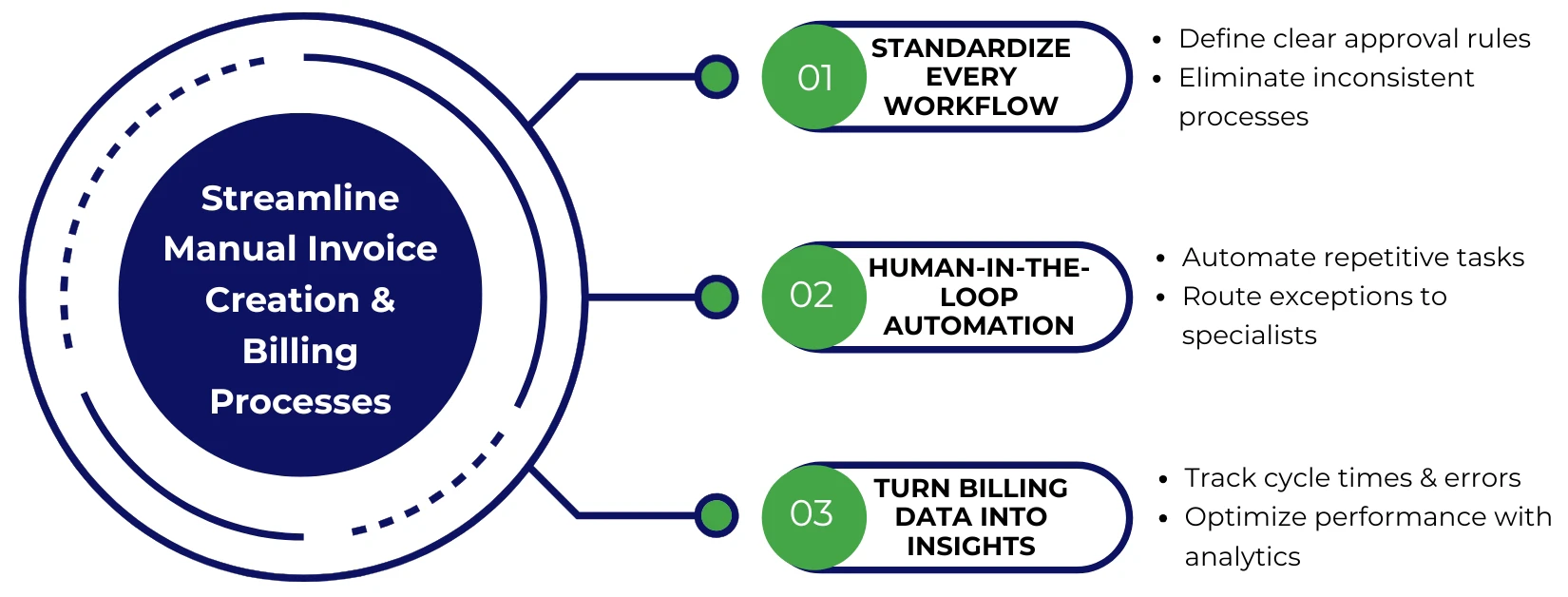
High-performing document workflows combine three capabilities:
The biggest opportunities for AI in BPO.
Design Standardized Workflows Before Scaling Operations
Before automation, organizations need clear rules for ownership, approvals, required fields, escalation paths, and exceptions.
Automation amplifies the process it is given. If the workflow is inconsistent, automation may move bad data faster without improving the outcome.
Embed Human Intelligence Where Automation Reaches Its Limits
Not every document should move without review. Complex exceptions, high-value transactions, unusual billing conditions, and compliance-sensitive records may still require human judgment.
The strongest model automates repetitive work while directing exceptions to trained specialists.
Turn Billing Data into Operational Intelligence
Billing workflows generate valuable operational data. Tracking approval cycle times, exception rates, processing accuracy, and bottlenecks enables leaders to optimize performance rather than simply process transactions continuously.
Real-World Operational Impact – From Manual Invoice Validation to Scalable Operations
Premier NX has helped organizations move beyond manual invoice processing by combining operational support, workflow redesign, quality assurance, and intelligent automation.
The Challenge
One of our financial services clients was managing high volumes of freight invoices through manual data entry and spreadsheet-based rate validation. As transaction volumes increased, the process became slower, more error-prone, and difficult to scale.
What Premier NX Did
Premier NX supported the client’s invoice operation through document processing, EDI implementation, quality assurance, flexible workforce capacity, and the development of an automated rate-validation application with configurable business rules.
The Impact
The new validation workflow reduced processing time from 40–50 minutes to 2–5 minutes. It also improved operational flexibility, strengthened data accuracy, and created a scalable model the client began considering for broader global use.
True Scale Requires More Than Faster Processing
Businesses do not invest in document processing simply to move files faster. They invest in cleaner data, predictable operations, faster cash flow, stronger compliance, and the ability to scale without unnecessary complexity.
Documents are simply where those outcomes begin.
Premier NX helps organizations improve document-intensive operations through workflow optimization, intelligent automation, quality assurance, analytics, and dedicated operational expertise.