

Key Takeaways
- 1Finance & Accounting outsourcing is shifting from cost reduction to operational scalability and reporting discipline.
- 2The strongest outsourcing candidates are workflows that are repeatable, measurable, and easier to govern through KPIs and controls.
- 3Mid-market companies are increasingly outsourcing accounting operations, AP/AR, payroll, FP&A support, reconciliations, and specialized finance workflows.
- 4Effective finance outsourcing models preserve internal strategic ownership while improving execution, visibility, and close-cycle consistency.
7 Finance and Accounting Tasks to Outsource in 2026
Finance teams are under pressure to close faster, report more clearly, and support growth with leaner teams.
Deloitte’s Q4 2025 CFO Signals survey found that 49% of CFOs cite automating processes to free employees for higher-value work as a top finance talent priority for 2026.1
The strongest finance & accounting outsourcing candidates are repeatable, measurable, and governable workflows in which strategic ownership remains in-house.
What Finance Tasks Are Best Suited for Outsourcing?
Finance tasks are best suited for outsourcing when they follow repeatable workflows, carry measurable KPIs, and can be governed through clear controls.
Use the Repeat–Measure–Govern Model:
| Test | What It Means |
|---|---|
| Repeat | Does the task follow a consistent workflow? |
| Measure | Can performance be tracked through KPIs? |
| Govern | Can internal leaders retain approval and visibility? |
A KPI is a key performance indicator. Examples include invoice turnaround, payroll accuracy, close-cycle time, and reconciliation completion.
What Breaks When Customer Volume Surges
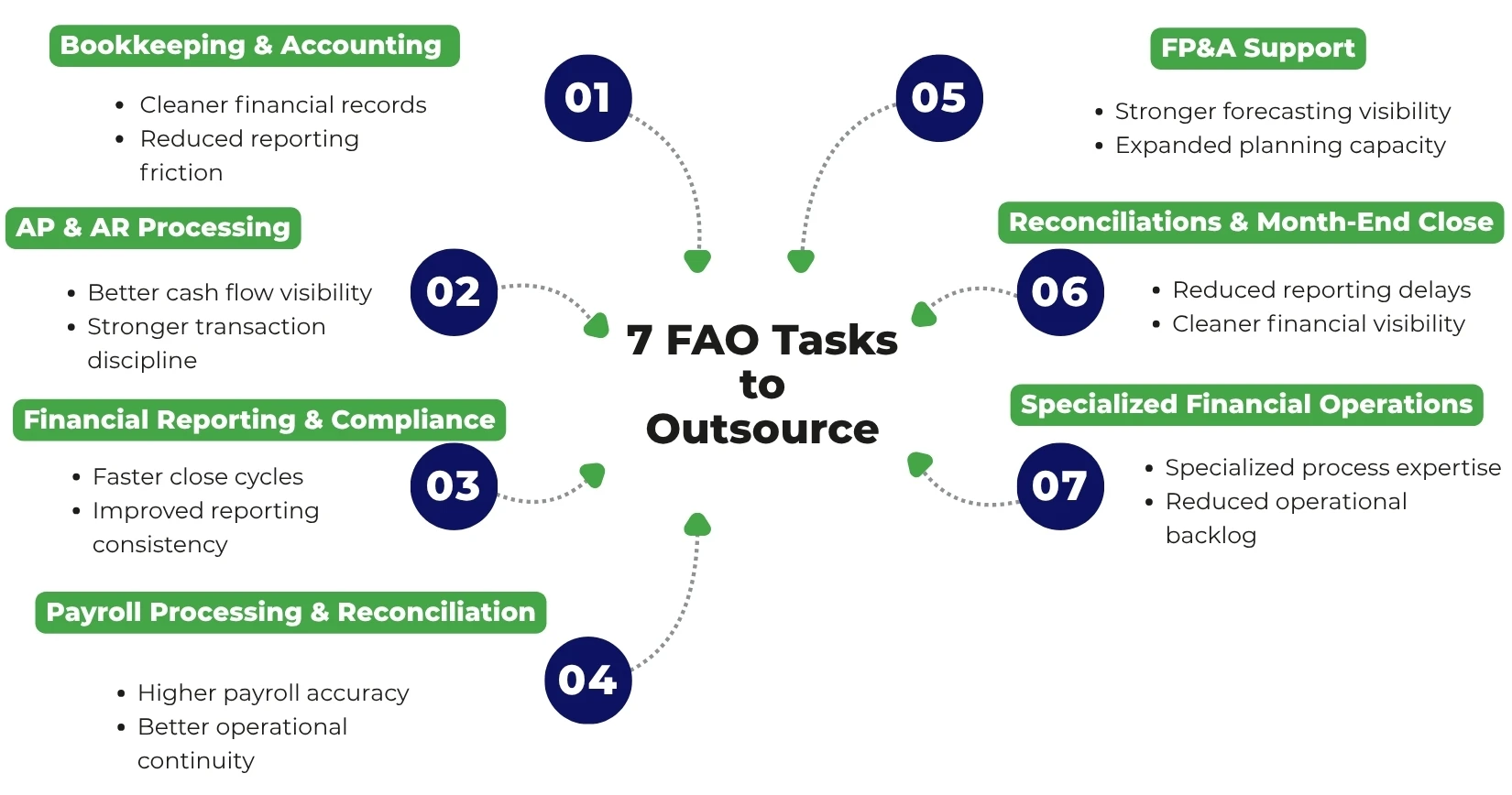
The most commonly outsourced finance tasks include bookkeeping, AP/AR, reporting support, payroll, FP&A, reconciliations, and specialized financial operations.
1. Bookkeeping and Accounting Operations: Create a Cleaner Financial Foundation
Mid-market companies outsource bookkeeping and accounting operations to keep financial records accurate, close-ready, and easier to govern as volume grows.
- Why it matters: Weak accounting discipline creates strategic drag. Delayed entries and unreconciled accounts slow decisions.
- Common scope: Daily bookkeeping, journal entry support, account maintenance, and financial record cleanup.
- Typical KPI: Record accuracy, reconciliation completion, and month-end readiness.
2. Accounts Payable (AP) and Accounts Receivable (AR) Processing: Improve Cash Flow Visibility
Companies outsource AP and AR processing to improve payment workflows, collections discipline, and visibility into cash movement.
- Entity note: AP, or Accounts Payable, manages money leaving the business. AR, or Accounts Receivable, manages money owed to the business.
- Common scope: Invoice processing, payment posting, vendor coordination, collections support, cash application.
- Typical KPI: Invoice turnaround, aging reduction, Days Sales Outstanding. DSO measures how long it takes to collect payment after a sale.
3. Financial Reporting and Compliance Support: Shorten the Close Cycle
Companies outsource reporting and compliance support to reduce close-cycle delays, improve consistency, and keep audit documentation organized.
- Entity note: The close cycle is the time needed to finalize financial results for a reporting period.
- Common scope: Management reporting, compliance files, close documentation, and audit preparation.
- Typical KPI: Close-cycle time, reporting accuracy, audit issue frequency.
4. Payroll Processing and Reconciliation: Strengthen Accuracy
Payroll outsourcing helps growing companies improve processing accuracy, reconciliation discipline, and continuity across complex workforce structures.
- Why it matters: Multiple locations, contractors, shifts, and pay rules increase exception risk.
- Common scope: Payroll inputs, employee data validation, payroll reconciliation, payroll reporting.
- Typical KPI: Payroll accuracy, processing turnaround, issue resolution time.
5. Financial Planning and Analysis (FP&A) Support: Expand Planning Capacity
Companies outsource FP&A support to improve forecasting discipline, reporting visibility, and planning capacity without overextending internal teams.
- Entity note: FP&A means Financial Planning and Analysis. It supports budgeting, forecasting, modeling, and variance analysis.
- Common scope: Budget preparation, forecast updates, variance analysis, KPI dashboards.
- Typical KPI: Forecast update speed, reporting accuracy, and budget cycle support.
6. Reconciliations and Month-End Close Support: Reduce Financial Noise
Companies outsource reconciliation and close support to improve reporting accuracy and create a more controlled month-end process.
- Why it matters: Close issues often come from small gaps: missing entries, unreconciled accounts, or weak documentation.
- Common scope: Account reconciliations, balance sheet reviews, journal entry support, reporting tie-outs.
- Typical KPI: Reconciliation completion, close readiness, exception volume.
7. Industry-Specific Financial Operations: Add Specialized Process Support
Certain financial workflows require industry-specific process knowledge, making them strong candidates for outsourcing in high-volume or compliance-sensitive operations.
- Why it matters: Medical billing, claims follow-up, freight invoices, and payment posting require specific documentation and exception handling.
- Common scope: Revenue cycle support, benefits verification, freight invoice processing, utility billing support.
- Typical KPI: Processing accuracy, turnaround time, backlog reduction.
What Finance Functions Should Stay In-House?
Strategic finance ownership should remain internal even when operational workflows are outsourced.
Keep internal control over:
- Treasury strategy and capital allocation
- Board reporting and investor communication
- Final forecasts, policies, and compliance decisions
The rule is simple: outsource execution where the workflow is structured; retain ownership where judgment and risk sit.
How Should Finance and Accounting Outsourcing Scale Over Time?
Finance and Accounting outsourcing works best when it scales in phases: stabilize the workload, build control, then support strategic finance capacity.
Premier NX helps companies avoid the “big switch” approach.
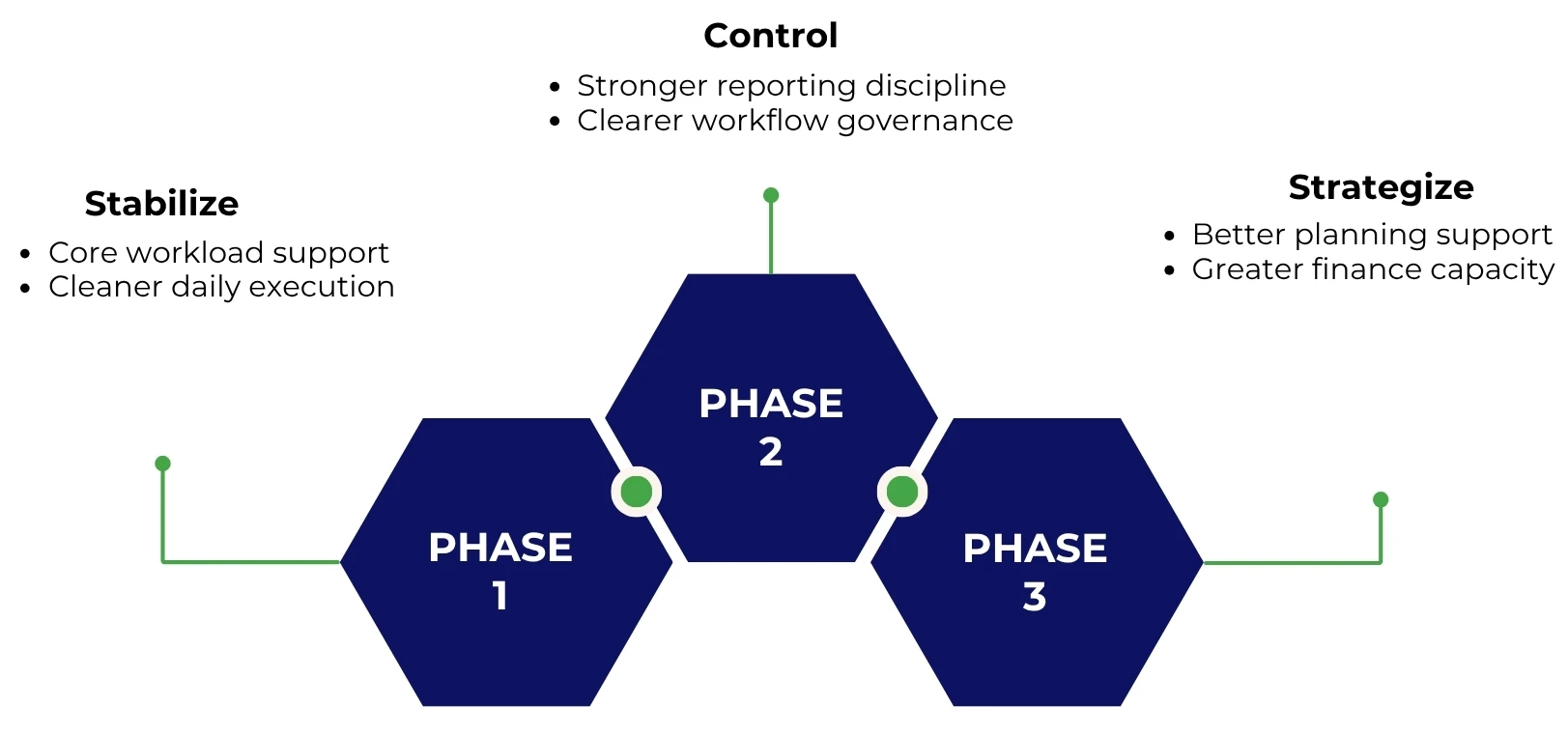
Phase 1: Stabilize
Bookkeeping, AP/AR, payroll prep, reconciliations, and month-end support.
Phase 2: Control
Reporting discipline, documentation standards, approval workflows, and KPI tracking.
Phase 3: Strategize
Budgeting support, forecast preparation, financial analysis, dashboards, and process improvement.
This phased model gives finance leaders capacity without forcing them to give up control.
Outsourcing Should Strengthen Finance Leadership
The best finance teams do not outsource to step away from control. They outsource to create more of it.
Premier’s point of view is simple: build an external finance operations layer that scales the work while internal leaders steer the business.
Find the Right Starting Point for Finance and Accounting Outsourcing
Not every finance workflow should be outsourced at once or in the same way.
If your team is managing close-cycle pressure, reporting delays, reconciliation backlogs, or transaction-heavy workloads, Premier NX can help you identify where external support will create the most value first.
Book a complimentary FAO readiness review, and we’ll map your current workflows, visibility gaps, and support needs into practical next steps for a more scalable finance operation.
About the Author

As CEO, Ali Din oversees the overall strategy and direction for Premier NX. With senior leadership roles at global HR and recruiting platforms, Indeed and ADP. Ali has over 25 years of experience in the IT and advanced technology sector. Ali’s time is focused on transformation in the business, both for professional development and for clients, to enhance business outcomes.