


Key Takeaways
- 1Scalable CX depends on the infrastructure behind the experience, not just the channels customers use.
- 2Adding more tools can increase complexity when systems, workflows, and data are not connected.
- 3Leaders need clear visibility into cost, quality, productivity, and customer trust to manage CX as the business grows.
- 4The strongest CX models combine automation with human judgment, so speed improves without losing empathy or control.
What happens when customer expectations grow faster than the infrastructure built to support them?
For many mid-market companies, this is where customer experience begins to strain. Growth increases demand, expands service channels, and raises customer expectations for faster, more connected support.
But the systems behind the experience often belong to an earlier stage of the business.
The result is familiar: teams work harder, tools multiply, reporting slows, and leaders lose visibility into what drives cost, quality, productivity, and customer trust.
Scalable customer experience does not begin with more channels. It begins with the right infrastructure: a connected operating foundation that helps people, processes, data, and technology move together as the business grows.
What “Infrastructure” Means in Customer Experience
At scale, customer experience is not defined by individual interactions alone. It is defined by how consistently those interactions can be delivered, measured, and improved across the business.
In this context, infrastructure is not simply a toolset. It is the operating architecture behind the experience: the foundation that determines how customer demand moves through the organization, how leaders gain visibility, and how teams respond as volume and complexity increase.
That foundation includes:
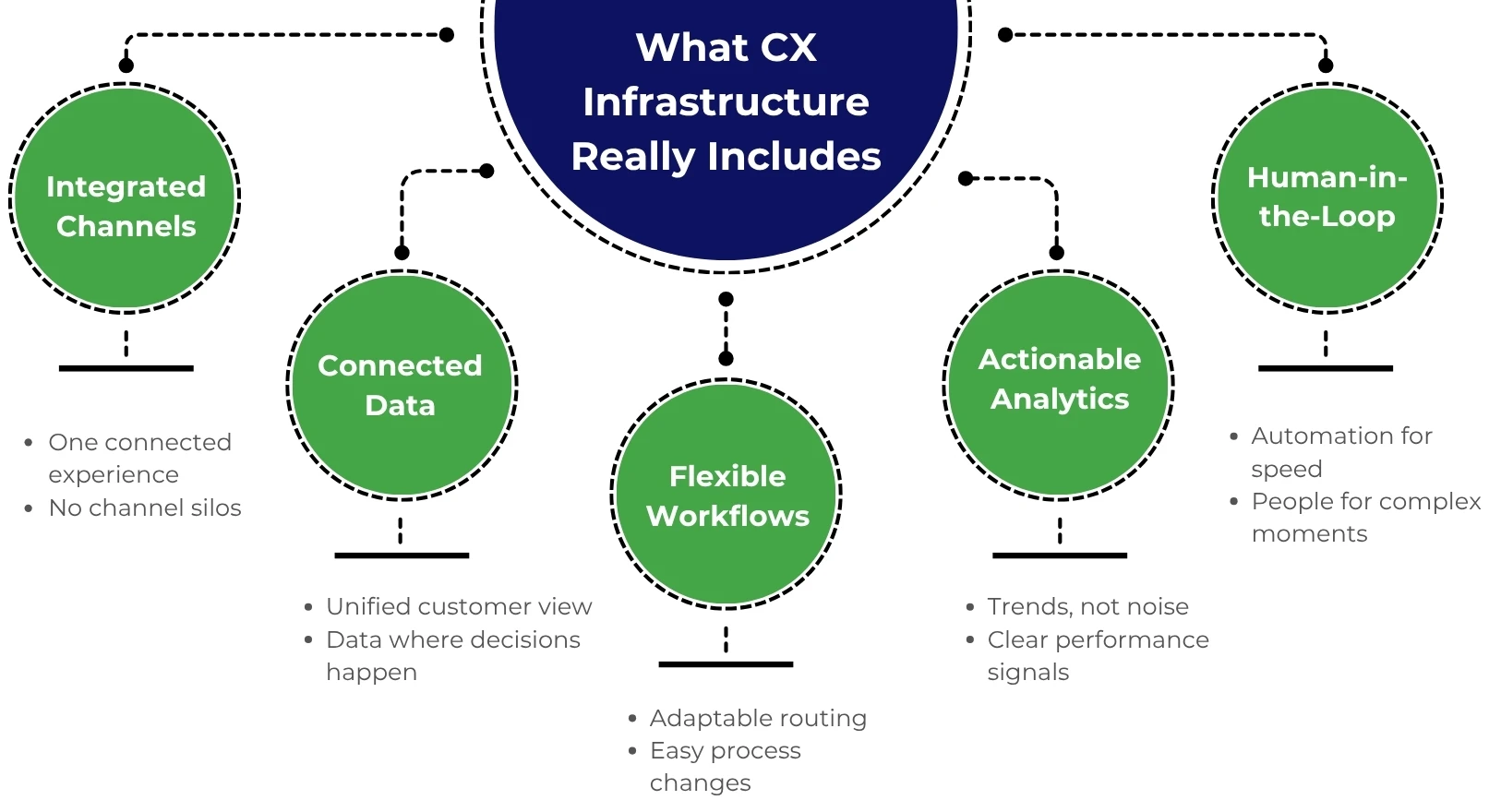
Integrated channels — voice, email, chat, SMS, self-service, and outbound engagement working together instead of operating in silos.
Connected data — customer history, interaction data, and operational metrics are available where decisions are made.
Flexible workflows — routing, escalation, ticketing, and follow-up processes that can adapt as the business grows.
Actionable analytics — reporting that helps leaders see trends, performance gaps, cost drivers, and improvement opportunities.
Human-in-the-loop design — automation that improves speed while preserving human judgment for complex, sensitive, or high-value moments.
Why More Tools Do Not Always Mean More Scale
A common response to CX friction is to add another tool.
A chatbot for faster response. A new ticketing layer. An SMS platform. A reporting dashboard. A workforce tool. Each solves a specific gap. Together, they can create a larger one.
Scale is not defined by how many tools are in the stack. It is defined by how well those tools operate as one system.
When they do not:
- Agents lose context between interactions
- Customers repeat information across channels
- Supervisors lack real-time visibility
- Finance teams cannot clearly connect cost to performance
- Leaders make decisions from incomplete or delayed data
Adding tools can increase activity. It does not automatically improve outcomes.
For mid-market companies, the real question is not, “Do we have enough technology?” It is, “Can our technology, teams, and workflows support growth without adding unnecessary cost or complexity?”
For a deeper look at this shift, listen to The 2026 Contact Center Mandate: Moving from AI Pilots to Proactive CX.
How to Know If Your CX Infrastructure Is Built to Scale
If more tools do not guarantee scale, leaders need a clearer way to evaluate the foundation behind CX.
The question is not whether the business has enough technology. The question is whether its infrastructure can support growth without adding complexity.
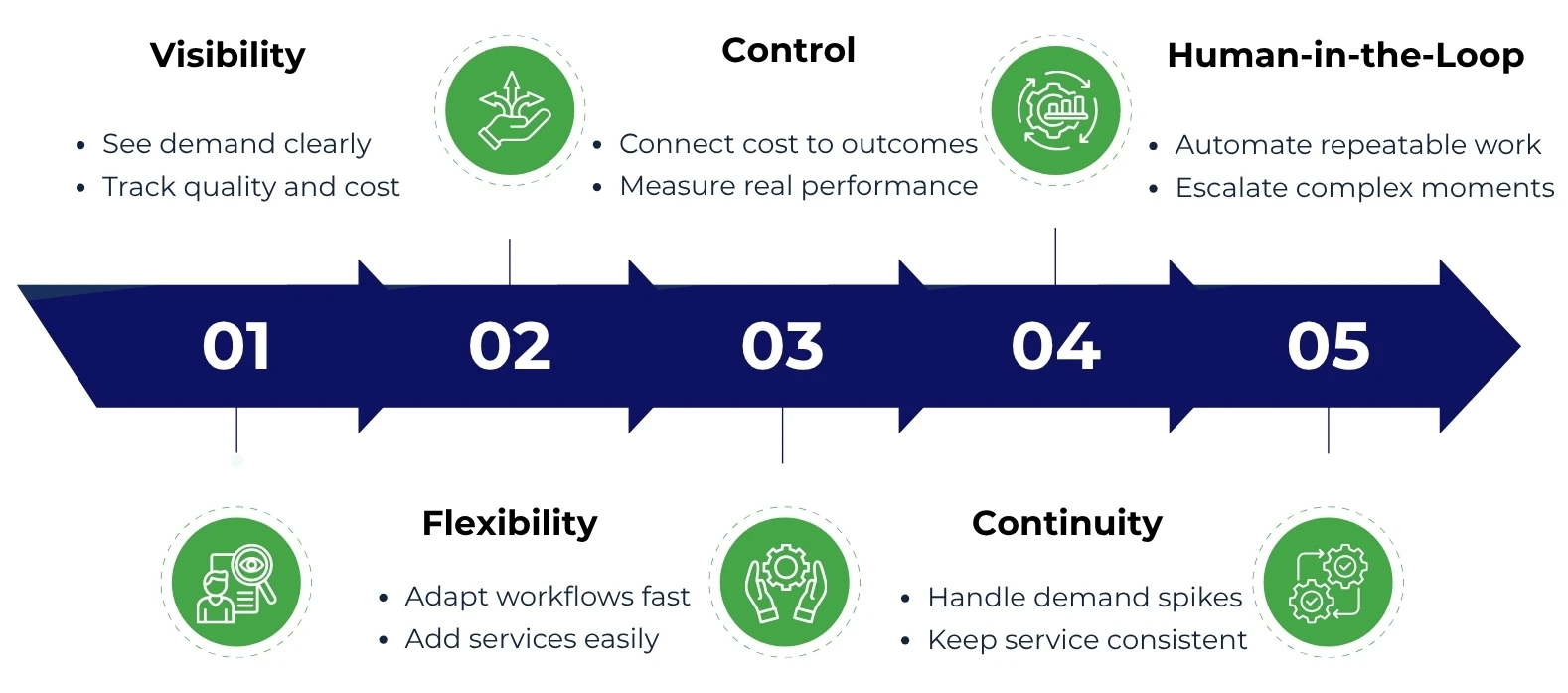
1. Visibility: Can leaders see what is happening across the operation?
Scalable infrastructure should give leaders a clear view of customer demand, service quality, agent performance, and outcomes.
It should show:
- Channel activity
- Repeat issues
- Resolution trends
- Quality gaps
- Cost and productivity signals
Visibility is what turns CX from activity tracking into informed decision-making.
2. Flexibility: Can the model adapt to the business?
Mid-market companies need infrastructure that fits their operating model, not the other way around.
It should support:
- Tailored workflows
- CRM and platform integration
- New service lines
- Changing customer needs
- Growth across teams or locations
Infrastructure should enable the business to evolve without requiring a full rebuild whenever priorities change.
3. Control: Can cost, quality, and outcomes be connected?
CX must be measurable as a business function.
The right infrastructure connects:
Cost → Productivity → Quality → Customer Outcome
This helps leaders understand whether automation, staffing, and process changes are improving performance or simply adding activity.
4. Continuity: Can service stay consistent as demand changes?
Scalable CX depends on operational resilience.
Infrastructure should support:
- Demand spikes
- Staffing changes
- Remote or distributed teams
- Process handoffs
- Business disruption
The goal is consistent service without over-reliance on manual coordination.
5. Human-in-the-Loop (HITL): Does automation support people, not replace them?
Scalable CX should balance self-service with human judgment.
Infrastructure should enable:
- Intelligent routing
- Agent-assist tools
- Knowledge support
- Automation for repeatable work
- Clear escalation to human experts
Automation should improve speed and efficiency while preserving empathy, context, and accountability in moments that matter.
Explore what mid-market leaders need to get right before scaling AI across customer service: AI in Customer Service 2026: What Mid-Market Leaders Need to Get Right
The Premier NX Perspective: Enterprise-Grade CX, Built for the Mid-Market
Scalable CX infrastructure should not require mid-market companies to operate like large enterprises.
The goal is to bring the right capabilities into the business without adding unnecessary complexity:
- Multichannel care that supports customers across touchpoints
- Connected workflows that reduce handoffs and manual effort
- AI-enhanced agent support through tools such as agent assist and knowledge bases
- Analytics and reporting that give leaders clearer visibility
- Human-in-the-loop execution for complex, sensitive, or high-value interactions
This is the perspective Premier NX brings to CX modernization. The focus is not on labor alone or automation alone. It is the right combination of tech-enabled operations, tailored service design, analytics, and human judgment.
For mid-market leaders, the value is practical: scalable CX infrastructure that improves speed, efficiency, and consistency without losing control, visibility, or customer connection.
Scalable CX Is Built Before the Customer Reaches Out
Customer experience is judged in the moment, but it is shaped long before that moment happens.
It is shaped by the infrastructure supporting the agent, the data driving the workflow, and the operating model underpinning the technology.
That is where the difference becomes visible.
- Does growth make service more consistent or more difficult to manage?
- Are teams resolving issues faster or coordinating across more systems?
- Can leaders see what is driving cost, quality, and customer trust?
- Does automation improve the experience or create distance from the customer?
If your current CX model is becoming harder to manage as the business grows, it may be time to assess whether the infrastructure behind it is ready for what’s next.