



Is medical billing outsourcing the answer to rising healthcare costs? For many providers, the answer is yes. Outsourcing reduces billing errors, speeds up reimbursements, and helps control labor and compliance costs.
Rising operating costs continue to challenge even the most financially stable healthcare providers. While early 2024 showed modest margin recovery; median margins rising to 1.2% from -0.5% and expenses remain stubborn. Operating costs increased nearly 7% year-over-year, driven by wage inflation, staffing gaps, and regulatory overhead.
Billing errors cost hospitals billions annually, leading to claim denials, delayed reimbursements, and even legal issues. Outsourcing firms specialize in medical billing and coding, ensuring compliance with ever-evolving healthcare regulations like HIPAA. Their expertise minimizes costly mistakes, accelerates reimbursements, and reduces the risk of penalties.
This blog explores whether medical billing outsourcing can effectively address these pressures and what healthcare leaders should evaluate when considering this shift as part of a broader financial strategy.
Key Takeaways
- 1Medical billing inefficiencies quietly drain revenue—outsourcing can help plug the gaps.
- 2Billing teams face turnover rates up to 40%.
- 3Is it time to shift your billing from in-house burden to a strategic service partner?
- 4Outsourcing isn’t a cost-cutting shortcut—it’s a structured way to gain operational stability.
- 5
Premier delivers billing support that aligns with your operations.
What are Cost Drivers Behind In-House Medical Billing?
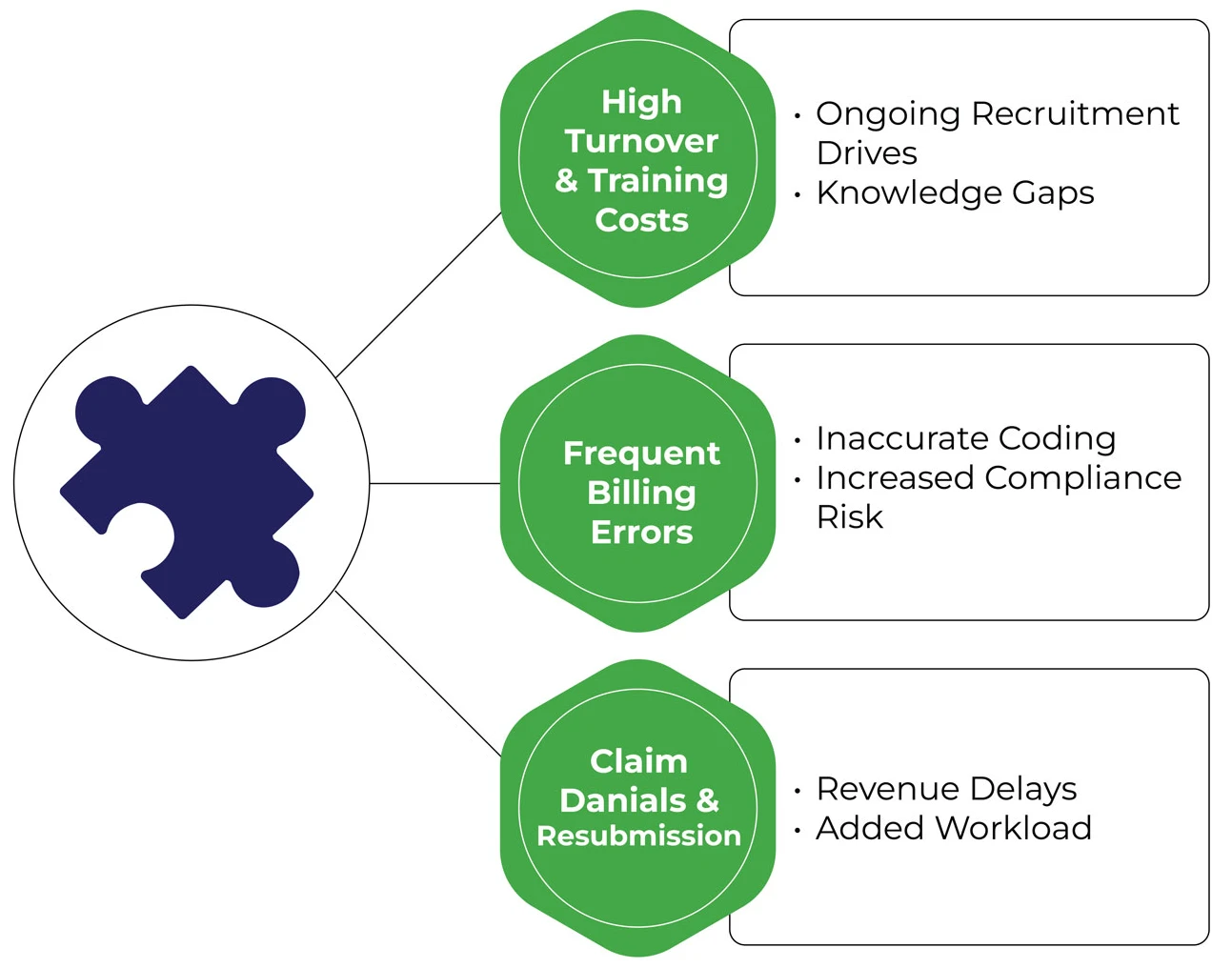
Managing billing internally leads to high turnover, costly technology upkeep, and delayed reimbursements, all of which drain revenue and divert focus from patient care. These inefficiencies highlight why many providers are exploring more streamlined, cost-effective alternatives.
Managing medical billing internally presents a range of cost and operational challenges. Staffing remains a primary concern; turnover among billing professionals can reach up to 40%, leading to recurring recruitment and training expenses. At the same time, regulatory demands require constant updates to billing practices and staff knowledge, increasing the burden on internal teams to remain compliant with ever-evolving payer requirements and coding standards.
Beyond personnel, inefficiencies in claims handling and accounts receivable can significantly impact revenue. Industry data shows nearly 20% of claims are denied, and a majority of those are never resubmitted, representing a tangible loss. Delayed reimbursements also affect cash flow, while maintaining up-to-date billing systems—often costing hundreds of dollars per provider monthly—adds recurring technology costs. Together, these factors compound to make in-house billing an increasingly expensive and complex function to manage.
Administrative tasks like billing often divert attention from patient care. Outsourcing frees healthcare professionals from these burdens, enabling them to prioritize patient-focused services. This shift not only improves care quality but also boosts patient satisfaction.
What are Major Differences between In-House & Outsourced Medical Billing?
When comparing in-house billing to outsourcing, the latter often delivers stronger revenue performance, better compliance, and lower overhead. Outsourced partners bring specialized expertise, advanced technology, and business continuity measures.
| Aspect | In-House Medical Billing | Outsourced Medical Billing |
|---|---|---|
| Cost Structure | Includes salaries, benefits, training, software, infrastructure, and turnover-related costs. Hidden costs often arise from inefficiencies and errors. | A fixed or variable fee based on volume or collections. Reduces overhead but may include transition or oversight costs. |
| Revenue Cycle Performance | Prone to delays due to staffing gaps, manual processes, or lack of specialization. Denials may go unaddressed. | Specialized teams and established workflows often result in faster turnaround, lower denial rates, and improved collections. |
| Technology Investment | Requires continual upgrades and cybersecurity safeguards; may lag due to budget constraints. | Specialized providers offer access to advanced platforms as part of service, reducing the need for direct capital investment. |
| Compliance and Risk | Higher burden on internal teams to stay updated with payer rules and regulations. | Outsourcing providers typically maintain compliance frameworks and have expertise in regulatory updates. |
| Business Continuity | Vulnerable to disruptions from turnover, absences, or local incidents. | Providers often have distributed teams and redundancy protocols to ensure uninterrupted service. |
How Much Does Outsourcing Medical Billing Really Cost?
The true cost of outsourcing medical billing isn’t just about fees; it’s about the value it returns. By improving billing accuracy, accelerating reimbursements, and reducing internal strain, outsourcing becomes a strategic lever for long-term financial stability.
After weighing the operational pros and cons, cost remains a central factor in deciding whether to outsource medical billing.
According to the Medical Group Management Association (MGMA), billing service providers typically charge between 4% and 9% of collected monthly revenue. This fee generally includes key functions such as coding, claims management, denial follow-up, and payment reconciliation.
While these costs are predictable and often built into performance-based pricing models, it’s important to note that vendors may use various billing structures; some charging by percentage, others by volume or claim type. The true financial impact depends on the complexity of your billing environment, current inefficiencies, and the depth of services required.
Healthcare leaders should look beyond just the price tag. Instead, evaluate how outsourced billing supports broader financial goals such as minimizing claim denials, improving revenue cycle performance, and reducing internal workload.
What Challenges Make the Benefits of Outsourced Medical Billing So Valuable?
Escalating Labor and Training Expenses
Staffing internal billing teams requires continuous recruitment, onboarding, and upskilling. With frequent turnover, these costs accumulate quickly and affect both workflow consistency and financial stability.
Increased Claim Denials and Revenue Loss
High denial rates often stem from errors in coding or delays in submission. Left unaddressed, they result in lost revenue, increased Accounts Receivable (A/R) days, and additional time spent on resubmissions.
Rising Compliance and Regulatory Costs
Keeping up with changing payer rules, coding standards, and privacy regulations requires significant investment in compliance and documentation—particularly for smaller practices with limited resources.
Significant Technology Investment Requirements
Investing in billing software, security infrastructure, and system upgrades adds ongoing expenses. In-house setups also require internal support or IT involvement, which further elevates total cost of ownership.
Weighing Outsourced Medical Billing as a Cost Strategy with Premier NX
Outsourcing medical billing isn’t a blanket solution, but for many healthcare organizations, it has proven to be a practical response to rising operational costs and billing inefficiencies.
At Premier NX, our co-sourcing approach has helped healthcare clients address workforce gaps, improve billing accuracy, and reduce administrative burdens by embedding dedicated teams directly into their operations while supporting end-to-end functions such as eligibility verification, claims processing, denial follow-up, and payment posting.
Premier NX has enabled billing partners to transition from fragmented third-party platforms to more streamlined workflows supported by customized tools and structured processes.
These improvements have led to measurable outcomes such as fewer payment errors, faster reimbursement cycles, and stronger internal process control—without sacrificing visibility or compliance.